

Close Menu

    Subscribe to Updates

    Get the latest creative news from FooBar about art, design and business.

    What's Hot

    Global Memory Shortage Set to Push Up Prices on Phones, Laptops, and More

    February 27, 2026

    Uber Rolls Out “Uber Autonomous Solutions” To Support Third-Party Robotaxi Partners

    February 27, 2026

    Discord Ends Persona Age Verification Trial Amid Privacy Backlash

    February 27, 2026
    Facebook X (Twitter) Instagram
    • Tech
    • AI
    • Get In Touch
    Facebook X (Twitter) LinkedIn
    TallwireTallwire
    • Tech

      Global Memory Shortage Set to Push Up Prices on Phones, Laptops, and More

      February 27, 2026

      OpenAI’s Stargate Data Center Ambitions Hit Major Roadblocks

      February 27, 2026

      Large Hadron Collider Enters Third Shutdown For Major Upgrade

      February 26, 2026

      Stellantis Faces Massive Losses and Strategic Shift After Misjudging EV Market Demand

      February 26, 2026

      AI’s Persistent PDF Parsing Failure Stalls Practical Use

      February 26, 2026
    • AI

      Uber Rolls Out “Uber Autonomous Solutions” To Support Third-Party Robotaxi Partners

      February 27, 2026

      Global Memory Shortage Set to Push Up Prices on Phones, Laptops, and More

      February 27, 2026

      OpenAI’s Stargate Data Center Ambitions Hit Major Roadblocks

      February 27, 2026

      Anthropic Raises Alarm Over Chinese AI Model Distillation Practices

      February 26, 2026

      AI’s Persistent PDF Parsing Failure Stalls Practical Use

      February 26, 2026
    • Security

      Discord Ends Persona Age Verification Trial Amid Privacy Backlash

      February 27, 2026

      FBI Issues Alert on Outdated Wi-Fi Routers Vulnerable to Cyber Attacks

      February 25, 2026

      Wikipedia Blacklists Archive.Today After DDoS Abuse And Content Manipulation

      February 24, 2026

      Admissions Website Bug Exposed Children’s Personal Information

      February 23, 2026

      FBI Warns ATM Jackpotting Attacks on the Rise, Costing Hackers Millions in Stolen Cash

      February 22, 2026
    • Health

      Social Media Addiction Trial Draws Grieving Parents Seeking Accountability From Tech Platforms

      February 19, 2026

      Portugal’s Parliament OKs Law to Restrict Children’s Social Media Access With Parental Consent

      February 18, 2026

      Parents Paint 108 Names, Demand Snapchat Reform After Deadly Fentanyl Claims

      February 18, 2026

      UK Kids Turning to AI Chatbots and Acting on Advice at Alarming Rates

      February 16, 2026

      Landmark California Trial Sees YouTube Defend Itself, Rejects ‘Social Media’ and Addiction Claims

      February 16, 2026
    • Science

      Large Hadron Collider Enters Third Shutdown For Major Upgrade

      February 26, 2026

      Google Phases Out Android’s Built-In Weather App, Replacing It With Search-Based Forecasts

      February 25, 2026

      Microsoft’s Breakthrough Suggests Data Could Be Preserved for 10,000 Years on Glass

      February 24, 2026

      NASA Trials Autonomous, AI-Planned Driving on Mars Rover

      February 20, 2026

      XAI Publicly Unveils Elon Musk’s Interplanetary AI Vision In Rare All-Hands Release

      February 14, 2026
    • Tech

      Zuckerberg Testifies In Landmark Trial Over Alleged Teen Social Media Harms

      February 23, 2026

      Gay Tech Networks Under Spotlight In Silicon Valley Culture Debate

      February 23, 2026

      Google Co-Founder’s Epstein Contacts Reignite Scrutiny of Elite Tech Circles

      February 7, 2026

      Bill Gates Denies “Absolutely Absurd” Claims in Newly Released Epstein Files

      February 6, 2026

      Informant Claims Epstein Employed Personal Hacker With Zero-Day Skills

      February 5, 2026
    TallwireTallwire
    Home»Tech»US Space Force Rolls Out Mythology, Ghosts And Sharks As Official Naming Themes For Satellites And Space Weapons
    Tech

    US Space Force Rolls Out Mythology, Ghosts And Sharks As Official Naming Themes For Satellites And Space Weapons

    5 Mins Read
    Facebook Twitter Pinterest LinkedIn Tumblr Email
    US Space Force Rolls Out Mythology, Ghosts And Sharks As Official Naming Themes For Satellites And Space Weapons
    US Space Force Rolls Out Mythology, Ghosts And Sharks As Official Naming Themes For Satellites And Space Weapons
    Share
    Facebook Twitter LinkedIn Pinterest Email

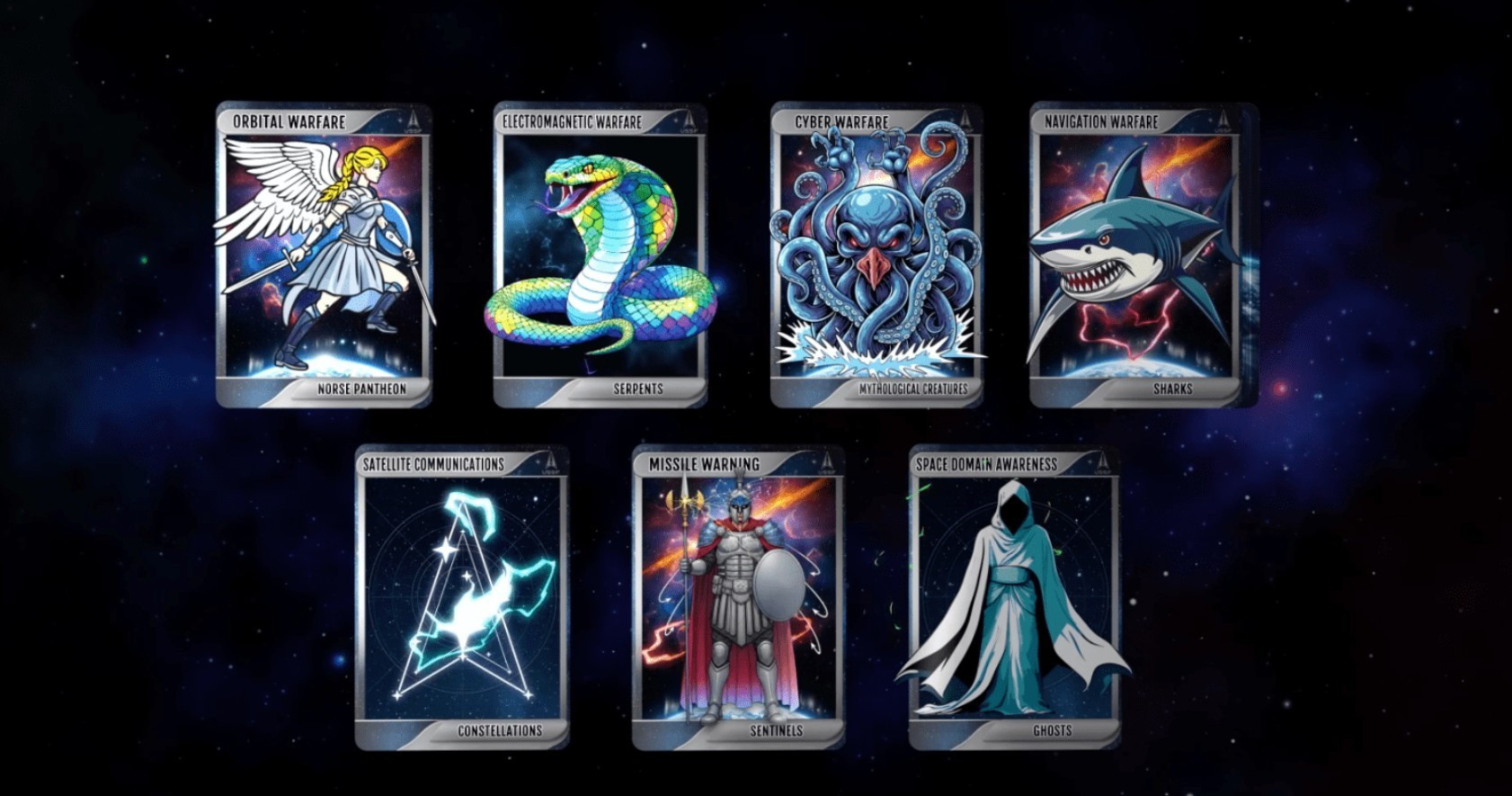
    At the Space Power Conference in Orlando, Florida, U.S. Space Force leadership unveiled a new official naming scheme for its satellites, space-based weapon systems, and mission platforms designed to mirror iconic naming traditions in other military branches by drawing from seven themed categories that reflect each mission area’s character and purpose — including Norse mythology for orbital warfare systems, sharks for navigation warfare, ghosts for space domain awareness, snakes for electromagnetic warfare, mythological creatures for cyber warfare, constellations for satellite communications, and sentinels for missile warning systems — with specific examples like the renaming of the Ultra-High Frequency Follow-On communications satellite to Ursa Major and a responsive space system to Bifrost to help cultivate identity and esprit de corps among Guardians.

    Sources: Space, Military Times

    Key Takeaways

    • The naming initiative marks a cultural shift within the Space Force, borrowing symbols from mythology and the natural world to help build a distinct identity for its space systems and missions.

    • Seven themed categories correspond to Space Force mission areas, with names rooted in concepts intended to convey character, functionality, and mission importance of each system.

    • Naming specific systems like Ursa Major and Bifrost is part of a broader push to foster tradition, familiarity, and esprit de corps among Guardians, similar to how other U.S. military branches leverage iconic platform names.

    In-Depth

    The U.S. Space Force is charting a new cultural course by formalizing a naming scheme for its satellites, space weapons and associated mission platforms that leans into evocative imagery and long-standing narrative traditions. At the 2025 Spacepower Conference in Orlando, Florida, Chief of Space Operations General Chance Saltzman detailed how the service will now assign themed names drawn from Norse pantheon figures, mythological beings, natural world symbols and more — a move both practical and symbolic as the Space Force seeks to distinguish itself among the U.S. armed services and reinforce the mission identity of its Guardians.

    For decades, other branches of the U.S. military have leveraged memorable names for their major platforms — think of the Air Force’s A-10 Thunderbolt II or F-22 Raptor — and the Space Force’s effort is a similar bid to give its otherwise abstract and technical systems a human connection. In many cases, the hardware involved operates beyond public view or in highly classified arenas. By associating a mission with a vivid name and visual motif, leaders hope to create traditions that resonate internally while projecting a narrative framework to partners, policymakers and the broader national security community that closely watches how space operations evolve.

    The naming scheme rests on seven categories, each tied to a core mission area. Orbital warfare systems will use names from the Norse pantheon, a nod to strength, strategy and mythic heritage. Navigation warfare platforms will be associated with sharks — creatures known for their keen navigational instincts. Mission areas focused on detecting and understanding threats in space, broadly referred to as space domain awareness, will receive “ghost” themed names that evoke silent vigilance. Snake imagery will anchor electromagnetic warfare, while mythological creatures more broadly will represent cyber warfare missions. Communications satellites will adopt names drawn from constellations — a fitting choice for systems that connect Earth and space — and missile warning systems will use sentinel themes to reflect their protective role.

    Two systems already offer glimpses of the new scheme in action. The Ultra-High Frequency Follow-On communications satellite, long a backbone in military satcom networks, has been formally dubbed Ursa Major, invoking the iconic Big Dipper constellation and its guiding star Polaris. That designation reflects both the satellite’s enduring role and its linkage to navigational lore. Meanwhile, an operationally responsive space platform managed by Space Force’s 1st Space Operations Squadron now goes by Bifrost, the mythic Norse bridge connecting worlds — a metaphor for that system’s connectivity between low Earth orbit and higher orbital regimes.

    Critically, the development of this naming tradition has not been a unilateral edict but an internally collaborative effort. Space Force leadership solicited input from Guardians across mission areas, seeking to ensure the themes resonate with operators who live with these systems every day. The six other category themes similarly grew out of feedback, discussions and focus groups conducted over the past year. Finalized names will ultimately undergo vetting to account for trademark issues and operational security concerns, but the broader thematic framework is already in place.

    Analysts see this approach as more than branding. In a domain where many systems are highly technical, classified or both, having a shared lexicon of names rooted in culture and narrative helps build cohesion. It also eases communication across the joint force and with international partners who increasingly rely on clear identification of space capabilities. By humanizing and contextualizing its tools, the Space Force aims to strengthen morale and reinforce its emerging institutional identity while aligning with long-standing traditions in military nomenclature.

    This naming initiative arrives as the Space Force continues to grow its portfolio of satellites and space weapons in response to strategic competition. As the United States and allied forces push to maintain space superiority, leveraging memorable names tied to mythology and natural imagery might seem an unconventional choice. Yet for a service seeking to define its role and heritage, these symbolic designations could become the foundation for future traditions, connecting operators with mission purpose and shared identity in the high frontier.

    Share. Facebook Twitter Pinterest LinkedIn Tumblr Email
    Previous ArticleUS Power Bank Recall Cited After Fires And Minor Burns; Amazon Units Affected
    Next Article Users Report Serious Psychological Harms After Interactions With ChatGPT, Prompting FTC to Take Notice

    Related Posts

    Global Memory Shortage Set to Push Up Prices on Phones, Laptops, and More

    February 27, 2026

    OpenAI’s Stargate Data Center Ambitions Hit Major Roadblocks

    February 27, 2026

    Large Hadron Collider Enters Third Shutdown For Major Upgrade

    February 26, 2026

    Stellantis Faces Massive Losses and Strategic Shift After Misjudging EV Market Demand

    February 26, 2026
    Add A Comment
    Leave A Reply Cancel Reply

    Editors Picks

    Global Memory Shortage Set to Push Up Prices on Phones, Laptops, and More

    February 27, 2026

    OpenAI’s Stargate Data Center Ambitions Hit Major Roadblocks

    February 27, 2026

    Large Hadron Collider Enters Third Shutdown For Major Upgrade

    February 26, 2026

    Stellantis Faces Massive Losses and Strategic Shift After Misjudging EV Market Demand

    February 26, 2026
    Top Reviews
    Tallwire
    Facebook X (Twitter) LinkedIn Threads Instagram RSS
    • Tech
    • Entertainment
    • Business
    • Government
    • Academia
    • Transportation
    • Legal
    • Press Kit
    © 2026 Tallwire. Optimized by ARMOUR Digital Marketing Agency.

    Type above and press Enter to search. Press Esc to cancel.