

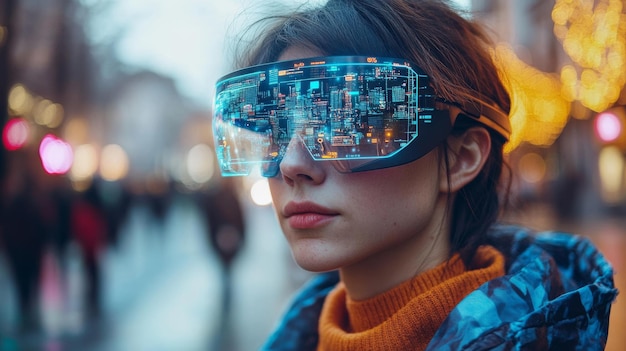
While much of the public debate around artificial intelligence has focused on job displacement, surveillance concerns, and cultural disruption, a growing number of practical applications are demonstrating how AI can genuinely improve everyday life. One of the most compelling examples comes from Aira, a company that has spent years helping visually impaired individuals navigate the world through live human assistance delivered via smartphone cameras. According to recent reporting, Aira has partnered with Google DeepMind to develop AI-powered visual assistance tools that can identify objects, answer questions, and help users perform routine tasks more efficiently. The technology is now being integrated with Meta‘s smart glasses, allowing for hands-free support. Importantly, company leaders say the goal is not to eliminate human assistants but to enhance their capabilities, lower costs, and expand access to services that many visually impaired Americans currently struggle to afford. At a time when much of Silicon Valley appears obsessed with replacing people, this represents a more constructive model in which technology serves individuals rather than rendering them obsolete.
Sources
- https://www.semafor.com/article/05/29/2026/how-ai-is-making-visual-assistance-more-accessible
- https://tech.yahoo.com/ai/meta-ai/articles/ai-making-assistance-visually-impaired-171636356.html
- https://about.fb.com/news/2026/05/accessibility-updates-meta-smart-glasses
- https://deepmind.google
Key Takeaways
- AI is increasingly being deployed in assistive technologies that enhance independence for visually impaired individuals rather than simply automating commercial tasks.
- The integration of AI assistance with wearable devices such as smart glasses represents a significant step toward real-time, hands-free accessibility tools.
- Companies developing accessibility-focused AI are emphasizing human-AI collaboration, suggesting that some of the most valuable uses of artificial intelligence may augment human expertise rather than replace it.
In-Depth
For years, Americans have been told that artificial intelligence would revolutionize society, yet much of the public has seen AI deployed in ways that feel intrusive, politically biased, or aimed primarily at reducing labor costs. That reality has fueled understandable skepticism. However, the latest advances in visual assistance technology offer a reminder that AI’s greatest value may emerge not from replacing workers, but from empowering people who face genuine physical challenges.
The work being done by Aira and its technology partners illustrates that distinction. By combining sophisticated AI models with wearable hardware and existing human support networks, visually impaired individuals can receive faster answers, better navigation assistance, and greater independence in everyday situations. Tasks that once required waiting for a live assistant may increasingly be handled instantly through AI-driven analysis.
What makes this development especially noteworthy is the decision not to eliminate the human element. Company leadership acknowledges that AI still struggles with certain real-world judgments and contextual assessments. Instead of pursuing a purely automated future, the system uses artificial intelligence to strengthen human assistance and improve efficiency.
That approach stands in sharp contrast to the prevailing corporate obsession with workforce reduction. Americans are far more likely to embrace AI when it demonstrably improves quality of life rather than simply boosting quarterly earnings. If the technology industry wants to rebuild public trust, accessibility innovations that help the disabled live more independently may provide a far stronger blueprint than another round of automation designed primarily to replace human beings.