

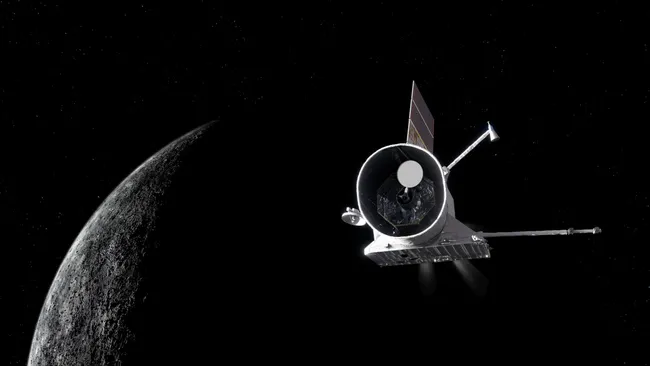
• The $2 billion European-Japanese BepiColombo mission successfully entered Mercury’s orbit Nov. 21, becoming only the second mission to orbit the planet.
• A software malfunction interrupted a critical engine firing, but mission controllers confirmed the spacecraft remained safe and in a stable orbit.
• Two scientific orbiters will separate in December to investigate Mercury’s surface, internal structure and magnetic field, with scientific operations beginning in April 2027.
The European-Japanese BepiColombo mission successfully entered orbit around Mercury on Nov. 21 after an eight-year journey, becoming only the second mission to orbit the solar system’s smallest planet. Launched in October 2018, the approximately $2 billion project traveled more than 6 billion miles, using planetary flybys to reduce speed before reaching Mercury. Its two connected spacecraft, developed by European and Japanese space agencies, are scheduled to separate in December and begin detailed scientific observations in April 2027.
The historic arrival was not without complications. A software glitch interrupted a critical thruster firing, leaving the spacecraft in protective safe mode and an orbit different from the original plan. Mission controllers subsequently confirmed that BepiColombo remained stable and that its revised trajectory should not disrupt the deployment schedule. The orbiters will examine Mercury’s surface, interior, thin atmosphere and magnetic environment, building on earlier American exploration of a planet that remains poorly understood.
Why It Matters
BepiColombo’s arrival demonstrates how disciplined engineering and international cooperation can accomplish missions that remain beyond the reach of most nations. Reaching Mercury requires more than powerful rockets: spacecraft must shed enormous speed, withstand intense solar heating and operate with limited opportunities for immediate intervention. Successfully securing orbit despite a software malfunction highlights both the value of contingency planning and the need for rigorous oversight of costly space programs.
The mission also underscores the enduring importance of American scientific leadership. Earlier U.S. spacecraft provided the foundation for modern understanding of Mercury, and new European and Japanese measurements can test those findings and expand the scientific record. Studying the planet’s unusual magnetic field, dense core and ancient terrain could clarify how rocky worlds formed, including Earth. With taxpayers funding major space initiatives worldwide, tangible discoveries and transparent reporting on operational problems will be essential measures of whether the investment delivers lasting value.
Sources
• https://science.nasa.gov/mission/bepicolombo/
• https://apnews.com/article/mercury-bepicolombo-space-planet-esa-0c80bbf2039ed4f6ee4a34426b3594a0