

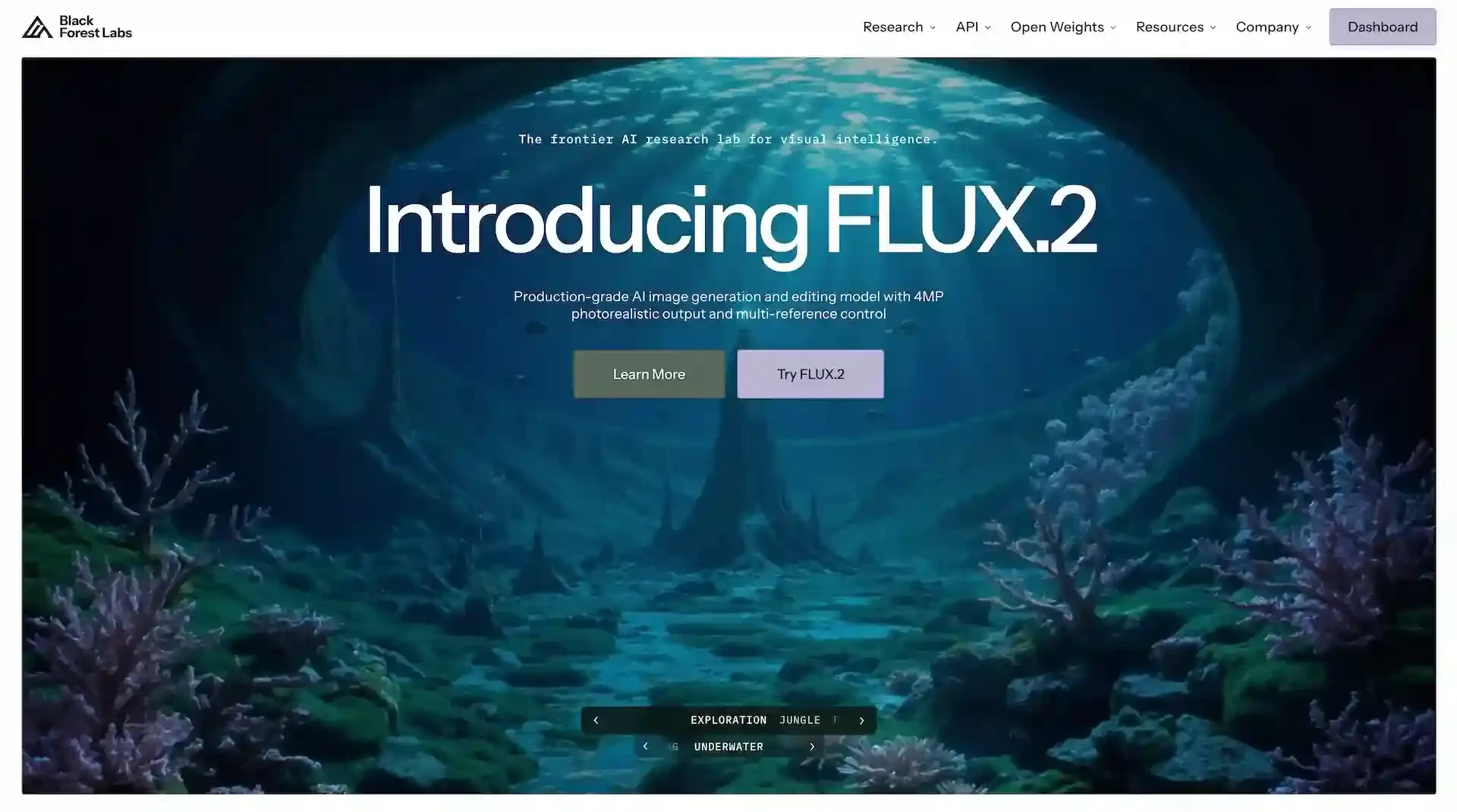
German AI startup Black Forest Labs (BFL) has unveiled its next-generation image generation and editing suite, FLUX.2 — a collection of four model variants designed for production-grade creative workflows. With advances including support for multi-reference conditioning, 4-megapixel resolution, improved text rendering, and an open-source VAE under Apache 2.0, FLUX.2 targets both enterprise users needing scalable, brand-ready visuals and developers seeking open-weight flexibility. The release positions FLUX.2 as a direct competitor to Nano Banana Pro and Midjourney, emphasizing consistent realism, cost efficiency, and cross-platform interoperability — a push toward mainstream adoption of AI-generated visual content.
Sources: VentureBeat, Fello AI
Key Takeaways
– FLUX.2 delivers 4-megapixel, multi-reference image generation with improved photorealism and text handling — a step up over earlier models and a direct challenge to leading proprietary systems.
– The inclusion of a fully open-source VAE under Apache 2.0 enables enterprises and developers to self-host or integrate FLUX.2 into existing asset pipelines — reducing vendor lock-in while supporting customization and scalable workflows.
– Compared to Nano Banana Pro and similar high-end image models, FLUX.2 offers competitive visual fidelity at a significantly lower per-image cost, making high-quality image generation more accessible for production use.
In-Depth
With the release of FLUX.2, Black Forest Labs may have tilted the balance in the evolving arms race of AI image models. While many models remain showcases for stylized art or experimental generation, FLUX.2 stakes its claim as a workhorse — built for real-world tasks like product visualization, brand-aligned asset production, UI mockups, and photorealistic rendering. The 4-megapixel output ensures that images are not just pretty — they’re high-resolution enough for commercial use, print, or advertising. That alone is a differentiator from many “normal” text-to-image offerings that top out at lower resolutions or struggle with detail when upscaled.
What’s especially significant is BFL’s dual-track release strategy. On one hand, there are proprietary, hosted versions (Pro, Flex) optimized for latency and fidelity — ideal for teams who want plug-and-play solutions with minimal overhead. On the other, BFL released the FLUX.2 VAE under the permissive Apache 2.0 license. That open-source commitment gives companies and developers the ability to self-host, customize, and integrate the core model into their own pipelines — avoiding vendor lock-in, complying with internal policies, and enabling lightweight fine-tuning for in-house style guides or brand requirements. Open-weight access democratizes high-quality image generation, lowering the entry barrier for smaller teams or independent creators.
Technically, FLUX.2 represents a re-architecting of the generative pipeline. It leverages what the developers call a latent flow matching architecture: a rectified flow transformer paired with a vision-language model (based on Mistral-3 24B) for semantic grounding, structural coherence, and visually realistic rendering. The updated VAE improves latent-space representation, reducing reconstruction distortion and improving fidelity in both generation and editing workflows. The improvements in prompt adherence, lighting, spatial logic, and world knowledge yield images that don’t just look good — they look “real.” That’s a crucial shift for production use, where unrealistic lighting, skewed proportions, or sloppy text rendering can destroy the credibility of a visual asset.
The multi-reference feature is another game changer. By allowing up to ten input images — whether for consistent style, recurring subjects, or complex compositional requirements — FLUX.2 simplifies workflows that would otherwise require fine-tuning, manual editing, or stitching multiple outputs. For instance, a brand wanting consistent product images for an entire catalog, or a creative team working on a visual series with recurring themes, can use FLUX.2 to maintain coherence across visuals. That’s something most existing models handle poorly or only with cumbersome custom pipelines.
From a financial and practical standpoint, the cost structure significantly enhances FLUX.2’s appeal. Compared with Nano Banana Pro and similar high-end models (which often use token pricing or charge steep rates for high-resolution output), BFL’s published estimates show FLUX.2 [Pro] billed at roughly $0.03 per megapixel — which translates into major savings, especially for high-resolution images or multi-image workflows. This affordability could make AI-generated images more viable for small businesses, independent creators, or high-volume projects where cost per image matters.
It’s also worth noting the strategic timing. The launch comes at a moment when demand for scalable AI-driven content is exploding, across marketing, e-commerce, design, and even internal enterprise operations. Many organizations are looking to standardize AI-generated visuals for product catalogs, marketing collateral, documentation, UI/UX prototyping, social-media content, and other asset-heavy workflows. With FLUX.2, BFL isn’t just giving them a new toy — they’re offering a practical, flexible, and cost-effective tool.
That said, FLUX.2 is not without trade-offs. While it excels at photorealism, prompt adherence, and consistency, it might not match the stylized artistry or wildly creative flexibility that models like Midjourney excel at. For artists chasing mood-driven, impressionistic, or surreal aesthetics, the more constrained, production-oriented output may not satisfy. Additionally, open-weight deployment requires some technical infrastructure — enough compute, familiarity with model hosting, and perhaps GPU resources to handle even quantized versions efficiently. For heavy users, that overhead might still be non-trivial.
But if you’re a creative director, a marketing manager, a small agency, or even an independent content creator who’s serious about using AI images in a consistent, brand-safe, repeatable way — FLUX.2 is a serious contender. It points to a future where AI-generated visuals are not just for art experiments or social-media curios — but core components of real creative workflows. And with its open-source backbone, it may help democratize high-quality visual generation beyond the biggest tech labs.
In short, FLUX.2 marks a pivotal moment: a shift from “what AI art can do” toward “what AI art should deliver” — reliable, realistic, scalable, and affordable. For anyone in the visual-content business or considering AI-driven production pipelines, it’s worth taking a hard look.