

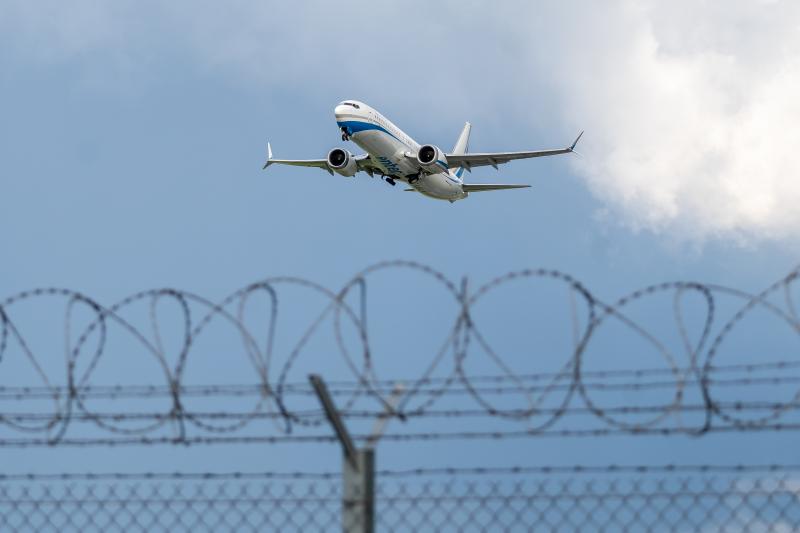
Federal aviation regulators are investigating a newly disclosed software problem affecting certain Boeing 737 MAX flight-management systems that can cause vertical navigation, or VNAV, to disengage during a specific sequence following an aborted landing. The problem affects versions 14 and 14.1 of the MAX flight-management-computer software and can arise when pilots execute a go-around from a precision approach with the autopilot engaged and subsequently modify the programmed flight path. Boeing maintains that the issue does not represent an immediate safety threat because the autopilot remains available and pilots are trained to operate without VNAV, but the FAA is convening a Corrective Action Review Board to examine the matter. The issue is particularly consequential because the recently certified MAX 7 used version 14, while the MAX 10 has been conducting certification testing with version 14.1. Southwest and United have declined to accept new aircraft equipped with the affected software, while several major U.S. carriers say their existing MAX fleets do not use the versions under review.
Key Takeaways
- The software glitch can cause VNAV to disengage following a missed approach under a particular combination of circumstances, increasing pilot workload at precisely the point when crews are operating close to the ground and already managing a demanding phase of flight.
- Boeing reportedly learned about the issue from an airline in November 2024 and concluded in February 2025 that it was not a safety issue, but additional information from operators later prompted a formal safety review. The FAA is now examining Boeing’s findings and says it will act immediately if it determines that the problem presents a safety concern.
- The investigation threatens another complication for Boeing’s MAX program. The MAX 7 was certified using affected software, the MAX 10 has been testing with another affected version, and Southwest and United have told Boeing they do not want newly delivered aircraft equipped with the problematic software.
In-Depth
Boeing’s latest 737 MAX software problem may involve a relatively narrow set of circumstances, but its timing and history make it difficult to dismiss as a routine technical matter. The glitch involves the aircraft’s flight-management computer and can cause VNAV, which automatically manages an aircraft’s vertical flight path, to disengage after a missed approach when pilots alter the programmed route. Autopilot remains operational, but crews can be left with a less sophisticated form of automated pitch control and additional tasks during a demanding, low-altitude phase of flight.
Boeing says pilots are trained to handle the situation and maintains that the glitch does not constitute an immediate safety problem. Nevertheless, the FAA is convening a Corrective Action Review Board, and airlines themselves are demonstrating caution. Southwest and United have said they will not accept newly delivered aircraft carrying the affected software, while Alaska, American, Southwest and United say their existing MAX fleets do not use the versions at issue.
More troubling is the timeline. Boeing reportedly first learned of the problem in November 2024 and determined in February 2025 that it did not constitute a safety issue. Additional operator information subsequently prompted a formal review, with Boeing submitting its findings to federal regulators this month.
That history inevitably raises questions about whether Boeing and regulators are applying sufficient scrutiny early enough when software anomalies emerge. The MAX program already carries the burden of the 2018 and 2019 crashes, which killed 346 people, as well as subsequent manufacturing and quality-control controversies. Boeing’s permanent software correction was initially projected for 2028, although the company is now attempting to accelerate it. The FAA’s review could consequently affect MAX 7 deliveries and the long-delayed certification of the MAX 10, making this both a safety oversight issue and another test of Boeing’s effort to restore confidence in its most important commercial aircraft program.
Sources
- https://www.cbsnews.com/news/boeing-737-max-software-glitch-aborted-landings-faa-investigation/
- https://aviationweek.com/air-transport/boeing-tackles-737-max-software-glitch-10-certification-looming
- https://theaircurrent.com/feed/dispatches/boeing-software-issue-potential-delay-737-max-10/
- https://www.faa.gov/newsroom/faa-statement-certification-boeing-737-max-7