

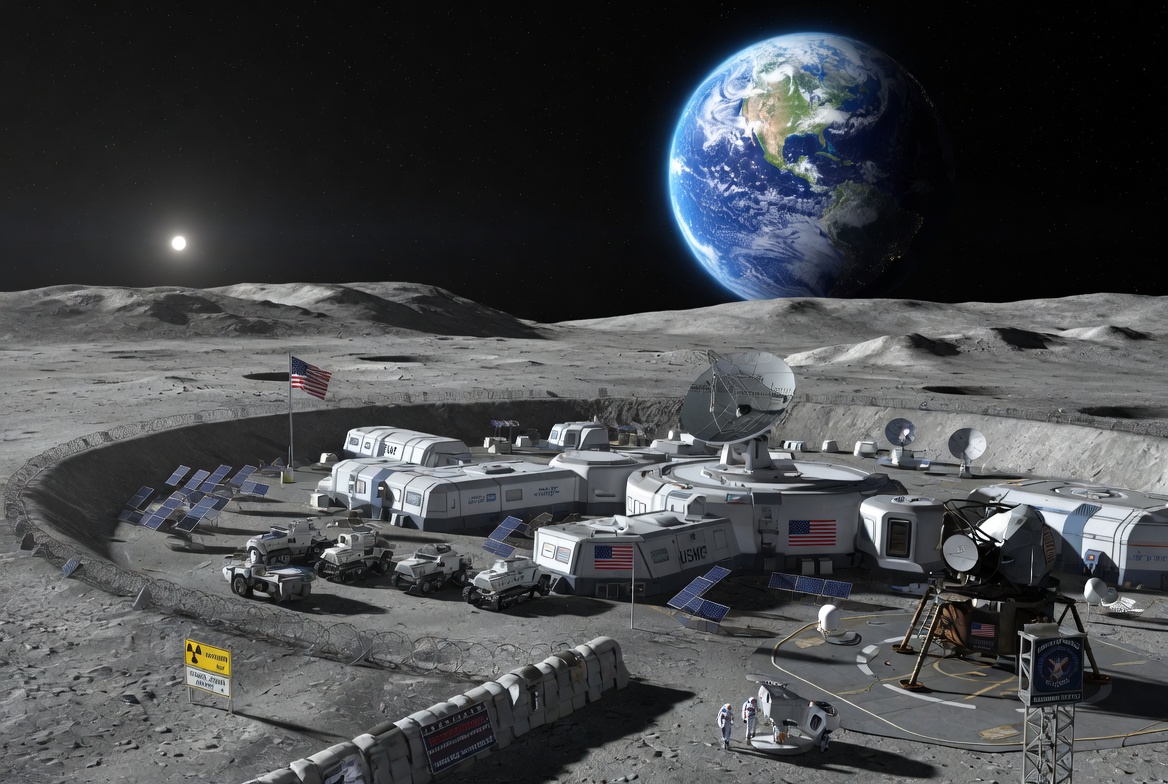
The idea of establishing a technology- and AI-dominant military base on the Moon sounds like science fiction at first glance, but it is quickly becoming a serious topic of geopolitical discussion. As global powers accelerate their investments in space infrastructure, the Moon is no longer just a scientific outpost—it is emerging as the ultimate strategic high ground. From a conservative perspective that prioritizes national security, deterrence, and technological leadership, the concept deserves a clear-eyed evaluation. There are undeniable advantages to such a move, but also significant risks that cannot be ignored.
On the pro side, the most obvious benefit is strategic dominance. In military doctrine, high ground has always provided a decisive advantage. The Moon, sitting roughly 238,000 miles from Earth, offers a vantage point unlike anything in human history. A nation that establishes a permanent, AI-powered military presence there would gain unparalleled surveillance capabilities. Advanced sensors, autonomous systems, and AI-driven analytics could monitor global activity in real time, providing early warnings of missile launches, troop movements, or emerging threats. In a world where seconds matter, that kind of awareness could be the difference between deterrence and disaster.
Another major advantage is deterrence itself. A visible, technologically superior presence on the Moon would send a clear message to adversaries: escalation beyond Earth will not go unanswered. Much like nuclear submarines during the Cold War, a lunar base could serve as a silent but powerful reminder of capability. AI-driven defense systems stationed on the Moon could potentially intercept threats in space before they ever reach Earth, adding a new layer to missile defense architecture. From a conservative standpoint, strength prevents conflict—and a lunar base would represent strength on an entirely new scale.
There’s also the matter of technological leadership. Building and maintaining a lunar military installation would require breakthroughs in robotics, artificial intelligence, energy systems, and materials science. These innovations wouldn’t stay confined to the military sphere; they would inevitably spill over into the civilian economy, driving growth and maintaining a competitive edge over rivals like China. Conservatives tend to favor policies that reinforce national self-reliance and industrial strength, and a project of this magnitude could revitalize both.
Resource security is another factor that often gets overlooked. The Moon contains valuable materials, including rare earth elements and helium-3, which could play a role in future energy production. A military presence could help secure these resources, ensuring they don’t fall under the control of hostile powers. In a world increasingly defined by supply chain vulnerabilities, that kind of forward positioning has real economic and strategic value.
However, the cons are just as significant—and they demand serious consideration.
First, there is the risk of escalation. Militarizing the Moon could trigger a new arms race, not just in space but across all domains. If one nation establishes a military base there, others will follow. The result could be a crowded, contested environment where misunderstandings and miscalculations carry enormous consequences. Conservatives generally support strong defense, but they also recognize the dangers of unchecked escalation. A lunar arms race could destabilize the very security it aims to protect.
Second, the cost would be staggering. Even with advances in private spaceflight, building a permanent, AI-driven military installation on the Moon would require hundreds of billions—if not trillions—of dollars over time. That raises legitimate questions about priorities. At a time when many argue for fiscal restraint and reducing national debt, committing to such a massive project could face resistance, even among those who support strong defense. The challenge would be ensuring that the investment delivers clear, measurable benefits without becoming a bottomless financial sinkhole.
There’s also the issue of vulnerability. While the Moon offers strategic advantages, it is also an isolated and harsh environment. A lunar base would be highly dependent on supply lines from Earth, at least in its early stages. Disrupt those lines, and the base could quickly become a liability rather than an asset. Additionally, any infrastructure on the Moon would be exposed and difficult to defend in the traditional sense. Unlike Earth-based installations, there’s no atmosphere to shield against certain types of attacks, and limited options for concealment or redundancy.
Ethical and legal concerns also come into play. Existing international agreements, such as the Outer Space Treaty, place limits on the militarization of celestial bodies. While those frameworks may evolve, establishing a military base on the Moon would likely spark global debate about the future of space governance. Conservatives tend to value sovereignty and national interest, but they also understand the importance of maintaining a stable international order. Ignoring these concerns could create long-term diplomatic friction.
Finally, there is the question of reliance on AI. While artificial intelligence offers tremendous advantages in speed and efficiency, it also introduces new risks. Autonomous systems making split-second decisions in a military context could lead to unintended consequences, especially in an environment as remote and complex as the Moon. Ensuring human oversight and accountability would be critical, but also challenging given the communication delays and operational constraints.
In the end, the idea of a tech- and AI-dominant military base on the Moon sits at the intersection of ambition and caution. It represents an opportunity to secure strategic dominance, drive innovation, and deter adversaries. But it also carries the potential for escalation, enormous cost, and unforeseen vulnerabilities. The real question isn’t just whether it can be done—it’s whether it should be done, and under what conditions. A disciplined, measured approach that balances strength with restraint will be essential if humanity is to extend its reach beyond Earth without repeating the mistakes of the past.