

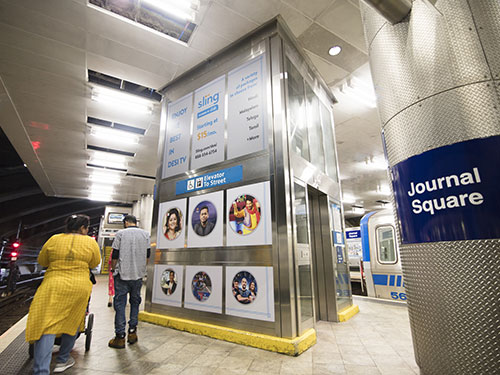
The race to dominate the artificial intelligence economy is no longer confined to Silicon Valley office parks or online ad campaigns. According to newly released transit advertising data, technology companies increased their share of advertising across New York City’s subway and bus system by roughly 50% in the first quarter of 2026 compared to a year earlier, with tech firms now accounting for about 15% of all transit advertising. The surge is being driven largely by AI startups and enterprise software companies seeking visibility in the nation’s financial capital, reflecting both the enormous amount of venture capital flowing into artificial intelligence and a growing belief that traditional, real-world advertising still cuts through the digital noise. The trend also highlights how America’s largest cities are increasingly becoming physical battlegrounds for the AI economy, with commuters now encountering a relentless stream of marketing campaigns aimed not at ordinary consumers, but at investors, executives, and decision-makers moving through urban business centers.
Sources
- https://www.semafor.com/article/05/29/2026/tech-ads-on-the-new-york-subway-are-up-50-this-year
- https://www.curbed.com/article/tech-ai-ads-nonsense-subway-mta.html
- https://techcrunch.com/2019/08/16/why-startups-ads-are-taking-over-the-subway/
- https://www.linkedin.com/posts/kushal-byatnal-92a33085_we-spent-50k-to-put-up-billboards-on-all-activity-7459322409557610496-OTdg
Key Takeaways
- AI and technology companies are increasingly abandoning an online-only marketing strategy and investing heavily in physical advertising to reach investors, executives, and business decision-makers in major financial centers.
- New York City’s transit system has become a highly visible showcase for the artificial intelligence boom, with tech advertising now representing a significant share of all subway and bus advertising inventory.
- The expansion of tech advertising reflects the enormous capital being poured into AI ventures, but it also raises questions about whether urban public spaces are becoming overly commercialized and increasingly dominated by corporate messaging.
In-Depth
For years, technology firms preached the gospel of digital marketing, arguing that sophisticated algorithms could target consumers more efficiently than traditional advertising ever could. Yet the AI boom is exposing an irony that many Americans are beginning to notice: some of the same companies building the future of digital advertising are now spending aggressively on old-fashioned billboards, transit posters, and station displays.
The reason is simple. In a marketplace crowded with thousands of startups promising revolutionary AI capabilities, visibility has become a form of legitimacy. A company that can afford to blanket New York’s subway system with advertisements signals to investors and customers that it possesses serious financial backing and intends to be a major player. The strategy is particularly effective in Manhattan, where hedge fund managers, venture capitalists, bankers, and corporate executives pass through transit hubs every day.
At the same time, the trend illustrates how deeply artificial intelligence has penetrated the broader economy. What began as a technological innovation is rapidly becoming a cultural phenomenon, influencing everything from investment decisions to urban landscapes. Critics argue that public spaces are increasingly being transformed into nonstop marketing platforms, while supporters contend that advertising revenue helps support transit systems facing constant budget pressures.
Either way, the explosion of tech advertising in New York’s subways is a visible reminder that the AI race is no longer theoretical. It is being fought in boardrooms, on trading floors, and now directly in front of millions of commuters every day.