

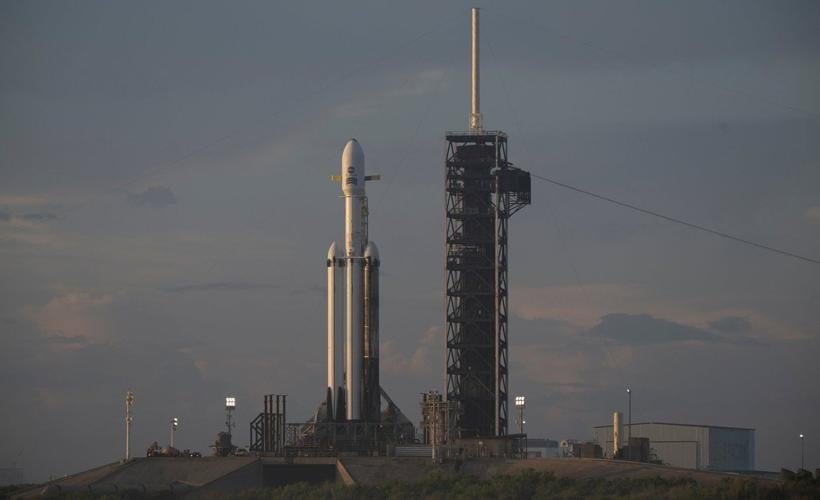
NASA’s Nancy Grace Roman Space Telescope launched Sunday aboard a Falcon Heavy rocket from Kennedy Space Center, beginning a million-mile journey toward the Sun-Earth L2 region and a mission aimed at some of astronomy’s biggest unanswered questions. Equipped with a Hubble-sized primary mirror but a field of view at least 100 times larger, Roman is designed to survey vast areas of space far faster than previous observatories, helping scientists investigate dark matter, dark energy, black holes, billions of galaxies and planets beyond our solar system. The multibillion-dollar observatory also carries an advanced coronagraph technology demonstration and incorporates telescope hardware originally developed for U.S. intelligence purposes before being transferred for civilian scientific use.
Key Takeaways
- Roman combines Hubble-class imaging capability with a field of view at least 100 times larger, giving scientists the ability to conduct sweeping infrared surveys of billions of galaxies rather than concentrating primarily on comparatively narrow portions of the sky.
- The telescope’s five-year mission will investigate dark energy, dark matter and the evolution of the universe while conducting an extensive census of exoplanets, potentially revealing planetary systems that conventional detection methods have missed.
- Roman represents an unusual example of government technology being repurposed productively: its 2.4-meter primary mirror originated with sophisticated reconnaissance-telescope technology transferred to NASA by the National Reconnaissance Office, converting hardware associated with an intelligence program into an instrument for civilian scientific discovery.
In-Depth
NASA’s launch of the Nancy Grace Roman Space Telescope marks an expansion of America’s ability to investigate the universe without abandoning the technologies that made Hubble and Webb scientific landmarks. Roman lifted off Sunday aboard a Falcon Heavy from Kennedy Space Center and is now beginning a three-month journey and commissioning period before operating near the Sun-Earth L2 point, roughly one million miles away.
The telescope’s principal advantage is scale. Its 2.4-meter primary mirror is comparable to Hubble’s, but Roman’s Wide Field Instrument can observe a field of view at least 100 times larger. That combination should allow astronomers to survey sections of the sky rapidly, mapping billions of galaxies while studying dark matter, dark energy, black holes, supernovae and planetary systems. The mission is also expected to identify large numbers of unknown exoplanets through techniques including gravitational microlensing.
Roman additionally carries a technology-demonstration coronagraph intended to block the glare of distant stars so scientists can better observe planets and surrounding material. If successful, that technology could strengthen the foundation for future missions designed to characterize Earth-like worlds.
The mission also illustrates a practical virtue often missing from large federal projects: useful hardware was repurposed. Roman’s primary mirror originated with telescope technology transferred to NASA by the National Reconnaissance Office. Rather than allowing government equipment to sit unused, engineers adapted it for civilian science. With Roman now launched, the real test becomes whether its five-year mission delivers discoveries commensurate with its multibillion-dollar investment and strengthens American leadership in space science.
Sources
- https://www.nasa.gov/news-release/nasas-dark-universe-seeking-nancy-grace-roman-space-telescope-launches/
- https://www.reuters.com/science/nasa-launches-powerful-new-roman-space-telescope-florida-2026-08-30/
- https://www.space.com/space-exploration/launches-spacecraft/nasas-roman-space-telescope-is-ready-for-launch-aboard-spacex-falcon-heavy-rocket