

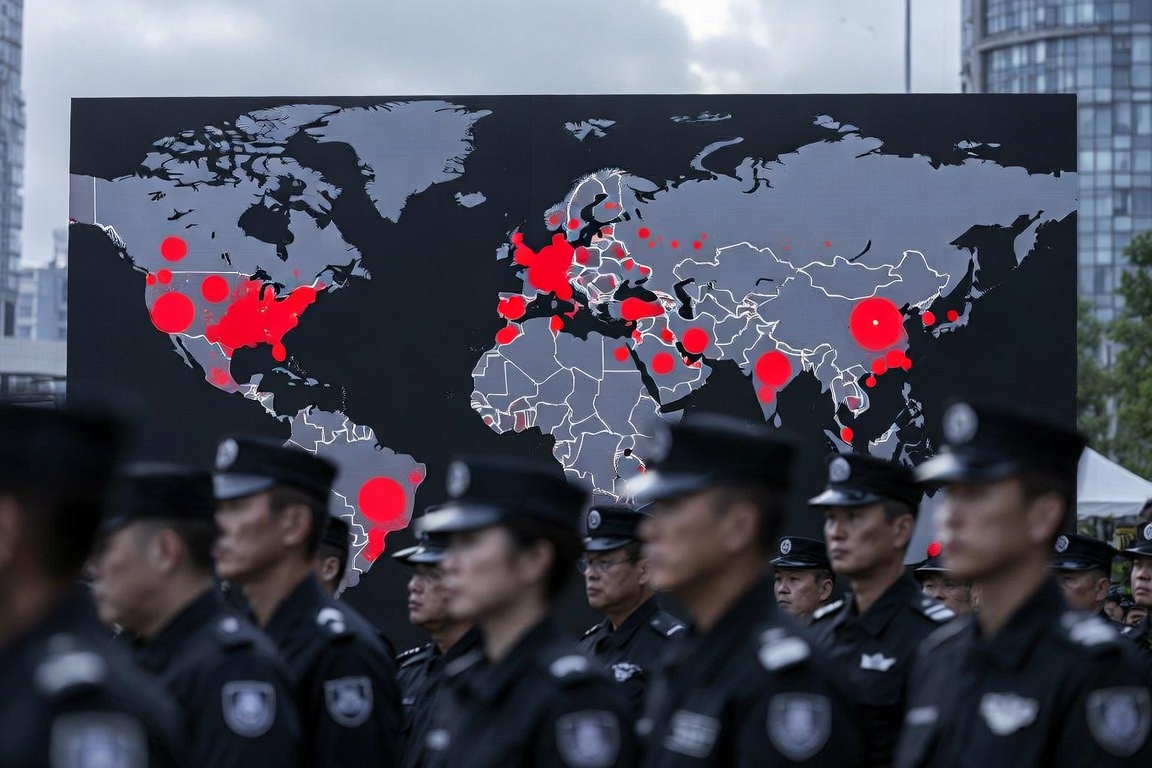
For decades, the United States and its allies have operated under a dangerous illusion—that economic engagement with communist China would inevitably lead to political liberalization and responsible global behavior. Instead, the opposite has occurred. The Chinese Communist Party (CCP) has leveraged access to Western markets, technology, and capital to build a surveillance state at home and extend its reach abroad. Nowhere is this more evident—or more dangerous—than in the infiltration of technology systems that underpin the free world.
Technology is no longer just a sector of the economy; it is the backbone of national security, commerce, communication, and daily life. From telecommunications infrastructure to semiconductors, cloud computing, and consumer devices, the integrity of these systems determines whether a society remains free or becomes vulnerable to coercion. Allowing a hostile, authoritarian regime like the CCP to embed itself within these systems is not merely naïve—it is strategically reckless.
The threat begins with hardware. Chinese firms, often subsidized or directly controlled by the state, have aggressively pursued contracts to build and supply telecommunications infrastructure around the world. These systems form the nervous system of modern nations. If compromised, they provide a direct pathway for espionage, data exfiltration, and even disruption of critical services. The concern is not hypothetical. Chinese law explicitly requires companies to cooperate with state intelligence efforts. That means any Chinese-built system carries an inherent obligation to serve the interests of Beijing when called upon.
Software presents an equally troubling vector. Applications developed by Chinese companies have proliferated globally, often gaining access to vast amounts of user data. This includes location information, communications, biometric identifiers, and behavioral patterns. In the hands of a regime that has demonstrated a willingness to surveil its own citizens with chilling efficiency, such data becomes a powerful tool for influence, blackmail, and strategic manipulation. The aggregation of this data allows for the construction of detailed profiles on individuals and institutions—profiles that can be exploited in ways that are difficult to detect and even harder to counter.
Beyond direct surveillance, there is the issue of intellectual property theft and technological dependency. For years, Western companies have reported systematic efforts by Chinese entities to acquire proprietary technologies through cyber intrusions, forced technology transfers, and strategic investments. This has allowed China to accelerate its development while undermining the competitive advantage of the very nations that enabled its rise. The result is a growing dependency on Chinese manufacturing and components, particularly in critical sectors such as rare earth materials and advanced electronics. This dependency creates leverage—leverage that can be used in times of geopolitical tension to pressure or destabilize adversaries.
Perhaps most concerning is the normalization of this infiltration. In the pursuit of lower costs and expanded markets, corporations and governments alike have too often turned a blind eye to the risks. Supply chains have become deeply entangled, making it difficult to disentangle secure systems from compromised ones. Each incremental concession—each contract awarded, each partnership formed—adds another layer of vulnerability.
The consequences of inaction are profound. In a worst-case scenario, the CCP could exploit embedded technologies to disrupt communications, cripple infrastructure, or manipulate information flows during a crisis. Even short of such dramatic actions, the steady siphoning of data and intellectual property erodes national strength over time. It is a slow-motion transfer of power, conducted not through open conflict but through strategic infiltration.
Addressing this threat requires a fundamental shift in thinking. Security must take precedence over convenience and cost. Governments must implement rigorous standards for technology procurement, ensuring that critical systems are sourced from trusted partners. Private companies must recognize that short-term gains from engaging with compromised suppliers can lead to long-term losses that extend far beyond the balance sheet.
Equally important is the need for technological self-reliance and allied cooperation. The free world must invest in its own capacity to produce critical technologies, from semiconductors to secure software platforms. Partnerships among democratic nations can provide alternatives to Chinese systems, reducing dependency and strengthening collective resilience.
This is not a call for isolationism, but for realism. The CCP has made clear, through both word and action, that it views technology as a tool of state power. Ignoring that reality does not make it disappear; it only increases the likelihood that the free world will find itself outmaneuvered.
The stakes could not be higher. In an era where information is power and connectivity defines capability, control over technology infrastructure is tantamount to control over the future. Allowing a hostile regime to infiltrate that infrastructure is not just a strategic error—it is an invitation to vulnerability. The time to confront this challenge is now, before the digital foundations of the free world are compromised beyond repair.