

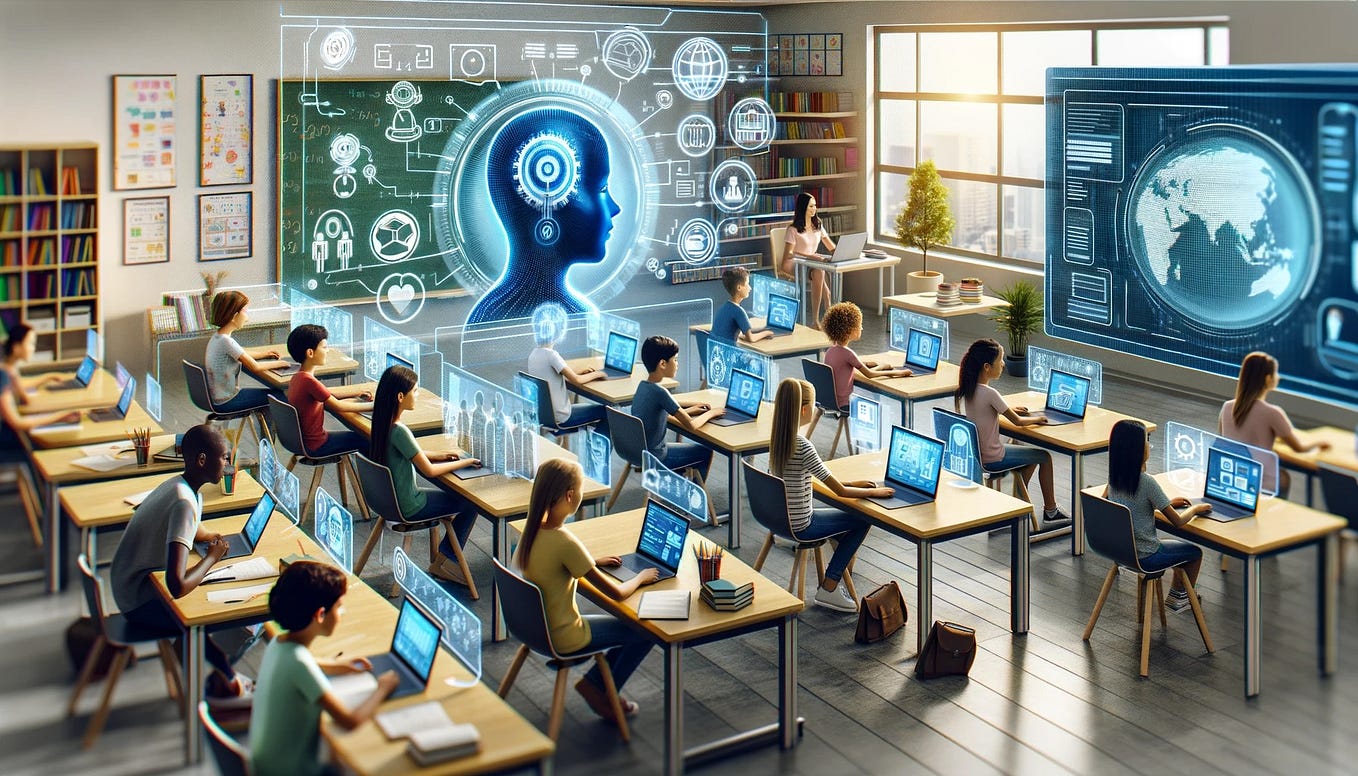
Artificial intelligence is rapidly becoming as common in education as calculators, laptops, and internet searches once were. Students can summon an explanation of calculus, rewrite an awkward paragraph, translate a foreign-language passage, generate computer code, or produce a respectable five-page essay in minutes. Teachers can use the same technology to develop lesson plans, create quizzes, summarize reading materials, and personalize instruction. There is genuine promise here. But introducing AI into classrooms without understanding its vulnerabilities risks transforming a useful educational tool into a substitute for education itself.
The first vulnerability is intellectual dependency.
Education is not merely the acquisition of correct answers. Its purpose is to teach students how to arrive at answers: how to read carefully, recognize weak arguments, wrestle with ambiguity, calculate, remember, compare evidence, and formulate independent conclusions. Those processes are often difficult and frustrating precisely because intellectual development requires effort.
Generative AI can remove that friction. That sounds beneficial until we consider what the friction accomplishes.
A student who asks AI to write an essay may receive an impressive product without developing the ability to construct an argument. A student who repeatedly asks AI to solve equations can advance through assignments without mastering mathematics. Eventually, schools could face the educational equivalent of GPS dependence: people become extraordinarily capable of reaching destinations while gradually losing their ability to navigate.
There is also the problem of accuracy. AI systems can produce incorrect information with remarkable confidence. They can misunderstand questions, invent citations, confuse historical events, misrepresent scientific findings, and construct persuasive explanations around faulty premises. The technology is improving rapidly, but improvement should not be confused with infallibility.
This creates an unusual educational paradox. The students most capable of recognizing an AI error are often those who need AI least. Students who have already developed substantial knowledge can challenge the machine. Students who have not developed that foundation may simply accept its output.
Bias presents another vulnerability. Every AI system necessarily reflects decisions about training data, moderation, ranking, terminology, and acceptable responses. This does not require a conspiracy or deliberate ideological manipulation. Human institutions inevitably make choices.
But classrooms are particularly sensitive environments. If students increasingly ask AI systems questions about history, economics, government, culture, religion, ethics, race, war, or public policy, the framing of an answer can matter almost as much as its factual accuracy. Even subtle differences in wording can influence how young people understand controversial subjects.
The proper response is not to demand that AI conform to one political worldview. That would merely replace one potential bias with another. Schools should instead teach students to recognize framing, compare sources, identify assumptions, and distinguish facts from interpretation. AI should become an object of critical examination rather than an electronic authority sitting unquestioned beside the textbook.
Privacy creates another concern. Educational AI systems can potentially collect enormous amounts of information about children: their writing ability, interests, weaknesses, questions, behavioral patterns, learning disabilities, and perhaps their political or personal beliefs. Schools should be exceptionally cautious about allowing such information to become part of permanent commercial data ecosystems.
Cybersecurity compounds the problem. Prompt injection, manipulated source materials, compromised educational platforms, and intentionally poisoned information could produce inaccurate or inappropriate responses. As schools connect AI to learning-management systems, student databases, and other institutional technology, the potential attack surface grows considerably.
Then there is cheating.
Schools will accomplish little by pretending students will voluntarily avoid a technology capable of completing homework in seconds. Traditional take-home assignments may become increasingly difficult to evaluate as evidence of individual competence. Education will consequently have to adapt.
That could mean more supervised writing, oral examinations, classroom discussions, handwritten problem solving, project demonstrations, and assignments requiring students to defend their reasoning. Ironically, widespread AI could force education to rediscover some decidedly old-fashioned methods.
Teachers themselves must remain central. The temptation to automate education will be substantial, particularly for financially strained school districts. AI tutors may eventually provide extraordinary individualized instruction, but replacing human teachers with software would misunderstand what teachers actually do. Good teachers recognize confusion, encourage reluctant students, impose discipline, inspire curiosity, understand personality, and establish expectations. Education is a human relationship as much as an information-delivery system.
None of this requires rejecting AI. Prohibition would probably fail and could leave American students poorly prepared for workplaces where AI will be commonplace. Students should learn how to use these systems effectively. They should understand prompting, verification, citation, privacy, model limitations, and responsible automation.
But there should be a clear principle governing AI in education: technology should expand human capability without replacing human competence.
The greatest danger is not that artificial intelligence becomes extraordinarily intelligent. It is that students become intellectually passive.
A society that delegates too much thinking to machines may eventually discover that it has produced citizens extraordinarily skilled at obtaining answers but increasingly incapable of determining whether those answers deserve to be believed. The classroom is therefore where America must establish its relationship with artificial intelligence carefully. AI can be a tutor, research assistant, calculator, translator, and intellectual sparring partner.
It should never become the student’s mind.