

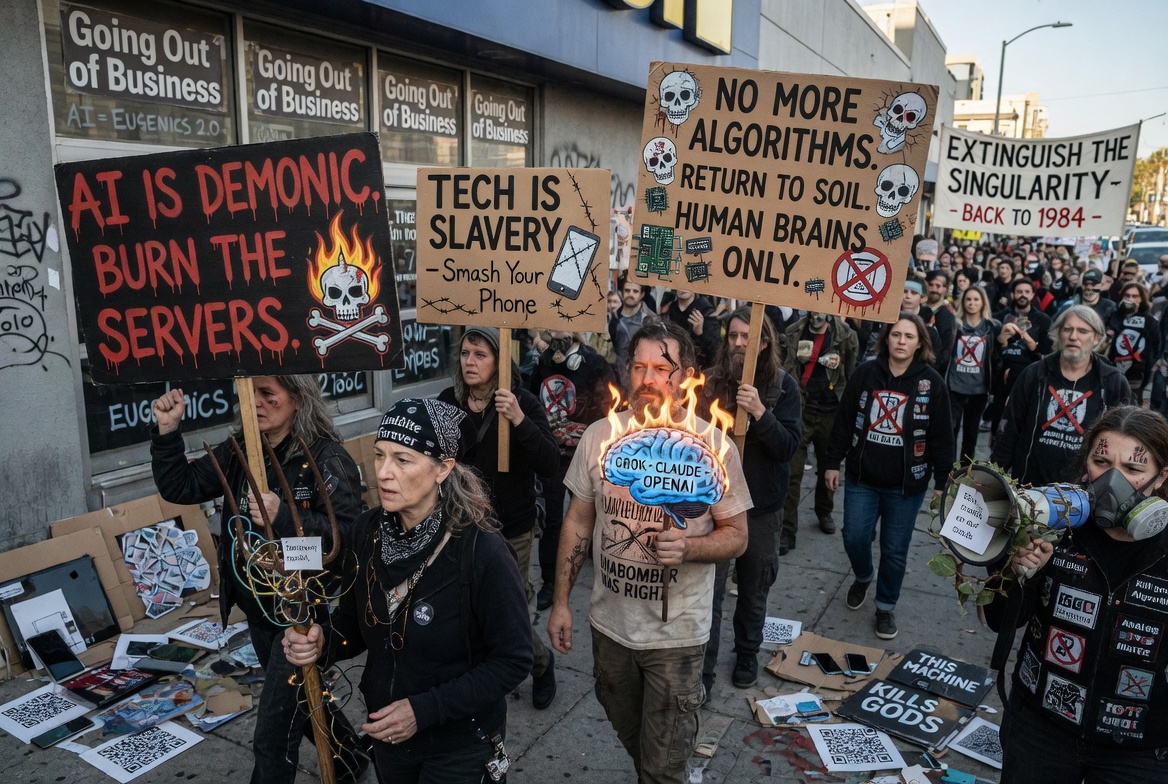
There’s a growing current in public discourse that doesn’t just question technology or artificial intelligence—it rejects them outright. This isn’t simple skepticism, which is healthy and necessary in any free society. It’s something sharper, more absolutist: a strain of anti-tech and anti-AI extremism that frames innovation itself as a threat rather than a tool. If left unchecked, that mindset risks doing more damage than the technologies it fears.
To be clear, concern about artificial intelligence is not only reasonable—it’s essential. Systems powered by machine learning are already reshaping labor markets, information ecosystems, and even national security. Questions about job displacement, privacy erosion, algorithmic bias, and centralized control deserve serious attention. But extremism begins where nuance ends. It’s one thing to demand guardrails; it’s another to call for the wholesale dismantling of technological progress.
The anti-tech fringe often paints a dystopian picture: AI as an omnipotent force that will inevitably enslave humanity, corporations as unaccountable overlords, and innovation as a one-way path to social collapse. This narrative thrives on fear, and fear can be persuasive. But it tends to flatten reality. Technology has never been a one-dimensional force. It has always been a double-edged sword—capable of both harm and extraordinary good, depending on how it’s used.
Consider history. The printing press was once viewed as dangerous because it democratized information. The industrial revolution sparked fears of mass unemployment and social upheaval. The internet itself was initially criticized as a breeding ground for chaos and moral decay. In each case, there were legitimate downsides. Jobs did change. Societies did shift. New risks did emerge. But humanity adapted, and the net result was an expansion of opportunity, knowledge, and capability.
What makes the current wave of anti-AI sentiment different is its intensity and its ideological framing. Some critics aren’t just warning about risks—they’re arguing that technological advancement is inherently illegitimate. That’s a far more radical position, and it carries serious consequences. If policymakers absorb that worldview, it could lead to overregulation, stifling innovation and ceding leadership to less restrained global competitors. In a world where technological dominance increasingly shapes geopolitical power, that’s not a trivial concern.
There’s also a deeper philosophical issue at play. Anti-tech extremism often reflects a lack of confidence in human agency. It assumes that people are incapable of guiding technology responsibly, that systems will inevitably spiral out of control, and that the only solution is to halt progress altogether. But that perspective overlooks a fundamental truth: technology doesn’t operate in a vacuum. It is designed, deployed, and governed by human beings. The question isn’t whether technology will shape society—it’s whether society will shape technology wisely.
That’s where a more grounded approach comes in. A balanced view acknowledges both the risks and the potential. It supports innovation while insisting on accountability. It recognizes that AI can enhance productivity, improve healthcare outcomes, optimize infrastructure, and expand access to information. At the same time, it demands transparency, ethical standards, and safeguards against abuse.
The danger of extremism—on either side—is that it narrows the conversation. Blind techno-optimism ignores real risks. But reflexive techno-pessimism ignores real opportunities. Neither serves the public well. What’s needed is a sober, clear-eyed assessment that avoids both hysteria and complacency.
There’s also a cultural dimension worth considering. Anti-tech sentiment often taps into broader anxieties about change—economic insecurity, loss of identity, erosion of traditional structures. Technology becomes a symbol for those fears, even when it’s not the root cause. Addressing that requires more than technical policy solutions; it requires leadership that speaks to those concerns without scapegoating innovation itself.
Another factor is trust. Many people don’t trust the institutions driving technological change—whether they’re large corporations, government agencies, or academic elites. That distrust isn’t entirely unfounded. There have been missteps, abuses, and failures of oversight. But the answer to mistrust isn’t rejection—it’s reform. Strengthening accountability mechanisms, increasing transparency, and ensuring broader participation in decision-making can help bridge that gap.
At the end of the day, the trajectory of technology is not predetermined. It will be shaped by choices—policy choices, market choices, cultural choices. Rejecting innovation outright doesn’t eliminate risk; it simply shifts the balance of power to others who are willing to move forward. In a competitive global landscape, that could mean falling behind in areas that directly impact economic strength and national security.
The conversation around AI and technology should be vigorous, even contentious. That’s a sign of a healthy society grappling with complex issues. But it should also be grounded in reality, not driven by fear-based absolutism. Innovation is not the enemy. Misuse is. And those are two very different things.
If there’s a lesson to take from history, it’s this: progress is rarely smooth, but it is rarely reversed without cost. The challenge isn’t to stop the future—it’s to shape it in a way that aligns with human values, preserves individual freedom, and expands opportunity. That requires engagement, not retreat.