

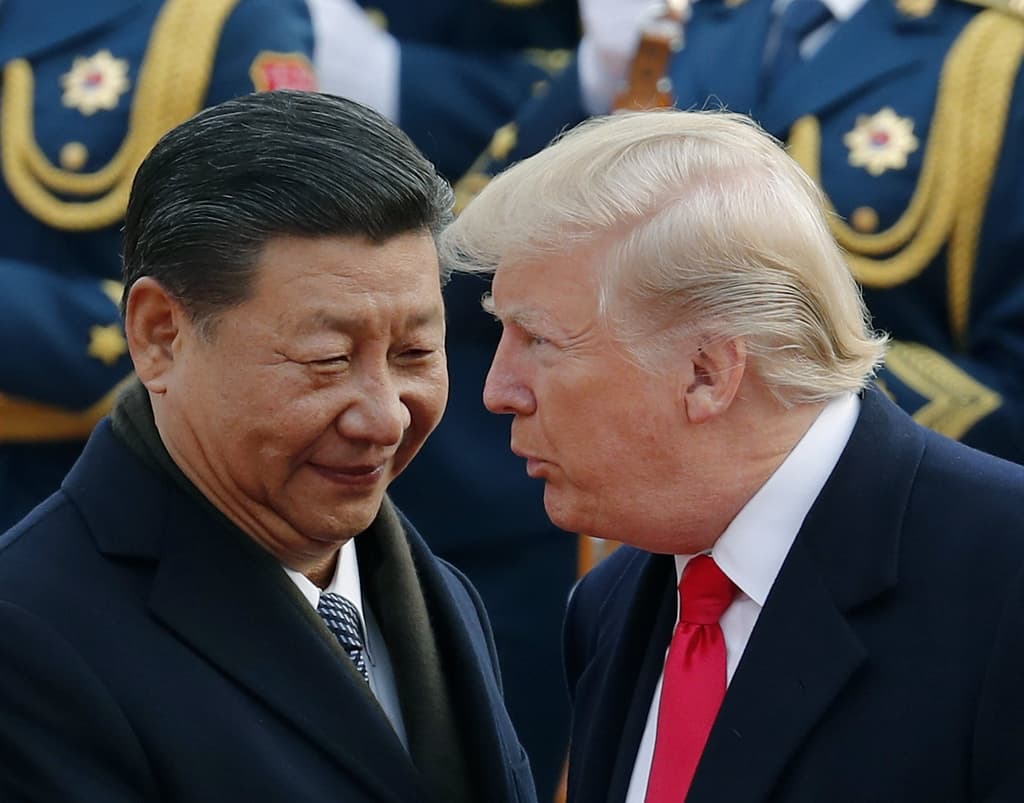
President Donald Trump has rejected broad U.S. integration with China on artificial intelligence, arguing that America should protect its technological advantage rather than share it with its principal strategic competitor. Following Chinese President Xi Jinping’s Washington visit, Trump said the United States leads China in AI by “at least a year, and maybe a year and a half” and should not open its capabilities while ahead. His position does not eliminate communication between Washington and Beijing: the two governments have established a dialogue on AI—now termed “super intelligence” by the administration—and a bilateral channel for serious AI incidents. The emerging approach separates limited risk-management discussions from technological integration, while congressional lawmakers continue pressing for stronger bilateral guardrails, testing standards and controls on increasingly powerful AI systems.
Key Takeaways
- Trump opposes integrating American and Chinese AI development, maintaining that the United States should protect its technological lead rather than share capabilities with Beijing.
- Washington and Beijing nevertheless agreed to establish a U.S.-China “Super Intelligence” dialogue and a bilateral communications channel intended to address serious AI-related incidents and shared risks.
- The policy debate increasingly centers on whether strategic competition and American technological leadership can coexist with narrowly defined safeguards designed to prevent dangerous AI incidents, cyber threats or unintended escalation.
In-Depth
President Donald Trump is drawing a firm distinction between talking with China about artificial intelligence risks and integrating American AI development with Beijing. After hosting Chinese President Xi Jinping, Trump said the United States should not “open it up” while it holds what he estimates is a one- to 18-month technological lead. His position treats AI leadership as a strategic national asset rather than a field for broad technological cooperation.
That distinction matters because Washington and Beijing agreed to limited engagement. The White House says the governments established a U.S.-China “Super Intelligence” dialogue to discuss risks and benefits and a bilateral channel for AI-related incidents. Such mechanisms allow communication without surrendering competitive advantages, proprietary technology or national-security capabilities.
The dispute is therefore not simply cooperation versus confrontation. A group of senators urged Trump to pursue formal guardrails with Xi, including development and testing standards, human control over autonomous systems, verification measures and consideration of a mutual pause in frontier development. Trump has rejected slowing American progress, arguing that restraints could hand China an advantage.
That approach reflects a broader strategic calculation. Advanced AI increasingly touches cybersecurity, military systems, economic productivity, scientific research and industrial competitiveness. Sharing capabilities with a geopolitical competitor could carry consequences far beyond commercial technology. At the same time, uncontrolled incidents involving powerful systems could create risks for both countries.
The emerging policy is consequently one of competitive separation paired with narrow communication: preserve American technological leadership, avoid broad integration with Beijing, but maintain channels capable of reducing misunderstandings or managing serious AI incidents.
Sources
- https://www.theepochtimes.com/china/trump-rejects-integrating-with-china-on-ai-6095566
- https://www.whitehouse.gov/fact-sheets/2026/09/fact-sheet-president-donald-j-trump-advances-a-fair-and-reciprocal-relationship-with-china-while-hosting-historic-state-visit/
- https://www.commerce.senate.gov/press/dem/release/cantwell-colleagues-push-trump-to-negotiate-ai-guardrails-with-xi-jinping/
- https://www.axios.com/2026/09/26/us-china-ai-si-deal