

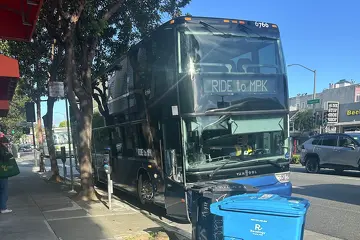
The once-ubiquitous “tech buses” that symbolized Silicon Valley’s takeover of San Francisco neighborhoods are now operating at dramatically reduced levels, with commuter shuttle pickups and drop-offs reportedly down roughly 40% from 2019 averages as remote and hybrid work continue reshaping the Bay Area economy. What was once a lightning rod for anger over gentrification, soaring housing costs, and the political favoritism shown toward the tech elite has become another visible casualty of the post-pandemic collapse of traditional commuting patterns. The quieter streets and thinner shuttle traffic underscore a larger truth many urban policymakers still refuse to admit: the work-from-home revolution permanently altered major blue-state cities that built their economic assumptions around dense office occupancy and endless tech-sector expansion. While transit authorities continue defending commuter shuttles as tools to reduce congestion and emissions, critics increasingly see the decline as evidence that the old model of San Francisco’s heavily subsidized urban-tech ecosystem has fundamentally changed, perhaps permanently.
Sources
https://www.sfchronicle.com/bayarea/article/tech-bus-commuter-shuttle-22231181.php
https://www.sfmta.com/projects/commuter-shuttle-program
https://en.wikipedia.org/wiki/San_Francisco_tech_bus_protests
https://www.sfgate.com/bayarea/article/tech-shuttle-bus-blocks-traffic-noe-19372372.php
Key Takeaways
- Private tech commuter shuttles in San Francisco are reportedly operating at roughly 40% below pre-pandemic activity levels, reflecting the enduring impact of hybrid and remote work arrangements.
- The “Google bus” era that once fueled protests over gentrification and displacement has faded considerably, reducing one of the most visible symbols of Silicon Valley’s influence over San Francisco culture and housing markets.
- Transit officials continue arguing that employer shuttle systems reduce traffic congestion and single-occupancy vehicle use, even as broader public transportation ridership throughout the Bay Area remains well below 2019 levels.
In-Depth
For more than a decade, San Francisco’s private commuter shuttle system stood as a glaring symbol of the city’s transformation from quirky cultural capital into an annex of Silicon Valley’s corporate empire. The massive white buses rolling through neighborhoods like the Mission and Marina represented more than transportation; they represented the political and economic triumph of the tech class over longtime residents increasingly priced out of their own communities. Now, according to newly released transit data, those buses are no longer nearly as common, and their decline says a great deal about where both San Francisco and the broader technology sector are headed.
The reduction in shuttle activity is not merely a transportation story. It is a direct reflection of the remote-work revolution that many establishment politicians and urban planners initially dismissed as temporary. The Bay Area’s economic model depended heavily on densely packed office towers, endless commuter flows, and an army of highly paid tech workers willing to tolerate astronomical housing prices in exchange for career opportunity. That formula has cracked. Employees increasingly work from home several days per week, companies have reduced office footprints, and many workers have simply left expensive urban cores altogether.
Ironically, the same political establishment that aggressively catered to the technology industry now finds itself confronting the economic consequences of overdependence on it. Downtown vacancy rates, weakened transit ridership, struggling retail corridors, and declining commuter activity all point to a city still searching for stability after years of ideological governance that prioritized elite economic interests while ignoring quality-of-life deterioration for ordinary residents.
At the same time, the decline of the tech buses does not necessarily mean the underlying tensions have disappeared. Housing affordability remains catastrophic, public transit systems still face financial instability, and crime and disorder continue pushing residents and businesses toward suburban alternatives. The buses may no longer dominate headlines or neighborhood intersections, but the deeper policy failures that fueled resentment toward them remain unresolved.