

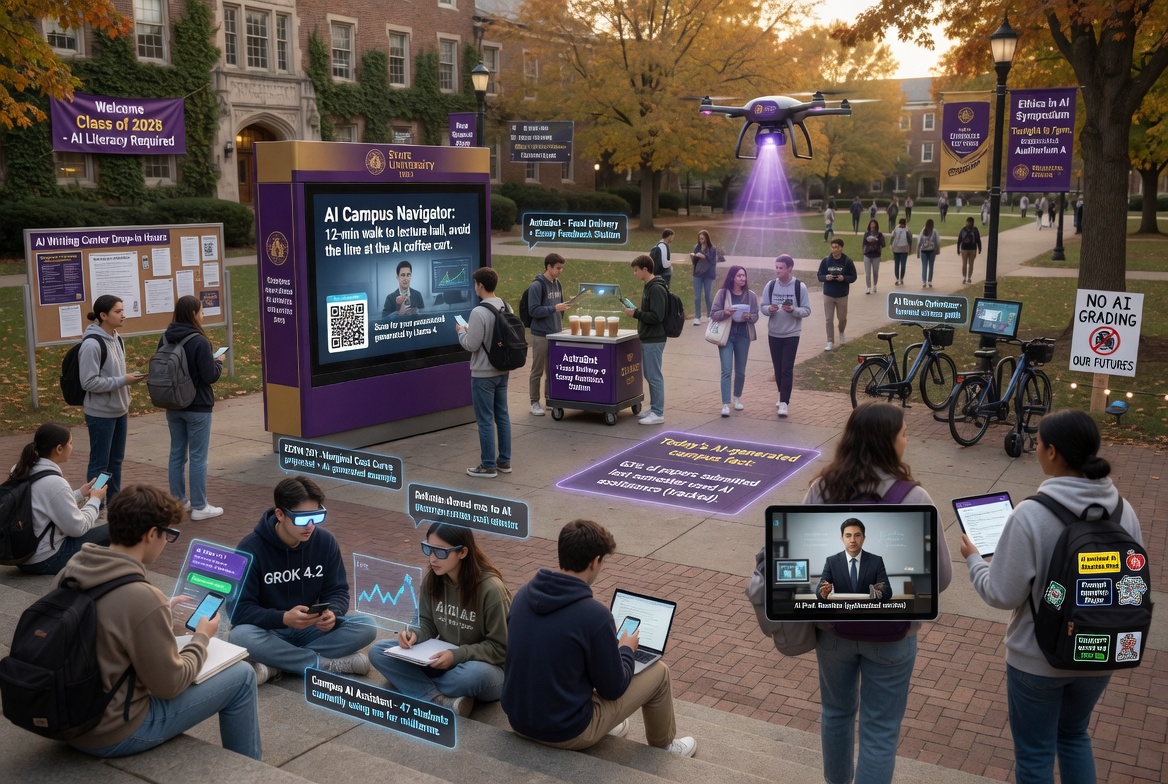
The rapid integration of artificial intelligence into academia has sparked both excitement and unease. On one hand, AI promises to enhance learning, streamline research, and democratize access to knowledge. On the other, it raises serious concerns about academic integrity, intellectual development, and the long-term consequences of outsourcing human thought. Like most transformative technologies, AI in academia is neither inherently good nor bad—it depends entirely on how it is used. A sober evaluation reveals both meaningful advantages and legitimate risks that institutions can’t afford to ignore.
One of the most compelling benefits of AI in academia is its ability to expand access to education. Students who once struggled to find tutoring or academic support can now receive instant assistance, often tailored to their individual needs. AI-powered tools can break down complex topics, translate materials into multiple languages, and offer explanations in various learning styles. This levels the playing field for students from different backgrounds and learning abilities, giving more people a fair shot at academic success. In an era where higher education costs continue to rise, the availability of free or low-cost AI tools also introduces a degree of affordability that traditional systems have struggled to provide.
AI also significantly enhances research capabilities. Scholars can process massive datasets in a fraction of the time it would take manually, uncovering patterns and insights that might otherwise go unnoticed. This has particular value in fields like medicine, engineering, and economics, where data-driven decision-making is critical. By accelerating literature reviews, summarizing findings, and even suggesting research directions, AI allows academics to focus more on critical thinking and innovation rather than administrative or repetitive tasks. In theory, this should lead to faster advancements and more impactful discoveries.
Efficiency is another undeniable advantage. Professors can use AI to assist with grading, course design, and administrative duties, freeing up time for meaningful interaction with students. Universities, often burdened by bureaucratic inefficiencies, can streamline operations and reduce costs. In a system where time and resources are constantly stretched, these gains are not trivial—they can reshape how education is delivered and experienced.
However, these benefits come with serious trade-offs that deserve equal attention. The most immediate concern is academic integrity. AI tools make it easier than ever for students to generate essays, solve problems, or complete assignments without truly engaging with the material. While plagiarism has always existed, AI introduces a new level of sophistication that is harder to detect and easier to justify. This raises a fundamental question: if a student relies on AI to do the work, are they actually learning anything? The answer, in many cases, is no.
Closely tied to this is the issue of intellectual development. Education is not just about producing correct answers—it’s about building the ability to think critically, analyze information, and articulate ideas. Overreliance on AI risks short-circuiting that process. When students turn to machines for instant solutions, they may lose the habit of wrestling with difficult concepts or developing original thought. In the long run, this could produce graduates who are less capable of independent reasoning, even if they appear competent on paper.
There are also concerns about bias and reliability. AI systems are only as good as the data they are trained on, and that data often reflects existing biases or inaccuracies. In an academic setting, where precision and credibility are paramount, relying on flawed outputs can lead to misinformation being reinforced rather than challenged. Students who lack the experience to critically evaluate AI-generated content may accept it at face value, compounding the problem.
Another downside is the potential erosion of the teacher-student relationship. Education has always been more than a transactional exchange of information; it involves mentorship, guidance, and human connection. If AI becomes a primary interface for learning, that relationship risks being weakened. While technology can supplement instruction, it cannot replicate the judgment, empathy, and experience that a skilled educator brings to the table.
Finally, there’s the broader institutional challenge. Academia has long been rooted in traditions that emphasize originality, rigor, and accountability. Integrating AI into this framework requires clear standards and enforcement mechanisms, which many institutions are still struggling to develop. Without thoughtful policies, the use of AI could create inconsistencies in evaluation, undermine trust in academic credentials, and blur the line between assistance and substitution.
In the end, AI in academia is a double-edged sword. It offers undeniable benefits in accessibility, efficiency, and research advancement, but it also introduces risks that strike at the core of what education is meant to achieve. The challenge moving forward is not to reject AI outright, nor to embrace it uncritically, but to establish boundaries that preserve the integrity of the academic enterprise. If used responsibly, AI can be a valuable tool. If used carelessly, it could fundamentally weaken the very system it aims to improve.