

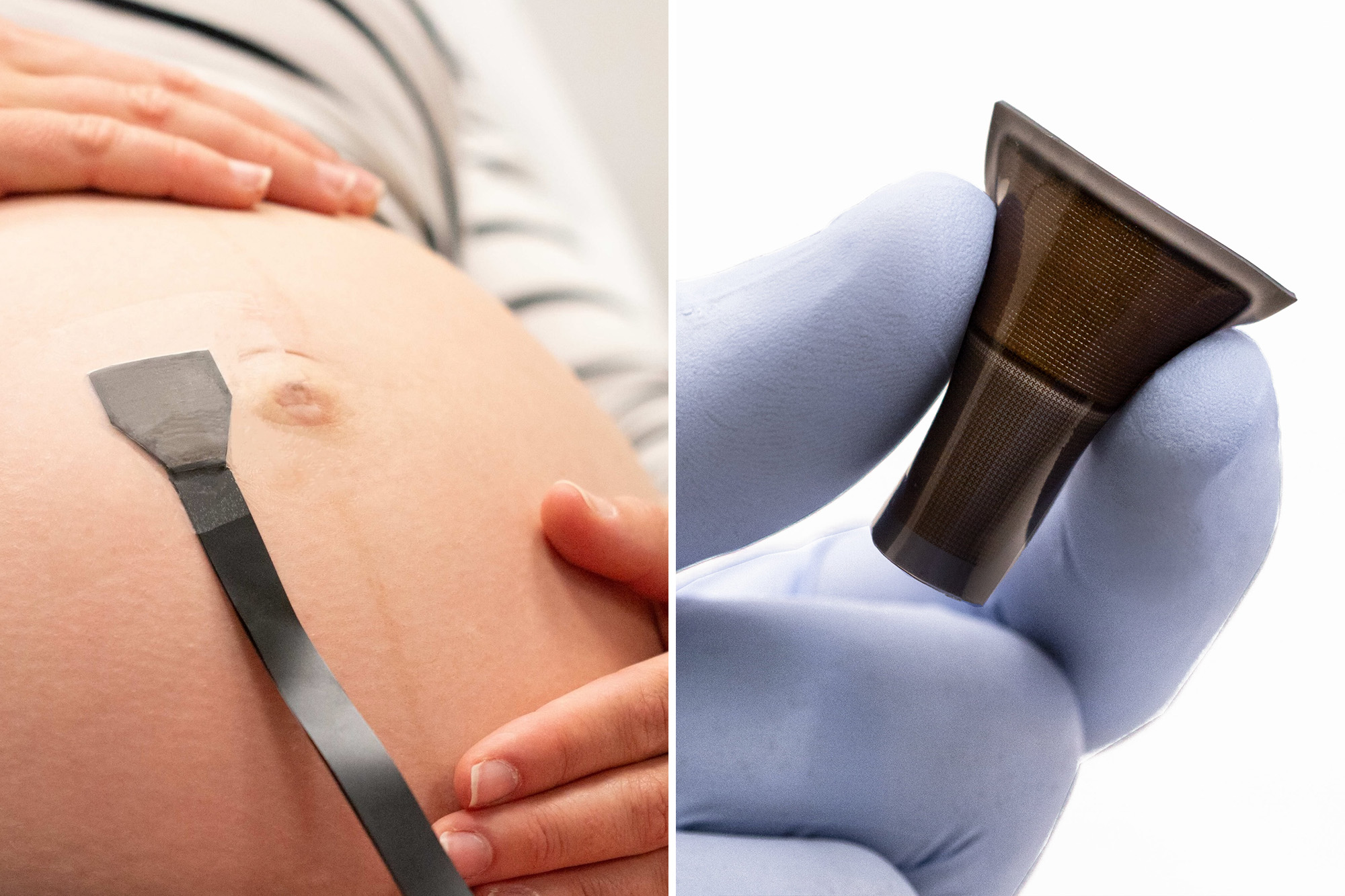
A newly developed wearable ultrasound patch known as the “UPatch” could dramatically change how high-risk pregnancies are monitored by allowing physicians to track fetal health continuously rather than relying on occasional hospital scans. Developed through research involving institutions in the United States and the United Kingdom, the adhesive device monitors blood flow in the fetus and umbilical cord in real time, producing results comparable to conventional ultrasound systems while operating for extended periods without constant technician involvement. Researchers report that the technology has already demonstrated the ability to identify severe placental dysfunction and fetal growth complications that might otherwise have gone undetected between routine appointments. The breakthrough arrives as healthcare systems increasingly seek remote-monitoring solutions that improve outcomes while reducing dependence on costly, labor-intensive hospital visits, potentially giving doctors a far more effective tool to intervene before preventable tragedies occur.
Sources
- https://nypost.com/2026/05/28/health/wearable-ultrasound-patch-can-monitor-high-risk-pregnancies
- https://www.nature.com/articles/s41587-026-03140-1
- https://www.theguardian.com/lifeandstyle/2026/may/26/scientists-create-wearable-ultrasound-to-continuously-monitor-babies-in-womb
- https://today.ucsd.edu/story/wearable-ultrasound-patch-could-improve-care-for-high-risk-pregnancies
Key Takeaways
- Continuous fetal monitoring may allow physicians to detect dangerous complications such as placental dysfunction, fetal growth restriction, preeclampsia, and abnormal blood-flow patterns far earlier than current intermittent ultrasound schedules permit.
- The technology performed at levels comparable to traditional clinical ultrasound equipment during testing involving more than 60 pregnancies, suggesting wearable monitoring could become a practical extension of modern prenatal care.
- The development points toward a future where high-risk pregnancies can be monitored from home, reducing unnecessary hospital visits while giving physicians more data and greater opportunity to intervene before a crisis develops.
In-Depth
For decades, prenatal medicine has operated under a fundamental limitation: doctors typically see only brief snapshots of fetal health during scheduled examinations. That reality has forced physicians to make critical decisions using intermittent data while complications can develop between visits. The new wearable ultrasound patch challenges that model by introducing something medicine has long sought but rarely achieved in practical form—continuous observation.
The implications are significant. High-risk pregnancies involving preeclampsia, gestational diabetes, hypertension, or fetal growth abnormalities often require aggressive monitoring because conditions can deteriorate rapidly. Traditional ultrasound technology remains effective, but it is expensive, labor-intensive, and dependent on trained specialists. A wearable system that can gather comparable information over extended periods offers a fundamentally different approach, one that favors prevention over reaction.
The most striking aspect of the research is not simply the technology itself but the outcome it already appears capable of delivering. Researchers documented cases in which continuous monitoring revealed severe fetal complications that prompted timely medical intervention. That matters because stillbirths, emergency deliveries, and long-term developmental complications often stem from problems that become apparent only after damage has already occurred. More data collected over longer periods can provide physicians with a clearer picture of what is actually happening inside the womb rather than relying on isolated moments captured during office visits.
The broader lesson is equally important. Modern medicine increasingly succeeds when technology empowers doctors with more information, not less. While policymakers continue debating healthcare spending and access, innovations that improve outcomes while potentially lowering costs deserve serious attention. If future trials validate current findings, wearable fetal-monitoring systems may become one of the most important advances in maternal medicine in years, giving families and physicians a better chance to identify danger before it becomes tragedy.