

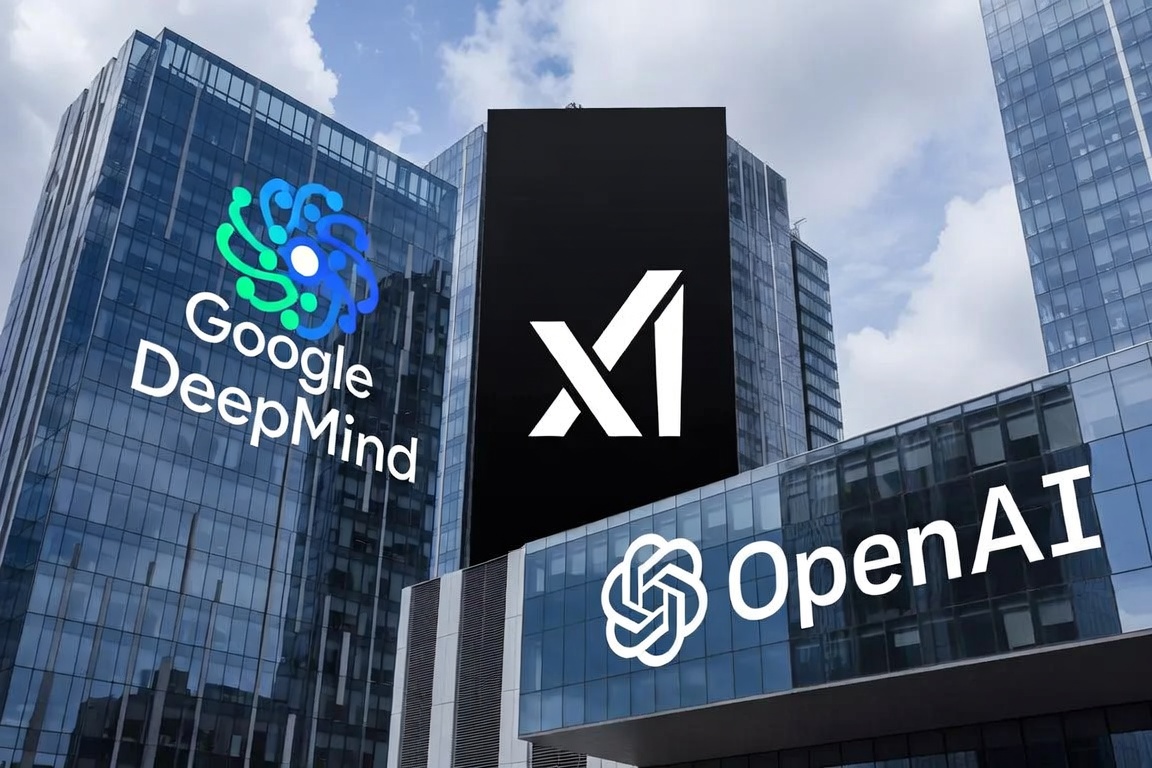
The artificial intelligence race is no longer about who can build the smartest chatbot. It has evolved into a contest over who will own the infrastructure of tomorrow’s digital economy. OpenAI, Google, Anthropic, and Elon Musk‘s xAI are now competing across every major front: frontier model releases, benchmark supremacy, enterprise adoption, pricing, strategic partnerships, and executive talent. The winner will likely shape not only the future of software, but the future of knowledge work itself.
While the technology press often obsesses over benchmark scores released every few months, businesses are increasingly asking a different question: Which company offers the most dependable platform for deploying AI at scale?
Today, each competitor brings distinct strengths—and each carries meaningful weaknesses.
OpenAI remains the company everyone else measures themselves against. Despite an increasingly crowded field, OpenAI continues releasing progressively more capable GPT models while expanding its agentic capabilities that move beyond simple conversation toward autonomous project execution. Government scrutiny has even delayed portions of recent model rollouts, illustrating how influential the company’s technology has become.
Google approaches the race from an entirely different position. Rather than building AI as a standalone business, Alphabet is embedding Gemini into virtually every product it owns—from Search and Workspace to Android and Cloud. Gemini’s latest generations have posted impressive reasoning and software engineering benchmark scores, demonstrating that Google’s enormous research investment is beginning to translate into measurable performance gains.
Anthropic has emerged as perhaps the most surprising challenger. Originally viewed as the “AI safety company,” it has steadily become the preferred provider for many enterprise developers. Claude models consistently rank among the strongest coding assistants while maintaining a reputation for reliability and long-context reasoning. Recent releases continue pushing Claude deeper into agentic workflows, where models browse the web, execute multi-step tasks, and assist knowledge workers with increasingly little supervision.
Then there is xAI.
Elon Musk entered the frontier-model race much later than his competitors, yet Grok has advanced at remarkable speed. Recent Grok releases have emphasized aggressive pricing, very large context windows, and enterprise integrations designed to attract developers who want lower costs without sacrificing capability. Although xAI still trails the established leaders in overall enterprise penetration, it is beginning to establish itself as a legitimate fourth competitor rather than merely an interesting experiment.
Benchmark performance, meanwhile, has become both essential and increasingly misleading.
Every major release now arrives accompanied by impressive charts showing gains in coding, mathematics, reasoning, scientific analysis, or autonomous software engineering. Google touts improvements in ARC-AGI and SWE-Bench scores. Anthropic highlights software engineering performance and long-duration agent tasks. OpenAI emphasizes real-world agent capability, while xAI promotes reasoning efficiency and large-context processing.
Yet enterprises are learning that benchmark leadership rarely translates directly into workplace productivity.
A model that scores two percentage points higher on a benchmark may provide virtually identical value inside a law firm, insurance company, or manufacturing business. Reliability, uptime, integration, security, compliance, and cost often matter far more than winning the latest academic leaderboard.
Pricing has therefore become a genuine competitive weapon.
OpenAI largely competes on capability first and price second.
Google can afford to bundle AI aggressively because advertising revenue subsidizes much of its ecosystem.
Anthropic has generally maintained premium pricing that many businesses willingly pay because of Claude’s coding performance and dependable behavior.
Meanwhile, xAI has chosen disruption. Grok’s API pricing undercuts many competing frontier models, making it attractive for organizations running high-volume inference workloads. Whether that pricing remains sustainable as usage grows remains an open question.
Enterprise adoption may ultimately prove more important than any benchmark.
OpenAI enjoys enormous mindshare and widespread deployment across corporations already invested in the Microsoft ecosystem.
Google possesses perhaps the greatest distribution advantage in history, capable of introducing Gemini to billions of existing Workspace, Android, and Cloud users almost overnight.
Anthropic has quietly become a favorite among software developers and technical organizations seeking dependable coding assistants. Industry analyses suggest Claude has captured a growing share of enterprise AI spending during the past year.
xAI faces the steepest climb.
Its consumer visibility is strong thanks to X and Elon Musk’s personal brand, but converting social-media popularity into long-term enterprise contracts is considerably more difficult. Large organizations tend to move cautiously, favoring vendors with mature governance, compliance certifications, and established support organizations.
Strategic partnerships further separate the contenders.
OpenAI continues benefiting from Microsoft’s cloud infrastructure and enterprise reach.
Google naturally leverages every division within Alphabet.
Anthropic has built relationships across multiple cloud providers and enterprise software vendors while expanding industry-specific applications such as scientific research. Recent collaborations also reflect growing interaction with government agencies on frontier-model safety standards.
xAI has begun broadening beyond its own ecosystem through cloud distribution and infrastructure partnerships, signaling recognition that enterprise customers prefer flexibility over vendor lock-in.
Executive leadership has become another competitive battlefield.
Sam Altman continues serving as the industry’s most recognizable executive, balancing product development with increasingly complex relationships in Washington.
Google’s AI strategy remains guided by Sundar Pichai alongside DeepMind leadership, emphasizing long-term research translated into commercial products.
Anthropic founders Dario and Daniela Amodei continue positioning the company as both ambitious and safety-conscious, even while rapidly expanding commercial deployments.
Elon Musk remains xAI’s greatest advantage—and its greatest uncertainty. His ability to attract talent, capital, and public attention is unmatched. Yet simultaneously leading multiple major companies inevitably raises questions about organizational focus and execution.
From a conservative perspective, one broader observation deserves attention.
Competition—not regulation—is driving this extraordinary pace of innovation.
Four years ago, no serious observer would have predicted four American companies investing hundreds of billions of dollars to build increasingly capable artificial intelligence systems. Today, fierce market competition is producing lower prices, faster innovation, better products, and broader enterprise adoption at a pace government planning could never replicate.
That does not eliminate legitimate concerns surrounding AI safety, labor displacement, or national security. Those questions deserve thoughtful public debate. But history repeatedly demonstrates that free-market competition generally produces better technologies than centralized planning.
The next twelve months will likely determine whether this market consolidates around two dominant providers or remains a genuinely competitive ecosystem.
My hypothesis is that OpenAI will likely retain leadership in frontier capabilities, Google will leverage unmatched distribution to capture enormous enterprise market share, Anthropic will continue winning high-value technical customers through quality and reliability, and xAI will emerge as the industry’s disruptive price competitor while steadily improving its enterprise credibility.
In the end, benchmark charts may generate headlines, but businesses will decide the winner. The company that delivers the best combination of performance, reliability, affordability, and trust—not merely the highest benchmark score—will define the next generation of artificial intelligence.