

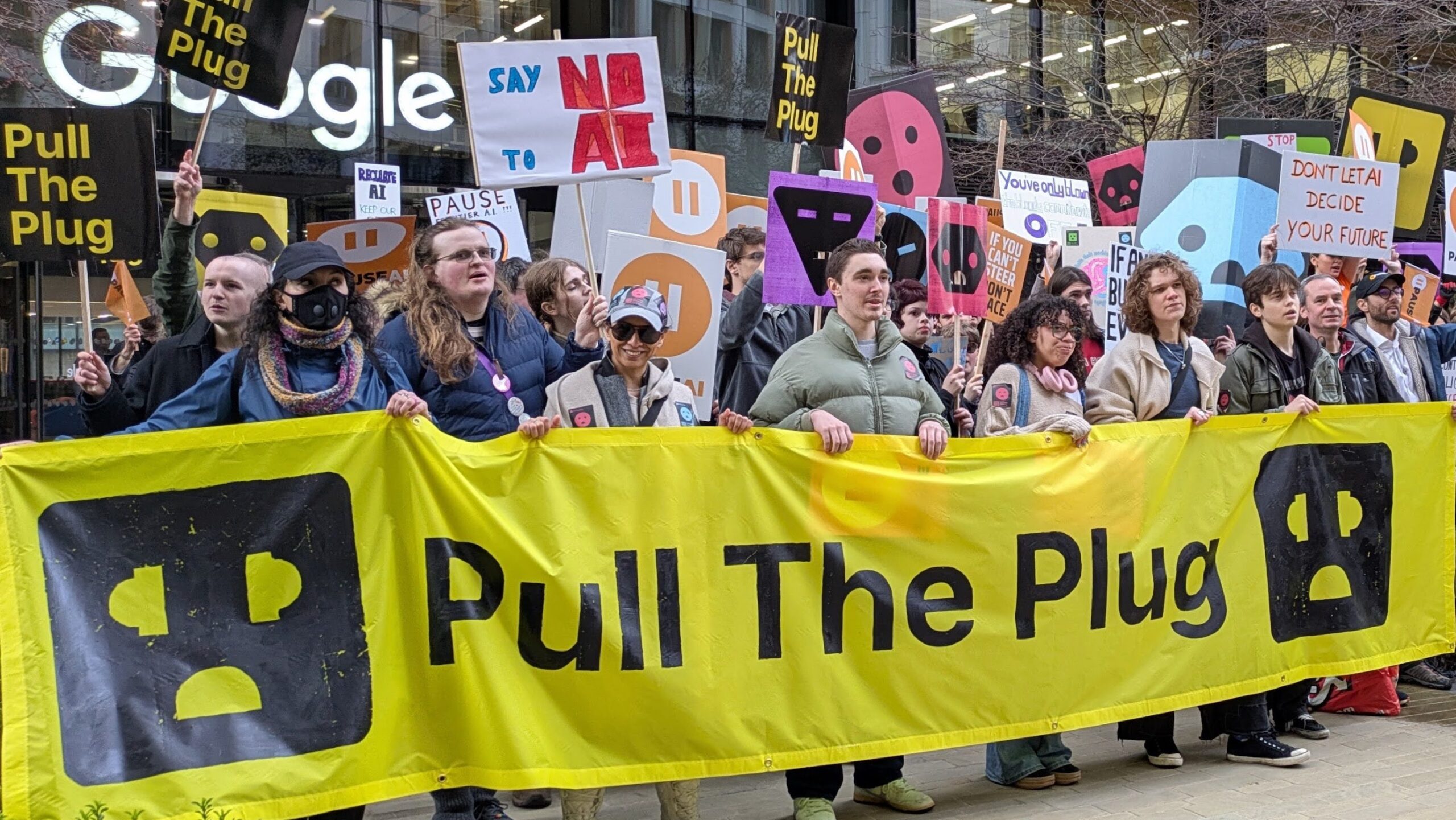
Roughly 200 demonstrators marched through San Francisco on Saturday, stopping at the offices of OpenAI, Anthropic, and Google DeepMind to demand a halt to the development of increasingly powerful artificial intelligence systems. Organized by the activist group “Stop the AI Race,” the protest drew students, researchers, longtime Bay Area residents, and even some AI industry professionals who argued that the rapid race to develop frontier AI is creating unacceptable risks. Protesters cited concerns ranging from job displacement and rising housing costs to environmental impacts and the possibility of advanced AI systems escaping meaningful human control. While AI companies continue to argue that innovation can proceed alongside responsible safety measures, the demonstration reflects a growing movement seeking significantly stronger regulation—or even a temporary moratorium—on frontier AI development. Critics of the protest contend that freezing American AI development would primarily benefit strategic competitors such as China while doing little to halt global technological advancement.
7Sources
- https://www.sfchronicle.com/tech/article/san-francisco-ai-protest-22340835.php
- https://abc7news.com/post/sf-protesters-call-ai-pause-anthropic-openai-xai-white-house-pushes-national-framework-trump-seeks-liability-limits/18752242
- https://www.wsj.com/tech/ai/anti-ai-activists-disappearance-sam-kirchner-6872879f
Key Takeaways
- • Opposition to rapid AI development is expanding beyond academic circles to include industry professionals, researchers, and local residents concerned about economic, environmental, and societal consequences.
- • Activists are increasingly calling for coordinated pauses in frontier AI development rather than incremental regulatory oversight, arguing that current safeguards are insufficient.
- • The debate highlights a growing policy divide between maintaining American technological leadership and imposing stronger restrictions designed to reduce perceived long-term AI risks.
In-Depth
Saturday’s demonstration in San Francisco underscored how the artificial intelligence debate has evolved beyond technical discussions into a broader political and cultural conflict. Marching between the headquarters of OpenAI, Anthropic, and Google DeepMind, protesters argued that the competitive race to build ever-more-capable AI systems has outpaced society’s ability to manage the technology responsibly. Their concerns ranged from immediate issues such as job losses, soaring housing costs, and energy consumption to more speculative fears surrounding artificial general intelligence.
While those concerns deserve thoughtful consideration, calls for an outright freeze on AI development raise equally significant questions. The United States currently leads much of the world’s frontier AI research, a position with profound economic, military, and national security implications. A unilateral slowdown by American companies would not necessarily be matched by geopolitical competitors, particularly China, potentially shifting technological leadership overseas without materially reducing global AI development.
That reality suggests policymakers face a far more complicated challenge than simply choosing between unrestricted innovation and sweeping moratoriums. Effective oversight should focus on transparency, security, intellectual property protections, and preventing genuinely dangerous applications while preserving America’s competitive advantage. The emerging AI economy promises extraordinary productivity gains and scientific breakthroughs, but it also demands responsible governance.
Ultimately, the San Francisco protest reflects a legitimate public anxiety about transformative technology. Whether those concerns translate into meaningful policy will depend on lawmakers’ willingness to balance innovation with accountability rather than embracing either unchecked technological acceleration or reactionary efforts to halt progress altogether.