

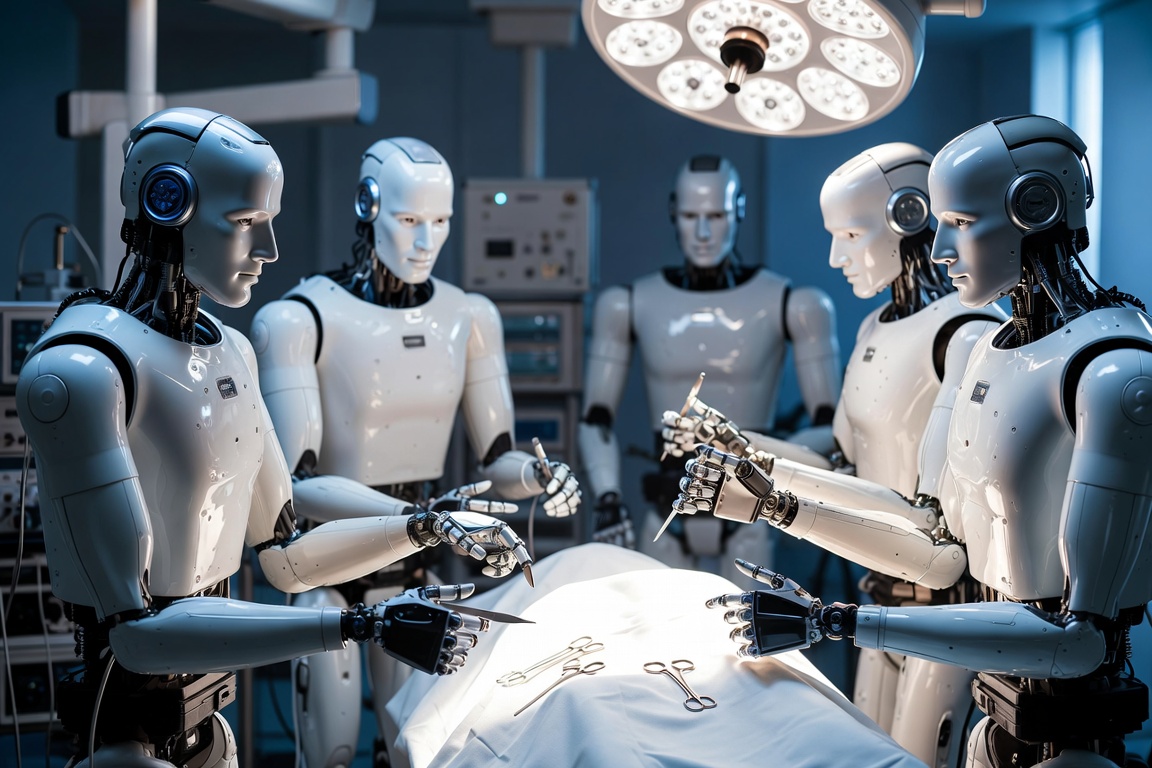
The advance of artificial intelligence into the operating room is no longer a speculative exercise—it is an unfolding reality. Robotic systems already assist surgeons with precision tasks, reducing human tremor and enhancing visualization. Yet the prospect of AI systems not merely assisting, but independently conducting surgeries, raises profound ethical questions that cut deeper than any scalpel. At stake is not only the future of medicine, but the preservation of human accountability, dignity, and trust in life-and-death decision-making.
Proponents of AI-driven surgery argue from a standpoint of efficiency and capability. Machines do not tire. They do not suffer lapses in judgment due to stress, distraction, or fatigue. Properly trained algorithms can process vast quantities of medical data, identify patterns invisible to the human eye, and execute procedures with mechanical precision. In theory, such systems could dramatically reduce surgical errors, standardize outcomes, and extend high-quality care to underserved populations. From a purely utilitarian perspective, the appeal is undeniable.
But medicine has never been a purely utilitarian enterprise. It is, at its core, a moral practice rooted in the relationship between physician and patient. This relationship is built on trust, empathy, and accountability—qualities that cannot be easily encoded into lines of code or neural networks. A machine may execute a flawless incision, but it cannot grasp the weight of a patient’s fear, the nuances of informed consent, or the moral gravity of a life placed in its care.
One of the most pressing ethical concerns surrounding AI-driven surgery is the question of responsibility. When a human surgeon errs, there is a clear line of accountability. Professional standards, malpractice law, and ethical codes provide mechanisms for judgment and redress. But when an autonomous system makes a mistake—whether due to flawed programming, incomplete data, or unforeseen circumstances—who bears responsibility? Is it the developer, the hospital, the overseeing physician, or the machine itself? The diffusion of accountability risks undermining one of the foundational principles of medicine: that those entrusted with care must answer for their actions.
Equally troubling is the potential erosion of human judgment in the operating room. Surgery is not merely a technical exercise; it is a dynamic process requiring real-time decision-making in the face of uncertainty. Unexpected complications, anatomical variations, and patient-specific factors often demand improvisation guided by experience and intuition. While AI can be trained on vast datasets, it is inherently constrained by the limits of its programming and training inputs. There is a danger that overreliance on automated systems could deskill human surgeons, leaving them less prepared to intervene when technology fails.
The issue of consent also takes on new dimensions in the age of AI surgery. Patients have long placed their trust in human physicians, whose training, credentials, and ethical obligations are well understood. The introduction of autonomous systems complicates this trust. Can patients meaningfully consent to a procedure conducted by an algorithm they cannot fully comprehend? Transparency becomes critical, yet even experts often struggle to explain the inner workings of advanced AI models. Without clear understanding, consent risks becoming a hollow formality rather than a genuine expression of patient autonomy.
There is also a broader societal concern about the commodification of care. The integration of AI into surgery is driven in part by economic incentives—reducing costs, increasing throughput, and maximizing efficiency. While these goals are not inherently unethical, they must be balanced against the risk of reducing patients to data points in a system optimized for output rather than individual well-being. Medicine, when stripped of its human element, risks becoming a transactional enterprise rather than a compassionate calling.
From a conservative perspective, these developments invite a sober assessment grounded in prudence rather than blind enthusiasm. Technological progress is not an unqualified good; it must be guided by enduring principles that safeguard human dignity and responsibility. The temptation to delegate critical moral decisions to machines should be resisted, not out of fear of innovation, but out of respect for the unique role that human judgment plays in matters of life and death.
This does not mean rejecting AI in medicine outright. On the contrary, AI has a valuable role to play as a tool that enhances human capability. The ethical path forward lies in maintaining a clear hierarchy: machines should assist, inform, and augment, but not replace the human surgeon. The physician must remain the ultimate decision-maker, accountable for outcomes and responsive to the needs of the patient.
In the final analysis, the question is not whether AI can perform surgery, but whether it should do so independently. The answer depends on what we value most in medicine. If we prioritize efficiency above all else, the case for autonomy may seem compelling. But if we hold fast to the principles of accountability, empathy, and human dignity, then the role of AI must remain carefully circumscribed.
The operating room is not merely a site of technical intervention; it is a place where human lives hang in the balance, guided by the steady hands and moral judgment of those sworn to heal. As we stand at this technological crossroads, we would do well to remember that not everything that can be automated should be. In the realm of surgery, the human touch is not a limitation to be overcome—it is a safeguard to be preserved.