

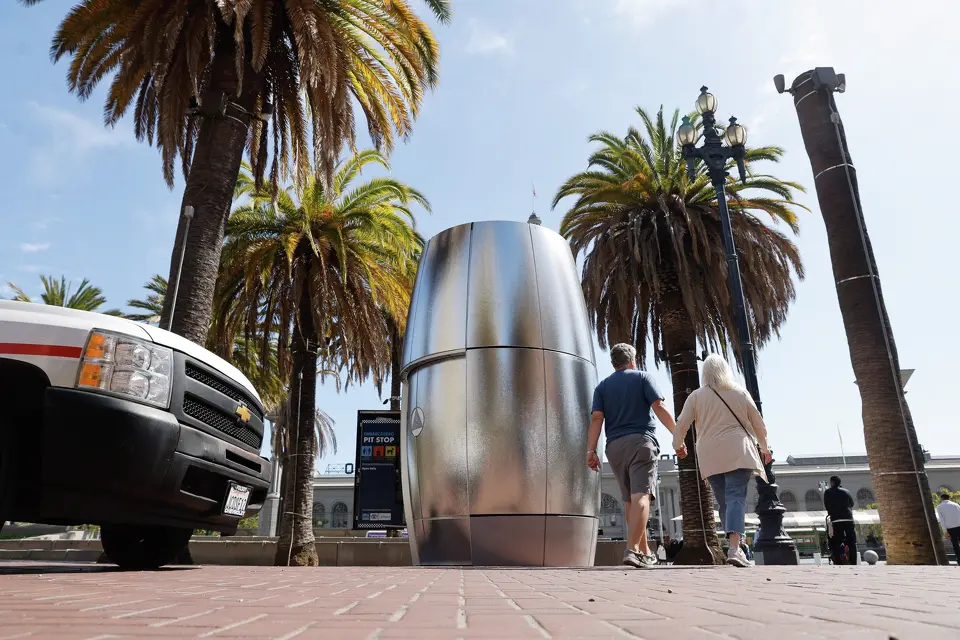
San Francisco’s effort to modernize its public restroom system with a futuristic, self-cleaning toilet has encountered persistent technical setbacks, delaying a broader citywide rollout and raising fresh questions about the practicality of increasingly complex public infrastructure. Installed near the Ferry Building in 2022, the automated restroom has generated more than 200 maintenance requests, primarily involving malfunctioning doors and cleaning-cycle failures. While city officials and the contractor remain committed to refining the design and expanding deployment beginning in 2027, the project has become another example of how ambitious government technology initiatives can struggle when reliability, maintenance costs, and operational realities collide.
Key Takeaways
- The prototype self-cleaning restroom has experienced hundreds of maintenance issues, delaying plans to deploy additional units throughout San Francisco.
- Officials continue to support the concept, arguing that newer models will improve efficiency and long-term sanitation despite the project’s early operational failures.
- The experience reinforces broader concerns that governments should prioritize durable, dependable public infrastructure over technologically sophisticated systems that introduce additional costs and maintenance challenges.
In-Depth
San Francisco’s latest public restroom initiative illustrates a recurring challenge facing governments eager to embrace sophisticated technology before proving its long-term reliability. The city’s prototype automated restroom was envisioned as a modern solution to sanitation, accessibility, and public hygiene, incorporating touchless controls, automated cleaning cycles, and computerized operation. Instead, frequent breakdowns have demonstrated that technological complexity often creates additional points of failure rather than eliminating existing problems.
The delays have implications beyond a single restroom. Officials had envisioned replacing older public facilities with dozens of similar units financed through advertising partnerships. Instead, technical problems combined with financial disruptions have postponed that broader deployment for several years. Supporters argue the revised designs will ultimately prove more efficient and environmentally sustainable, while critics question whether proven, simpler designs would have delivered more dependable service at lower long-term cost.
The episode also reflects a broader pattern in public-sector infrastructure. Governments frequently pursue highly customized, technologically advanced projects that promise innovation but require specialized maintenance, proprietary components, and continual software support. Taxpayers ultimately bear the cost when these systems fail to perform as advertised. Public restrooms serve a basic civic function: they must be available, sanitary, and dependable every day. Reliability often matters far more than novelty.
None of this diminishes the legitimate need for additional public restroom access in busy urban centers. Cities benefit from clean, well-maintained facilities that improve quality of life for residents, tourists, and workers alike. However, successful public infrastructure typically emphasizes durability, straightforward maintenance, and operational simplicity before technological sophistication. As San Francisco continues refining its restroom program, the experience serves as a reminder that innovation should complement practicality rather than replace it. Public confidence is built not by futuristic designs, but by infrastructure that consistently performs its intended purpose.