

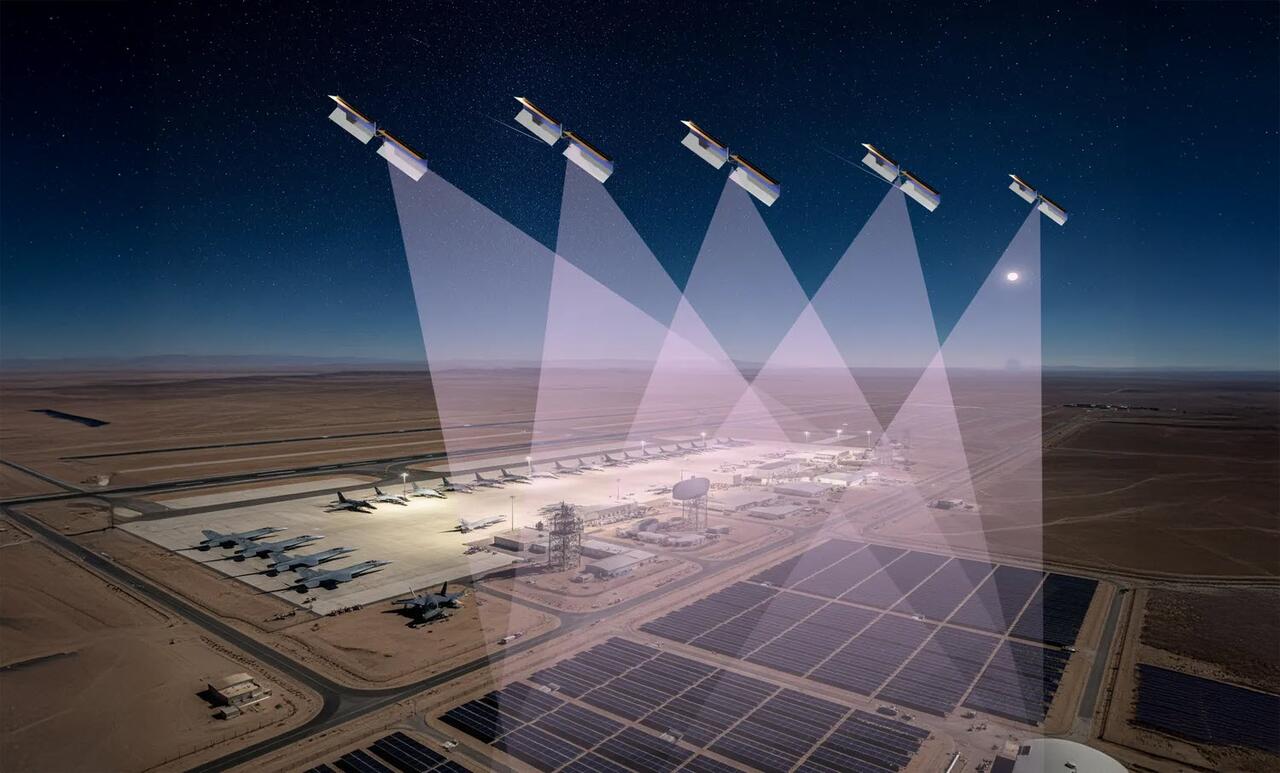
The Pentagon is putting new financial and institutional support behind an ambitious effort to collect solar energy in space and beam it to receivers on Earth, awarding Virginia-based Overview Energy a contract through the Operational Energy Capability Improvement Fund to develop a homing beacon capable of precisely guiding energy from orbit to terrestrial solar arrays. The company’s system would convert solar energy gathered by satellites into near-infrared light and direct it toward existing solar installations, potentially allowing those facilities to generate electricity after sunset while avoiding construction of additional transmission infrastructure. Overview has already demonstrated power transmission from a moving aircraft and plans an orbital demonstration in 2028, followed by initial geosynchronous deployment beginning in 2030. The military sees obvious strategic value in delivering power to remote bases and other locations without vulnerable fuel convoys or extensive terrestrial infrastructure. The concept is also attracting major private-sector interest, including an agreement giving Meta early access to as much as one gigawatt of future capacity, although the economics and technical feasibility of utility-scale orbital power remain unproven.
Key Takeaways
- The Pentagon-backed project will develop and test a homing beacon allowing Overview Energy’s satellites to identify terrestrial receivers, lock onto them and precisely transmit solar energy from orbit using near-infrared light.
- Overview plans its first orbital demonstration in 2028 and is targeting initial geosynchronous commercial deployment in 2030, building upon an airborne demonstration that successfully transmitted power from a moving platform to a ground receiver.
- Space-based solar power could give the military an important logistical advantage by delivering energy to remote locations without conventional fuel-supply chains, while civilian applications could provide around-the-clock electricity through existing solar installations; however, large-scale economics and orbital performance remain significant unanswered questions.
In-Depth
The Pentagon’s investment in space-based solar power is more than another renewable-energy experiment. For the military, reliable energy is fundamentally a logistical and national-security issue. Supplying remote installations requires fuel, transportation, personnel and infrastructure—all of which can become vulnerabilities during conflict.
Overview Energy proposes a radically different model. Satellites would collect sunlight in space, convert the captured energy into near-infrared light and beam it to existing terrestrial solar installations. The Pentagon-funded homing beacon is critical because orbital transmitters must accurately identify and continuously track specific receiving locations before useful amounts of power can be delivered safely.
The military potential is substantial. Energy could theoretically be redirected toward installations where it is needed without constructing conventional transmission lines or repeatedly transporting fuel through dangerous territory. The technology could eventually support unmanned systems and other energy-intensive operations while reducing dependence on exposed supply chains.
Civilian demand could prove equally important. Meta has agreed to obtain early access to as much as one gigawatt of Overview’s proposed capacity as technology companies search for reliable electricity for expanding AI infrastructure and data centers.
But taxpayers and policymakers should distinguish promising engineering from proven economics. Overview has demonstrated airborne power transmission, not a commercially viable space-to-Earth system. The decisive test is scheduled for 2028, with commercial operations targeted for 2030.
The Pentagon has legitimate reasons to investigate technologies capable of strengthening American military resilience. But continued public investment should follow measurable technical achievements rather than optimistic projections. If orbital solar power works economically at scale, it could become strategically significant. Until then, disciplined testing—not government enthusiasm—should determine whether the technology deserves large-scale deployment.
Sources
- https://www.zerohedge.com/markets/pentagon-backs-ambitious-plan-beam-solar-power-space
- https://breakingdefense.com/2026/10/dod-demo-contract-takes-a-step-closer-to-beaming-solar-power-from-space/
- https://www.prnewswire.com/news-releases/overview-energy-awarded-department-of-war-oecif-contract-to-develop-homing-beacon-for-space-solar-energy-302893643.html
- https://www.overviewenergy.com/updates/overview-and-meta
- https://about.fb.com/news/2026/04/powering-ai-strengthening-the-grid-space-solar-energy-and-long-duration-storage/