

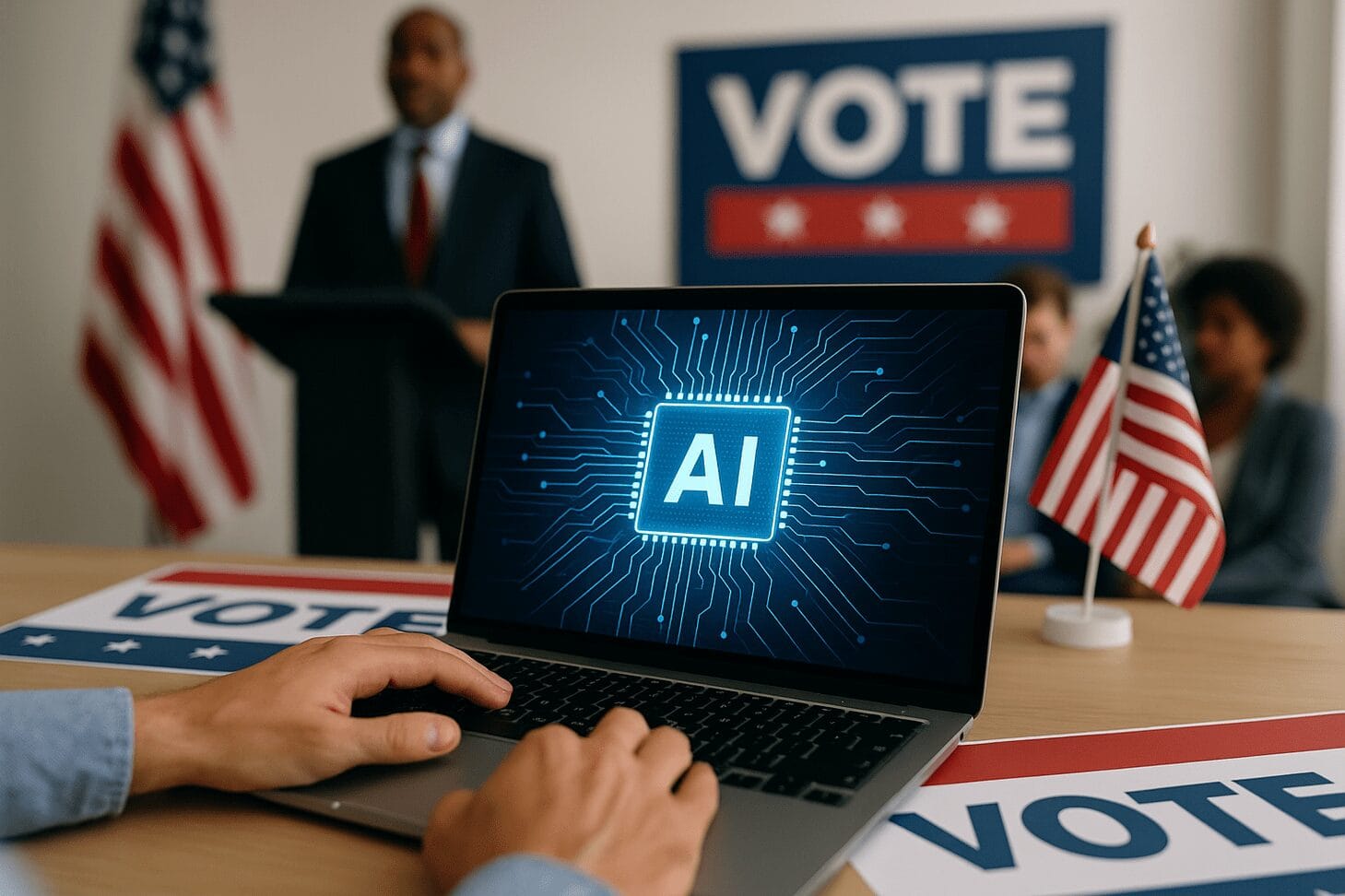
Artificial intelligence has entered political campaigning with remarkable speed. Campaigns can now use AI to draft advertisements, generate images, translate messages, analyze voter concerns, create voiceovers, edit video, and produce material that once required teams of consultants and production professionals. None of these applications is inherently unethical. The ethical problem begins when artificial intelligence stops helping campaigns communicate and starts helping them deceive.
That distinction should be central to the debate over AI-generated political advertising.
Political advertising has never been an exercise in pure objectivity. Candidates naturally present themselves favorably, emphasize an opponent’s failures, select statistics supporting their arguments, and employ imagery designed to provoke emotional responses. Campaign consultants existed long before artificial intelligence, and political advertisements have been manipulated through editing, lighting, music, selective quotations, and carefully constructed narratives for generations.
AI changes the equation because it dramatically expands what can be manufactured.
A campaign can potentially create convincing video of an opponent appearing to say something that was never said. A candidate’s voice can be cloned. Photographs can be fabricated depicting events that never happened. Real footage can be altered so subtly that an ordinary voter may have little chance of recognizing the manipulation. As the technology improves, the traditional assumption that seeing or hearing something provides at least some evidence that it occurred becomes increasingly unreliable.
That presents an ethical problem larger than ordinary political exaggeration.
There is a meaningful difference between producing an advertisement arguing that an opponent’s policies would create chaos and generating realistic footage falsely showing chaos caused by that opponent. There is likewise a difference between quoting a candidate’s actual statement in an advertisement and manufacturing the candidate’s voice saying words the person never uttered.
The principle should be straightforward: political campaigns should remain free to persuade, criticize, dramatize, satirize, and argue, but they should not knowingly manufacture false evidence and present it to voters as authentic.
That standard does not require banning AI from campaigns.
Consider a campaign that wants an advertisement depicting the economic consequences it believes will result from a proposed tax increase. AI-generated imagery might illustrate closed storefronts or financially struggling families. Provided the advertisement is clearly presented as an illustration of a predicted consequence rather than documentary evidence of something that has already occurred, its use is not fundamentally different from actors, animation, computer graphics, or traditional stock imagery.
Similarly, using AI to improve sound quality, generate graphics, translate an advertisement into another language, organize publicly available information, or reduce production costs raises few unique ethical concerns. Technology has always changed campaigning. Artificial intelligence is another powerful tool.
The danger is establishing rules broad enough to allow government officials to decide which political messages are legitimate.
Political speech deserves especially strong protection precisely because those holding governmental power have an obvious interest in regulating their critics. A law supposedly intended to prevent deceptive AI advertising could easily become a mechanism through which government agencies, political appointees, or partisan officials determine what constitutes misleading political expression.
That cure could become worse than the disease.
A better approach emphasizes authenticity and disclosure rather than governmental control over political viewpoints. When realistic AI-generated content depicts a real candidate doing or saying something the candidate did not actually do or say, viewers should be given enough information to understand what they are seeing. Disclosure requirements can address deception without granting government broad authority to police political arguments.
Campaigns should also establish their own ethical boundaries.
Before releasing AI-generated material, campaign professionals should ask a simple question: Would a reasonable viewer mistakenly believe this is authentic evidence of an actual event? If the answer is yes, the content should either be clearly identified as artificial or not used.
Candidates should recognize another practical reason for restraint. Once campaigns normalize fabricated political evidence, every authentic recording becomes easier to deny. A politician caught making an embarrassing statement could simply claim that the recording was AI-generated. The proliferation of deepfakes therefore threatens not only to create false evidence but also to undermine confidence in genuine evidence.
That may ultimately prove to be AI’s most corrosive political consequence.
American elections depend upon vigorous disagreement. Candidates should be free to make aggressive arguments, challenge their opponents, use humor and satire, predict consequences, and present sharply different visions of government. Protecting that freedom requires resisting efforts to transform concerns about artificial intelligence into another justification for regulating political speech.
But freedom carries responsibility.
The ethical boundary should not be determined by whether AI was used. It should be determined by what AI was used to accomplish. Technology that helps a candidate communicate an argument is fundamentally different from technology used to manufacture evidence.
Artificial intelligence can make political communication cheaper, faster, more sophisticated, and more accessible. It can allow underfunded candidates to compete with campaigns possessing enormous advertising budgets. Those are legitimate advantages.
But voters must remain capable of distinguishing advocacy from fabrication.
The challenge, therefore, is not keeping artificial intelligence out of politics. That is neither realistic nor desirable. The challenge is preserving something considerably older and more important than AI: the expectation that when a political campaign presents something as fact, it has not knowingly manufactured the evidence supporting it.
Democracy can survive powerful new communication technologies. It has done so repeatedly.
What it cannot easily survive is a political culture in which citizens no longer know whether their own eyes and ears can be trusted.