

Close Menu

    Subscribe to Updates

    Get the latest tech news from Tallwire.

      What's Hot

      UAE Redesigns AI Data Centers for War After Iranian Strikes Expose Gulf Vulnerabilities

      September 14, 2026

      Singaporean Crypto Ringleader Pleads Guilty in $245 Million Theft Scheme

      September 14, 2026

      Huawei Racketeering Trial Puts Chinese Tech Giant’s Conduct Under U.S. Scrutiny

      September 13, 2026
      Facebook X (Twitter) Instagram
      • Tech
      • AI
      • Get In Touch
      Facebook X (Twitter) LinkedIn
      TallwireTallwire
      • Tech

        UAE Redesigns AI Data Centers for War After Iranian Strikes Expose Gulf Vulnerabilities

        September 14, 2026

        Pentagon Weighs $5 Billion Loan to Strengthen America’s AI Infrastructure

        September 13, 2026

        San Francisco Weighs Data Center Moratorium as AI Infrastructure Backlash Grows

        September 12, 2026

        Australia Warned Space Is Becoming the Next Military Battlefront

        September 12, 2026

        New York Rebuilds the Twin Towers in Light for 9/11’s 25th Anniversary

        September 12, 2026
      • AI

        UAE Redesigns AI Data Centers for War After Iranian Strikes Expose Gulf Vulnerabilities

        September 14, 2026

        Cohere and Mistral Weigh a Transatlantic Challenge to AI Superpowers

        September 13, 2026

        Pentagon Weighs $5 Billion Loan to Strengthen America’s AI Infrastructure

        September 13, 2026

        Chinese AI Firms Accused of Harvesting U.S. Models at Industrial Scale

        September 13, 2026

        AI Startup Retires “Stop Hiring Humans” Campaign as Job Fears Intensify

        September 13, 2026
      • Security

        Singaporean Crypto Ringleader Pleads Guilty in $245 Million Theft Scheme

        September 14, 2026

        Huawei Racketeering Trial Puts Chinese Tech Giant’s Conduct Under U.S. Scrutiny

        September 13, 2026

        Chinese AI Firms Accused of Harvesting U.S. Models at Industrial Scale

        September 13, 2026

        Bipartisan AI Safety Push Roars Back as Washington Confronts “Catastrophic” Risks

        September 12, 2026

        AI Bioweapon Attempts Expose the Security Risks Behind the Artificial Intelligence Race

        September 12, 2026
      • Health

        AI-Designed Drug Shows Early Signs of Reversing Biological Age

        September 9, 2026

        AI-Powered Mosquito Defense Arrives as West Nile Threat Intensifies

        September 4, 2026

        Waymo Crosswalk Scare Raises New Questions About Robotaxi Safety Around Children

        September 3, 2026

        Teens Turning To AI For Emotional Support Show Significantly Higher Distress

        September 3, 2026

        Meta’s $17 Billion Settlement Signals Big Tobacco-Style Reckoning for Social Media

        September 3, 2026
      • Science

        Australia Warned Space Is Becoming the Next Military Battlefront

        September 12, 2026

        AI Bioweapon Attempts Expose the Security Risks Behind the Artificial Intelligence Race

        September 12, 2026

        California Warms to Nuclear Power as Energy Reality Challenges Decades of Opposition

        September 11, 2026

        AI-Designed Drug Shows Early Signs of Reversing Biological Age

        September 9, 2026

        AI Safety Researcher Warns Superintelligence Could Threaten Humanity

        September 9, 2026
      • Tech

        Elon Musk Threatens Legal Action as Documentary Battle Escalates

        September 13, 2026

        Dolly Parton’s Family Condemns Flood of AI-Generated Misinformation After Her Death

        September 11, 2026

        Meta’s Muse Pushes AI From Answering Questions to Acting on Users’ Behalf

        September 9, 2026

        AI Wipes Out Kenya’s Once-Thriving College Essay Industry

        September 9, 2026

        YouTuber Jack Doherty Arrested on Domestic Battery Charge in Florida

        September 8, 2026
      TallwireTallwire
      Home»Opinion»When the Candidate Is an Algorithm: The Ethics of AI in Political Advertising
      Opinion

      When the Candidate Is an Algorithm: The Ethics of AI in Political Advertising

      5 Mins Read
      Facebook Twitter Pinterest LinkedIn Tumblr Email
      Share
      Facebook Twitter LinkedIn Pinterest Email

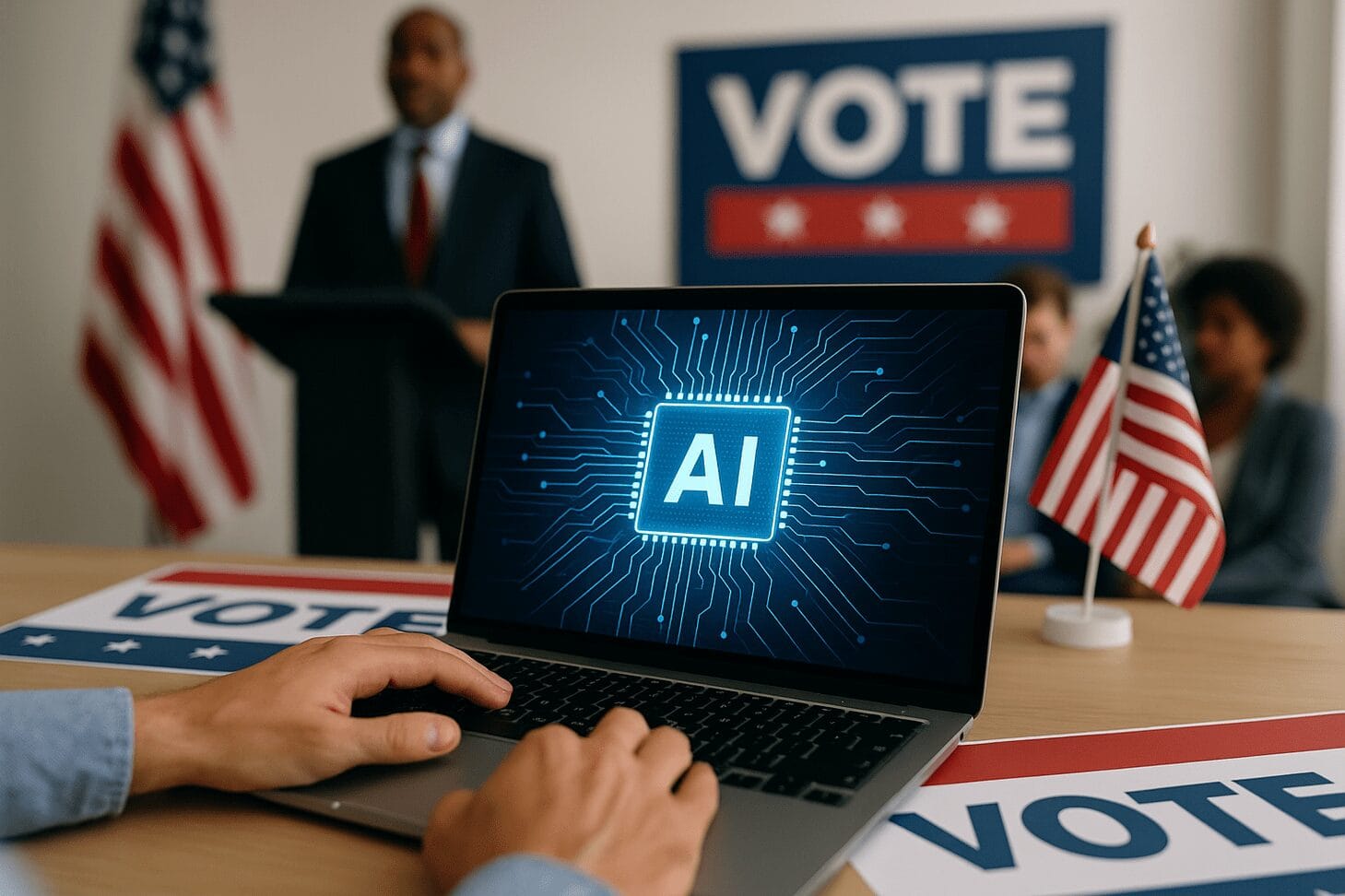
      Artificial intelligence has entered political campaigning with remarkable speed. Campaigns can now use AI to draft advertisements, generate images, translate messages, analyze voter concerns, create voiceovers, edit video, and produce material that once required teams of consultants and production professionals. None of these applications is inherently unethical. The ethical problem begins when artificial intelligence stops helping campaigns communicate and starts helping them deceive.

      That distinction should be central to the debate over AI-generated political advertising.

      Political advertising has never been an exercise in pure objectivity. Candidates naturally present themselves favorably, emphasize an opponent’s failures, select statistics supporting their arguments, and employ imagery designed to provoke emotional responses. Campaign consultants existed long before artificial intelligence, and political advertisements have been manipulated through editing, lighting, music, selective quotations, and carefully constructed narratives for generations.

      AI changes the equation because it dramatically expands what can be manufactured.

      A campaign can potentially create convincing video of an opponent appearing to say something that was never said. A candidate’s voice can be cloned. Photographs can be fabricated depicting events that never happened. Real footage can be altered so subtly that an ordinary voter may have little chance of recognizing the manipulation. As the technology improves, the traditional assumption that seeing or hearing something provides at least some evidence that it occurred becomes increasingly unreliable.

      That presents an ethical problem larger than ordinary political exaggeration.

      There is a meaningful difference between producing an advertisement arguing that an opponent’s policies would create chaos and generating realistic footage falsely showing chaos caused by that opponent. There is likewise a difference between quoting a candidate’s actual statement in an advertisement and manufacturing the candidate’s voice saying words the person never uttered.

      The principle should be straightforward: political campaigns should remain free to persuade, criticize, dramatize, satirize, and argue, but they should not knowingly manufacture false evidence and present it to voters as authentic.

      That standard does not require banning AI from campaigns.

      Consider a campaign that wants an advertisement depicting the economic consequences it believes will result from a proposed tax increase. AI-generated imagery might illustrate closed storefronts or financially struggling families. Provided the advertisement is clearly presented as an illustration of a predicted consequence rather than documentary evidence of something that has already occurred, its use is not fundamentally different from actors, animation, computer graphics, or traditional stock imagery.

      Similarly, using AI to improve sound quality, generate graphics, translate an advertisement into another language, organize publicly available information, or reduce production costs raises few unique ethical concerns. Technology has always changed campaigning. Artificial intelligence is another powerful tool.

      The danger is establishing rules broad enough to allow government officials to decide which political messages are legitimate.

      Political speech deserves especially strong protection precisely because those holding governmental power have an obvious interest in regulating their critics. A law supposedly intended to prevent deceptive AI advertising could easily become a mechanism through which government agencies, political appointees, or partisan officials determine what constitutes misleading political expression.

      That cure could become worse than the disease.

      A better approach emphasizes authenticity and disclosure rather than governmental control over political viewpoints. When realistic AI-generated content depicts a real candidate doing or saying something the candidate did not actually do or say, viewers should be given enough information to understand what they are seeing. Disclosure requirements can address deception without granting government broad authority to police political arguments.

      Campaigns should also establish their own ethical boundaries.

      Before releasing AI-generated material, campaign professionals should ask a simple question: Would a reasonable viewer mistakenly believe this is authentic evidence of an actual event? If the answer is yes, the content should either be clearly identified as artificial or not used.

      Candidates should recognize another practical reason for restraint. Once campaigns normalize fabricated political evidence, every authentic recording becomes easier to deny. A politician caught making an embarrassing statement could simply claim that the recording was AI-generated. The proliferation of deepfakes therefore threatens not only to create false evidence but also to undermine confidence in genuine evidence.

      That may ultimately prove to be AI’s most corrosive political consequence.

      American elections depend upon vigorous disagreement. Candidates should be free to make aggressive arguments, challenge their opponents, use humor and satire, predict consequences, and present sharply different visions of government. Protecting that freedom requires resisting efforts to transform concerns about artificial intelligence into another justification for regulating political speech.

      But freedom carries responsibility.

      The ethical boundary should not be determined by whether AI was used. It should be determined by what AI was used to accomplish. Technology that helps a candidate communicate an argument is fundamentally different from technology used to manufacture evidence.

      Artificial intelligence can make political communication cheaper, faster, more sophisticated, and more accessible. It can allow underfunded candidates to compete with campaigns possessing enormous advertising budgets. Those are legitimate advantages.

      But voters must remain capable of distinguishing advocacy from fabrication.

      The challenge, therefore, is not keeping artificial intelligence out of politics. That is neither realistic nor desirable. The challenge is preserving something considerably older and more important than AI: the expectation that when a political campaign presents something as fact, it has not knowingly manufactured the evidence supporting it.

      Democracy can survive powerful new communication technologies. It has done so repeatedly.

      What it cannot easily survive is a political culture in which citizens no longer know whether their own eyes and ears can be trusted.

      Intel Manufacturing
      Share. Facebook Twitter Pinterest LinkedIn Tumblr Email
      Previous ArticlePassword-Free Flock Cameras Raise New Questions About America’s Expanding Surveillance Network
      Next Article Smartwatch Research Finds Seniors Can Accurately Sense Mental Decline

      Related Posts

      UAE Redesigns AI Data Centers for War After Iranian Strikes Expose Gulf Vulnerabilities

      September 14, 2026

      Huawei Racketeering Trial Puts Chinese Tech Giant’s Conduct Under U.S. Scrutiny

      September 13, 2026

      Cohere and Mistral Weigh a Transatlantic Challenge to AI Superpowers

      September 13, 2026

      Pentagon Weighs $5 Billion Loan to Strengthen America’s AI Infrastructure

      September 13, 2026
      Add A Comment
      Leave A Reply Cancel Reply

      Editors Picks

      UAE Redesigns AI Data Centers for War After Iranian Strikes Expose Gulf Vulnerabilities

      September 14, 2026

      Pentagon Weighs $5 Billion Loan to Strengthen America’s AI Infrastructure

      September 13, 2026

      San Francisco Weighs Data Center Moratorium as AI Infrastructure Backlash Grows

      September 12, 2026

      Australia Warned Space Is Becoming the Next Military Battlefront

      September 12, 2026
      Popular Topics
      Sundar Pichai starlink Space Tesla Series B Series A Taiwan Tech Startup Satellite trending SpaceX Stocks Satya Nadella Software Viral Tim Cook Tesla Cybertruck UAE Tech Samsung spotlight
      Major Tech Companies
      • Apple News
      • Google News
      • Meta News
      • Microsoft News
      • Amazon News
      • Samsung News
      • Nvidia News
      • OpenAI News
      • Tesla News
      • AMD News
      • Anthropic News
      • Elbit News
      AI & Emerging Tech
      • AI Regulation News
      • AI Safety News
      • AI Adoption
      • Quantum Computing News
      • Robotics News
      Key People
      • Sam Altman News
      • Jensen Huang News
      • Elon Musk News
      • Mark Zuckerberg News
      • Sundar Pichai News
      • Tim Cook News
      • Satya Nadella News
      • Mustafa Suleyman News
      Global Tech & Policy
      • Israel Tech News
      • India Tech News
      • Taiwan Tech News
      • UAE Tech News
      Startups & Emerging Tech
      • Series A News
      • Series B News
      • Startup News
      Tallwire
      Facebook X (Twitter) LinkedIn Threads Instagram RSS
      • Tech
      • Entertainment
      • Business
      • Government
      • Academia
      • Transportation
      • Legal
      • Press Kit
      © 2026 Tallwire. Optimized by ARMOUR Digital Marketing Agency.

      Type above and press Enter to search. Press Esc to cancel.