

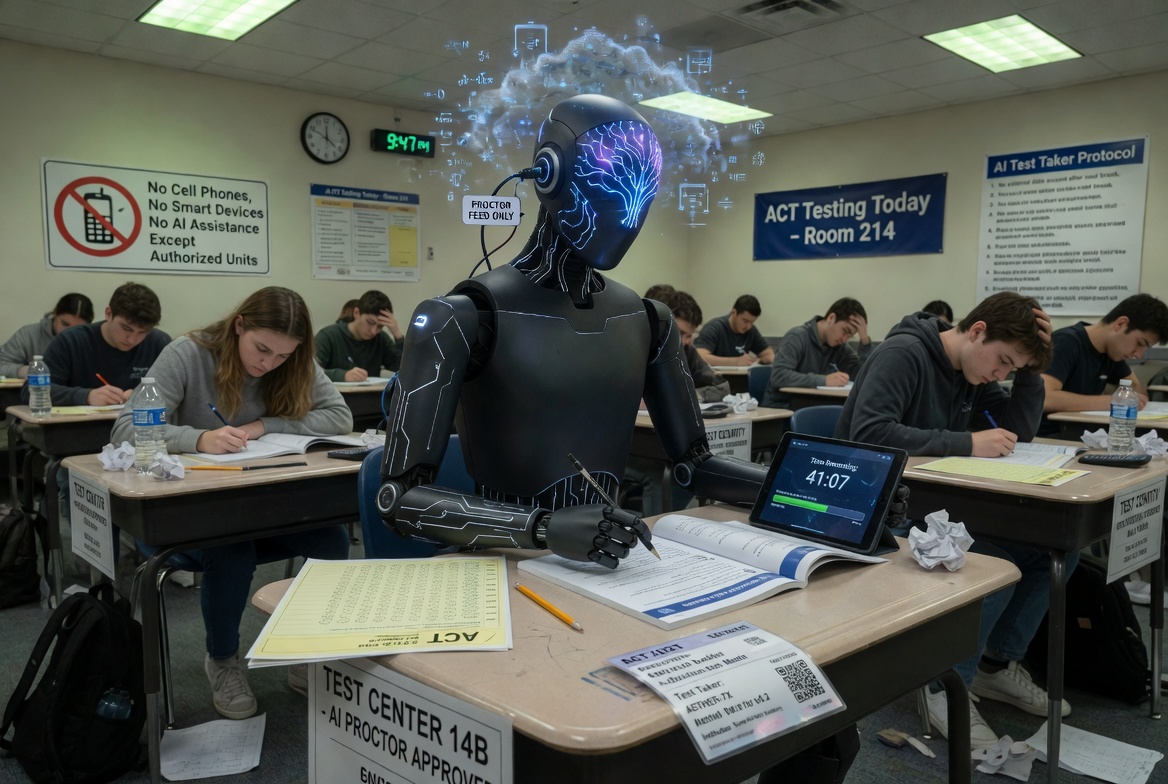
The arrival of advanced artificial intelligence in classrooms has forced a long-overdue reckoning with how students learn, how they are evaluated, and what academic achievement truly means. Nowhere is that tension more visible than in high-stakes standardized tests like the SAT and ACT. These exams have long been positioned as objective measures of readiness, discipline, and intellectual ability. But with AI tools capable of generating essays, solving complex math problems, and even simulating test-taking strategies, the foundation beneath those assumptions is shifting—rapidly.
On the surface, the advantages of AI in education are significant and difficult to dismiss. Properly used, AI can democratize access to high-quality academic support. A student in an underfunded school district can now receive guidance that rivals private tutoring. AI-driven platforms can break down algebraic concepts, refine grammar in essays, and provide practice tests tailored to a student’s weaknesses. For families who cannot afford expensive test prep programs, this represents a leveling force—arguably the most powerful one introduced in decades.
There’s also a case to be made that AI enhances efficiency. Students preparing for the SAT or ACT can compress weeks of study into days by using targeted feedback loops. Instead of guessing why an answer is wrong, they can receive immediate, clear explanations. That kind of precision training can build confidence and competence quickly. In a system where time is often the scarcest resource, AI becomes a force multiplier.
From a broader perspective, AI may even push education toward a more honest reflection of real-world skills. In professional environments, individuals are increasingly expected to use tools—digital, automated, and intelligent—to solve problems. If a student uses AI to refine an argument or check a calculation, one could argue that they are demonstrating practical competence rather than cheating. In that sense, the rigid boundaries of traditional testing may simply be outdated.
But that optimistic view runs into a hard reality: standardized tests like the SAT and ACT are designed to measure individual performance under controlled conditions. The moment AI becomes a crutch rather than a supplement, the integrity of those measurements begins to erode. If students rely on AI to do the thinking for them during preparation, they risk building a hollow skill set—one that performs well in practice environments but collapses under pressure when the tool is unavailable.
This is where the dangers become more serious. Overreliance on AI can weaken foundational abilities. Writing, for example, is not just about producing a polished final product—it’s about structuring thoughts, developing arguments, and learning discipline through revision. If AI handles that process, students may never fully develop those skills. The same applies to math reasoning, critical reading, and analytical thinking. What looks like progress on the surface may actually be intellectual atrophy underneath.
There is also a fairness issue that cuts both ways. While AI can expand access, it can also deepen inequality depending on how it is used. Students with greater familiarity, better prompts, or more sophisticated tools may gain an edge that isn’t tied to ability but to technological literacy. In a testing environment that is supposed to reward merit, that creates a distortion. The playing field may be leveled in one sense, but tilted in another.
More concerning is the potential for outright misuse. As AI tools become more advanced, the temptation to use them in ways that cross ethical lines increases. Even if safeguards are in place during official SAT or ACT administrations, the preparation process itself can become compromised. Students may inflate their practice scores with AI assistance, creating a false sense of readiness. That mismatch can lead to poor performance when it matters most, undermining both confidence and outcomes.
There’s also a cultural consequence that shouldn’t be ignored. Standardized testing has always been as much about discipline as it is about knowledge. The act of preparing—working through difficult problems, managing time, and learning from mistakes—builds resilience. If AI shortcuts that process, students may lose an important developmental experience. Convenience, in this case, comes at the cost of character.
The path forward likely isn’t to reject AI outright, nor is it to embrace it without limits. The more practical approach is to redefine how these tools are integrated into education while preserving the integrity of assessment. That could mean stricter boundaries during test preparation, clearer guidelines for ethical use, and perhaps even a reevaluation of what standardized tests are meant to measure in the first place.
In the end, AI is not the problem—human behavior is. Used wisely, it can expand opportunity, sharpen skills, and make preparation more effective. Used carelessly, it can hollow out the very abilities that tests like the SAT and ACT are meant to measure. The challenge isn’t technological; it’s philosophical. It comes down to whether education prioritizes genuine learning or simply the appearance of achievement.