

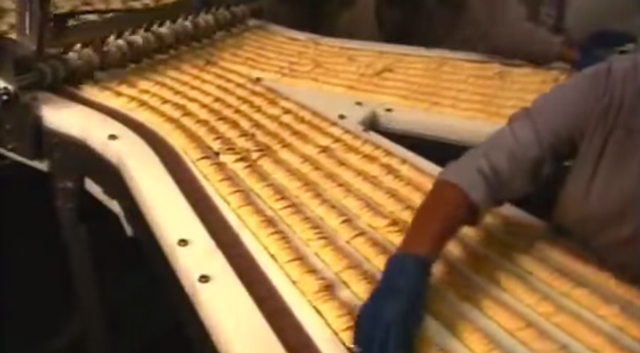
Kellanova has spent roughly four years and an estimated $4 million to $5 million developing an artificial intelligence-driven manufacturing system designed to produce a more consistent Pringle by accounting for natural variations in ingredients before defects occur. Working with Siemens, the company created a real-time digital twin of its production process at a Polish factory, where AI continuously analyzes hundreds of production variables and recommends machine adjustments to improve quality, reduce waste, and increase efficiency. Company officials report the system has improved product quality by approximately 10%, reduced waste by 13%, and generated a return on investment exceeding 40%, with expansion planned for additional European facilities and a U.S. production line by 2027. Rather than replacing human workers, the AI currently serves as a decision-support tool, illustrating how artificial intelligence is increasingly being deployed in manufacturing to enhance productivity through precision, consistency, and data-driven optimization.
Sources
- https://www.wsj.com/tech/ai/inside-the-long-ai-powered-quest-to-perfect-pringle-making-ab37a231
- https://news.bloomberglaw.com/international-trade/europe-bets-industrial-ai-can-salvage-its-manufacturing-edge
- https://www.linkedin.com/pulse/how-pringles-redefining-food-production-digital-twins-bvgjf
Key Takeaways
- AI is proving its greatest immediate commercial value not through consumer chatbots, but by improving industrial manufacturing processes, reducing waste, and increasing production consistency.
- Digital twin technology allows manufacturers to model production in real time, enabling predictive adjustments before defects occur rather than correcting problems after they emerge.
- The Pringles project demonstrates that successful AI deployment in industry is currently centered on augmenting skilled workers with actionable recommendations instead of fully automating factory decision-making.
In-Depth
Artificial intelligence’s most meaningful economic impact may ultimately come not from flashy consumer applications, but from quietly revolutionizing manufacturing. The effort to perfect the production of Pringles illustrates how AI is increasingly being used to solve practical industrial problems that directly improve efficiency and profitability. By creating a digital twin of its production line, engineers can account for hundreds of variables—from the moisture content of dough to differences in potato harvests—that were previously managed largely through operator experience and manual adjustments.
For manufacturers facing rising labor costs, tighter margins, and increased global competition, this type of investment represents a strategic use of artificial intelligence rather than technology deployed for its own sake. AI’s recommendations enable operators to make better-informed decisions while preserving human oversight, reducing the likelihood of costly production errors and unnecessary waste. Reported gains in quality and return on investment suggest that carefully targeted AI projects can generate measurable financial benefits without requiring wholesale replacement of experienced personnel.
The broader significance extends well beyond snack foods. Industrial AI offers manufacturers an opportunity to strengthen domestic production by improving productivity, increasing consistency, and extracting greater value from existing facilities. As global competition intensifies, companies that successfully integrate advanced analytics with experienced human operators are likely to enjoy meaningful advantages in cost, quality, and scalability. Rather than replacing skilled workers, projects such as this suggest that AI’s near-term role is best understood as a force multiplier—one that enhances human expertise while helping manufacturers produce higher-quality products with fewer resources.