

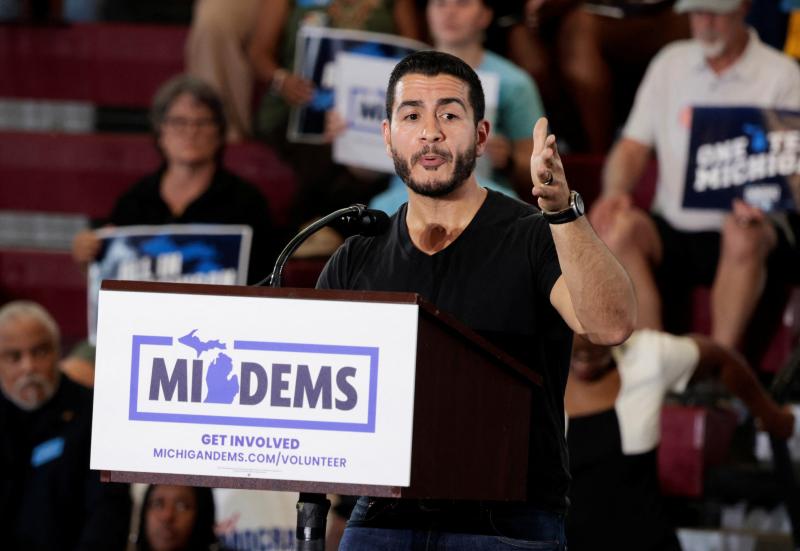
Michigan Democratic Senate nominee Abdul El-Sayed is drawing renewed scrutiny after stating he would go beyond Sen. Bernie Sanders’ proposal for public ownership of major artificial intelligence companies by advocating what he described as “some system of public control” over the industry. During a podcast interview, El-Sayed argued that AI presents existential risks that justify stronger democratic oversight, suggesting options ranging from public representation on corporate boards to independent oversight bodies. His remarks have intensified debate over the proper balance between innovation, private enterprise, and government authority as AI becomes increasingly central to the U.S. economy and national security.
Key Takeaways
- El-Sayed said he would go beyond Bernie Sanders’ proposal for public ownership of major AI companies by advocating broader forms of public control over the industry.
- Rather than explicitly calling for government seizure of AI firms, El-Sayed suggested mechanisms such as public board representation and regulatory oversight intended to place the industry under greater democratic control.
- The comments are likely to become a significant issue in Michigan’s Senate race, highlighting broader disagreements over free markets, government intervention, and how rapidly advancing AI technologies should be governed.
In-Depth
Artificial intelligence has quickly become one of the defining economic and strategic issues of the decade, making proposals for its governance politically consequential. Abdul El-Sayed’s recent comments place him among the most aggressive advocates for expanding government involvement in the industry. While acknowledging Bernie Sanders’ proposal for public ownership of major AI firms, El-Sayed argued that ownership alone is insufficient and that some form of ongoing public control is necessary to ensure democratic accountability over technologies he believes carry potentially existential risks.
From a conservative perspective, the proposal raises fundamental questions about the proper role of government in directing private enterprise. The United States has historically relied on competitive markets, private investment, and entrepreneurship to drive technological innovation. Critics argue that introducing government control over corporate governance risks politicizing research, slowing innovation, discouraging investment, and expanding federal influence into one of the nation’s fastest-growing industries. They contend that targeted regulation addressing safety, security, and competition is preferable to creating permanent structures for government participation in corporate decision-making.
Supporters of El-Sayed’s position counter that AI’s unprecedented capabilities justify stronger public oversight than previous technological revolutions received. They argue that decisions involving advanced AI systems increasingly affect employment, privacy, national security, and public safety, making democratic accountability an appropriate safeguard.
As AI becomes more deeply integrated into the economy, the debate is likely to extend well beyond Michigan’s Senate race. Policymakers from both parties generally agree that AI requires some degree of oversight, but they remain sharply divided over whether that oversight should preserve market-driven innovation or move toward a model featuring substantially greater government involvement in the industry’s operation and governance.
Sources
- https://nypost.com/2026/08/19/us-news/abdul-el-sayed-reveals-he-would-take-socialist-plan-a-step-further-than-bernie-sanders-for-key-us-industry/
- https://www.foxnews.com/politics/el-sayed-reveals-would-go-step-further-sanders-socialist-plan-major-us-industry
- https://www.newyorker.com/news/the-new-yorker-interview/abdul-el-sayeds-argument-for-america-and-against-his-own-party