

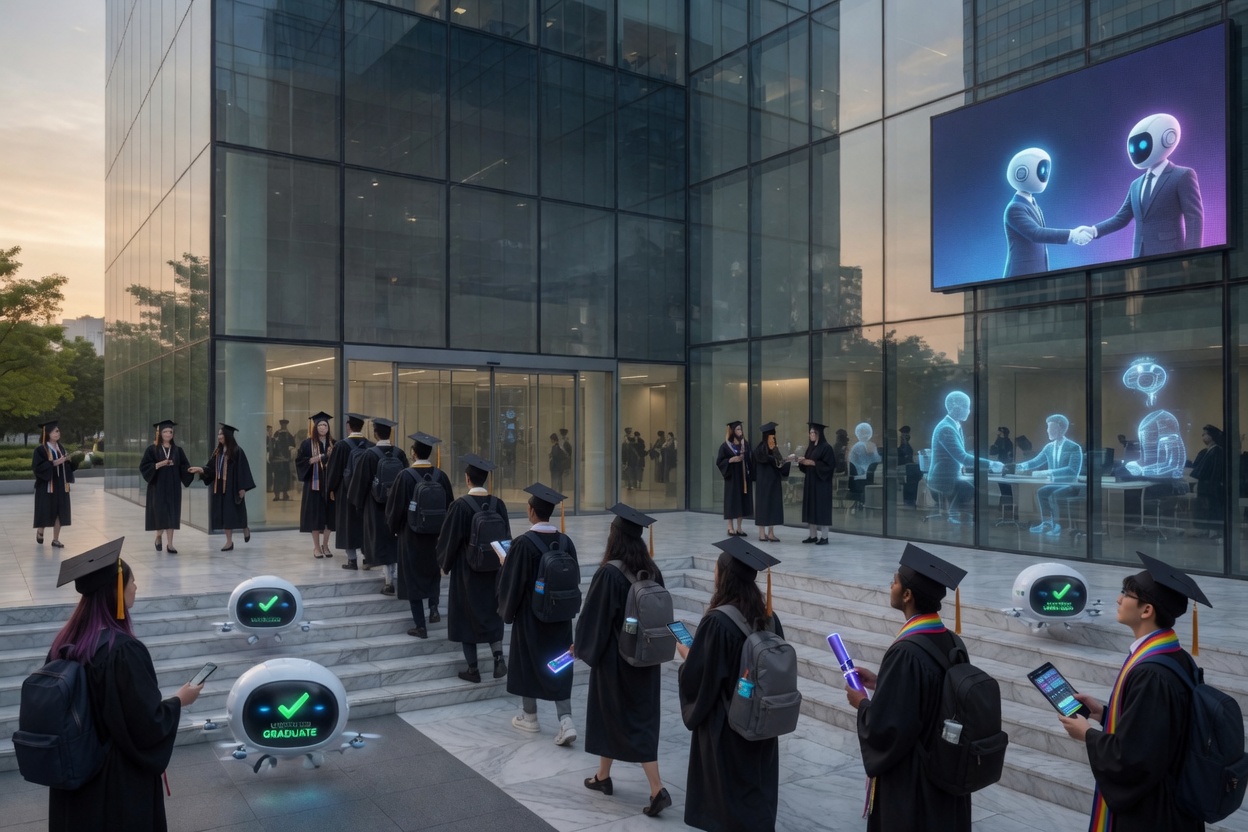
For decades, each new wave of technological change has been framed as a threat to workers, especially those just entering the job market. The rise of artificial intelligence is no different in that regard—except in scale. Yet for contemporary graduates, the AI-dominated business landscape is not simply a disruptive force; it is a field of opportunity, particularly for those prepared to engage it with discipline, adaptability, and a grounded understanding of value creation. While older professionals often face the burden of retraining and unlearning, new graduates are uniquely positioned to build their careers natively within this transformed environment.
One of the clearest advantages lies in familiarity. Today’s graduates have grown up alongside rapid technological advancement. They are not adapting to AI—they are entering the workforce already accustomed to automation, data-driven systems, and digital tools. This baseline comfort reduces friction and accelerates productivity. Where previous generations might hesitate to trust or deploy AI systems, younger professionals tend to approach them as extensions of their workflow. In practical terms, this means a graduate can leverage AI to amplify output—drafting reports, analyzing datasets, generating insights—at a speed that would have been unthinkable even a decade ago.
Another significant advantage is efficiency-driven differentiation. In a competitive job market, the ability to do more with less is highly valued. AI enables entry-level employees to punch above their weight. A recent graduate equipped with the right tools can handle tasks that once required entire teams. This doesn’t eliminate the need for human judgment; rather, it elevates the importance of it. Employers increasingly look for individuals who can guide AI outputs, refine them, and ensure they align with real-world objectives. Graduates who develop this supervisory relationship with technology—rather than a passive reliance—will distinguish themselves quickly.
There is also a structural advantage tied to timing. Businesses across industries are still figuring out how to integrate AI effectively. This creates a temporary but powerful opening for those who can step in early and shape processes. A graduate entering a firm today has the opportunity not just to follow established workflows but to help define them. That kind of early influence can accelerate career progression. Instead of waiting years to take on leadership responsibilities, a capable young professional may find themselves at the center of innovation initiatives simply because they understand the tools better than their senior counterparts.
From a conservative perspective, it’s worth noting that this shift rewards initiative and individual merit more directly than many legacy systems did. AI reduces the importance of institutional gatekeeping in certain areas. A motivated graduate with a laptop and the right skill set can produce work that competes with established firms. This levels the playing field in ways that align with free-market principles: those who create value efficiently rise, regardless of pedigree. It also encourages entrepreneurship. Lower barriers to entry mean more graduates can realistically consider starting their own ventures, using AI to manage operations, marketing, and even product development.
At the same time, the AI-driven environment places a premium on skills that cannot be easily automated. Critical thinking, ethical reasoning, communication, and domain expertise become more—not less—important. Graduates who invest in these areas will find that AI enhances rather than replaces their capabilities. For example, in fields like finance, healthcare, or law, AI can process information rapidly, but it still requires human oversight to interpret results and make decisions that carry real consequences. This dynamic creates a hybrid professional model: part technologist, part strategist.
There is also an economic angle to consider. Businesses adopting AI often experience cost savings and productivity gains. In a healthy market, those gains can translate into expansion, new hiring, and increased demand for skilled workers who understand how to operate within this new framework. Graduates entering at this stage can ride that wave of growth. They are not stepping into stagnant roles; they are entering evolving ones, where responsibilities—and compensation—can scale more rapidly.
Of course, none of this is automatic. The advantages described are contingent on effort and mindset. Graduates who treat AI as a shortcut rather than a tool risk becoming overly dependent and easily replaceable. The real opportunity lies in mastering the technology while maintaining a clear sense of purpose and accountability. That means understanding not just how to use AI, but when to question it, override it, or refine its outputs.
In the end, the narrative that AI will simply displace the next generation of workers misses a crucial point. Every technological revolution creates winners and losers, but those who enter the system at the right moment—with the right approach—often find themselves on the winning side. For contemporary graduates, the AI-dominated business world is less a threat than a proving ground. It rewards competence, initiative, and adaptability—qualities that, when paired with powerful new tools, can open doors far earlier and far wider than in previous eras.