

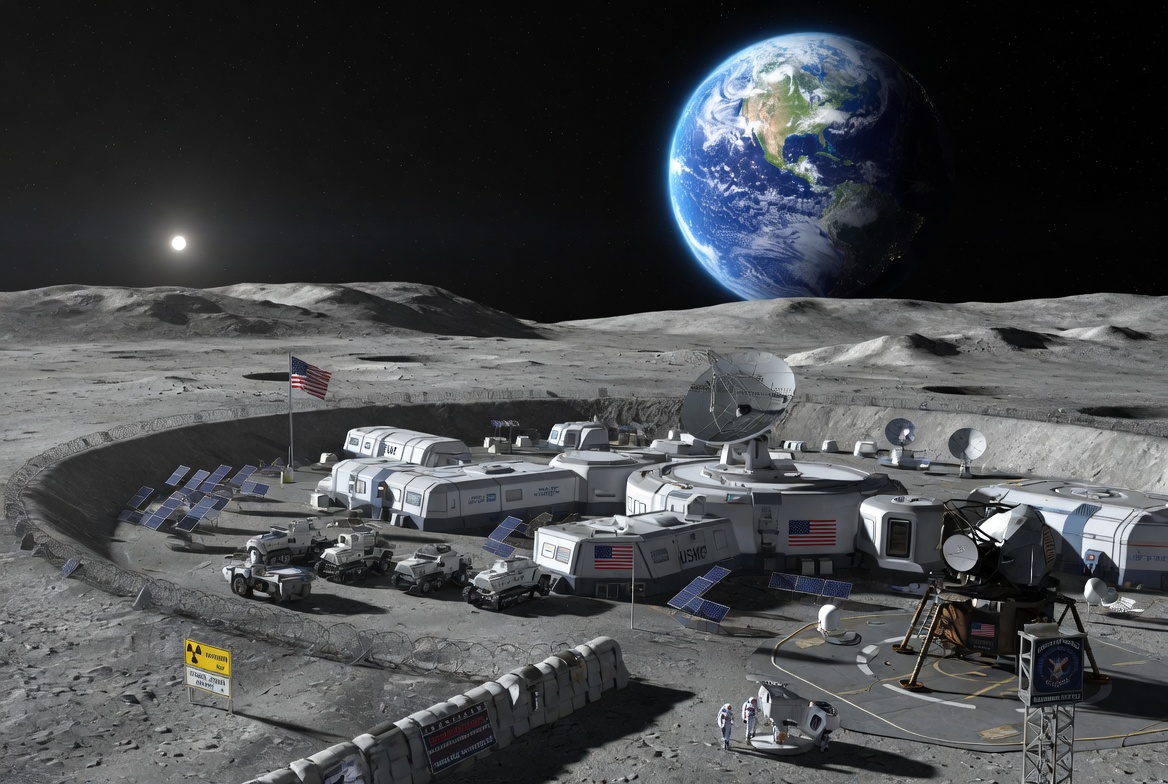
– NASA has selected eight aerospace companies, including SpaceX and Blue Origin, to compete for lunar delivery contracts under a 10-year, $10 billion program supporting a permanent American presence on the moon.
– Blue Origin secured a $94 million contract, with a possible $140 million extension, to deliver a nuclear-powered lunar rover designed to investigate potential water ice near the moon’s south pole.
– The initiative expands America’s commercial space industry through investments in lunar transportation, communications, power infrastructure and scientific exploration, with major missions targeted for 2028.
NASA has selected eight aerospace companies, including SpaceX and Blue Origin, to compete for lunar cargo delivery work under a 10-year contracting framework worth up to $10 billion. The Commercial Lunar Payload Services 2 program will support a base near the moon’s south pole. Other competitors include Firefly Aerospace, Intuitive Machines, ispace U.S., Lockheed Martin Space, Northrop Grumman Space Systems and Voyager Technologies. The $10 billion represents a contracting ceiling, not money awarded.
NASA also increased its existing lunar delivery contract ceiling from $2.6 billion to $4.2 billion and awarded $1.3 billion in separate transportation task orders. Blue Origin received a $94 million base award, with a $140 million option, to deliver the nuclear-powered PROMISE rover. Targeted for launch in late 2028, the rover will investigate lunar terrain and potential ice deposits. SpaceX was selected for a 2028 communications deployment demonstration, while additional projects will develop power and communications infrastructure.
Why It Matters
The announcement moves America’s lunar ambitions beyond occasional astronaut visits toward an enduring presence supported by commercial infrastructure. Competitive contracting could expand the aerospace industrial base, encourage innovation and reduce dependence on any single supplier. The south pole is important because potential water ice could help sustain crews and reduce the need to transport resources from Earth. Lunar communications, dependable power and cargo delivery will be essential before a permanent foothold becomes practical.
A $10 billion contracting ceiling is not a $10 billion expenditure, and eligibility to bid guarantees no company future business. Taxpayers should expect measurable milestones, transparent competition and cost controls as NASA builds out the program. Technical delays remain a concern, particularly for complex landers and transportation systems. Success would strengthen American leadership in space and potentially support missions to Mars. Failure to enforce accountability could leave ambitious infrastructure plans with substantial costs and little operational capability.
Sources
- https://nypost.com/2026/11/08/tech/nasa-unveils-10b-moon-base-contract-as-spacex-blue-origin-join-lunar-gold-rush/
- https://www.nasa.gov/news-release/nasa-awards-moon-base-transportation-technology-science-projects/
- https://nasawatch.com/2026/11/08/nasa-moon-base-contracts-landers-rover/
- https://app.govly.com/public/signals/243654