

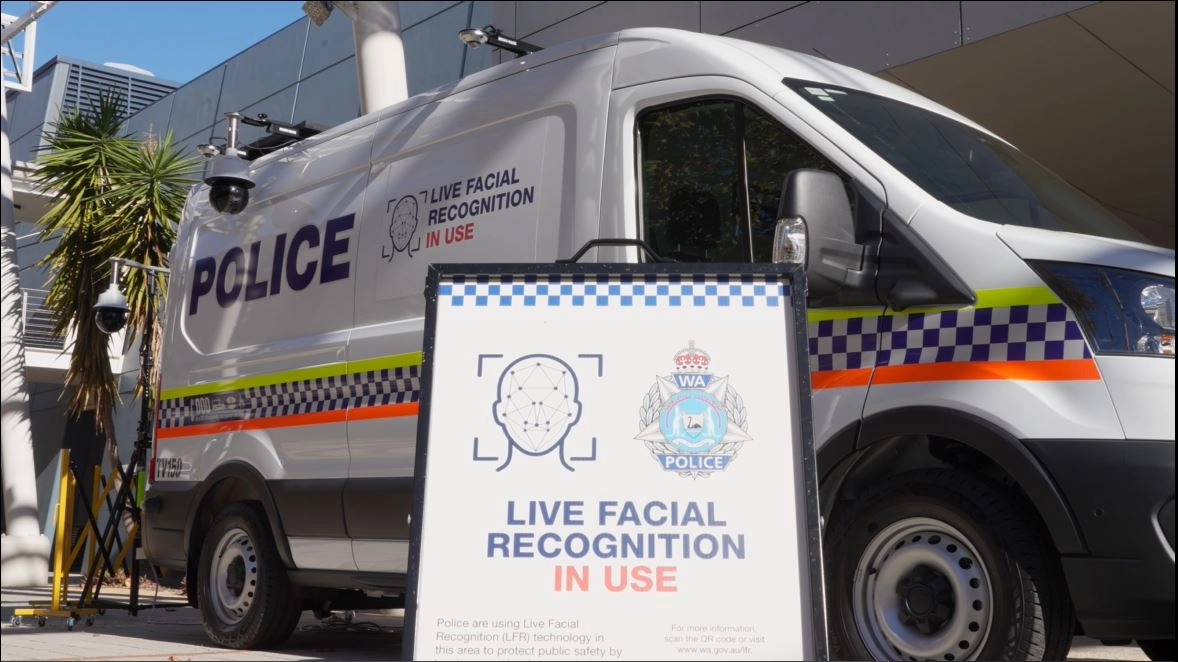
Western Australia has become the first Australian state to trial a mobile police van equipped with live facial recognition technology capable of scanning faces in public spaces and comparing them against a police watchlist in real time. Authorities say the marked vehicle will be deployed at major public events and entertainment precincts to identify wanted criminals, violent offenders, missing persons, and individuals subject to warrants. Police insist the system is not intended for indiscriminate surveillance, emphasizing that only faces matching a limited watchlist are retained while all other data is immediately discarded. Civil liberties advocates, however, warn that even if the initial deployment is narrowly tailored, the technology establishes infrastructure that could eventually normalize widespread government surveillance. The trial has reignited debate over where democracies should draw the line between legitimate public safety tools and protections against expanding state monitoring, particularly as advances in artificial intelligence make mass identification increasingly practical. Recent discussions surrounding the trial have also revived scrutiny of Australia’s previous use of facial recognition technology during COVID-19 quarantine enforcement and broader concerns regarding transparency, oversight, data retention, and mission creep.
Sources
- https://www.theepochtimes.com/world/wa-police-trials-facial-recognition-van-that-scans-every-face-nearby-6051921
- https://www.reuters.com/world/asia-pacific/australias-two-largest-states-trial-facial-recognition-software-police-pandemic-2021-09-16
- https://www.youtube.com/watch?v=pOvq-BZrnR4
Key Takeaways
- Western Australia is conducting Australia’s first trial of a police vehicle using live facial recognition technology to identify individuals on law enforcement watchlists at public events.
- Supporters argue the technology provides law enforcement with a force multiplier that can quickly locate dangerous offenders without requiring officers to manually identify suspects in large crowds.
- Critics contend that even with limited safeguards, the deployment represents another step toward normalizing government surveillance and expanding state monitoring capabilities over time.
In-Depth
For years, conservatives have argued that government should aggressively pursue criminals while remaining firmly constrained by constitutional principles and individual liberty. Western Australia’s facial recognition trial illustrates the tension between those two priorities. There is little doubt that identifying violent fugitives, dangerous repeat offenders, or missing persons more efficiently serves a legitimate public safety interest. Technology that helps police intervene before violence occurs can save lives and better protect innocent citizens.
The larger question is not whether the technology works, but whether governments possess the discipline to keep its use narrowly confined. History demonstrates that emergency powers and surveillance tools frequently expand beyond their original purpose. Australia’s earlier use of facial recognition during COVID-19 enforcement is now being cited as an example of how technologies introduced for one objective can later become available for entirely different applications.
That reality should concern advocates of limited government. Conservatives have traditionally maintained that government power, once granted, is rarely surrendered voluntarily. While today’s watchlist may contain only wanted offenders, tomorrow’s criteria depend upon future governments, future bureaucrats, and future political priorities. The debate therefore should not be framed as choosing between security and liberty, but rather determining how to preserve both through rigorous statutory limits, independent oversight, transparent auditing, strict data deletion requirements, and meaningful penalties for misuse. Strong policing and strong civil liberties need not be mutually exclusive, but maintaining that balance requires constant vigilance before extraordinary surveillance quietly becomes ordinary.