

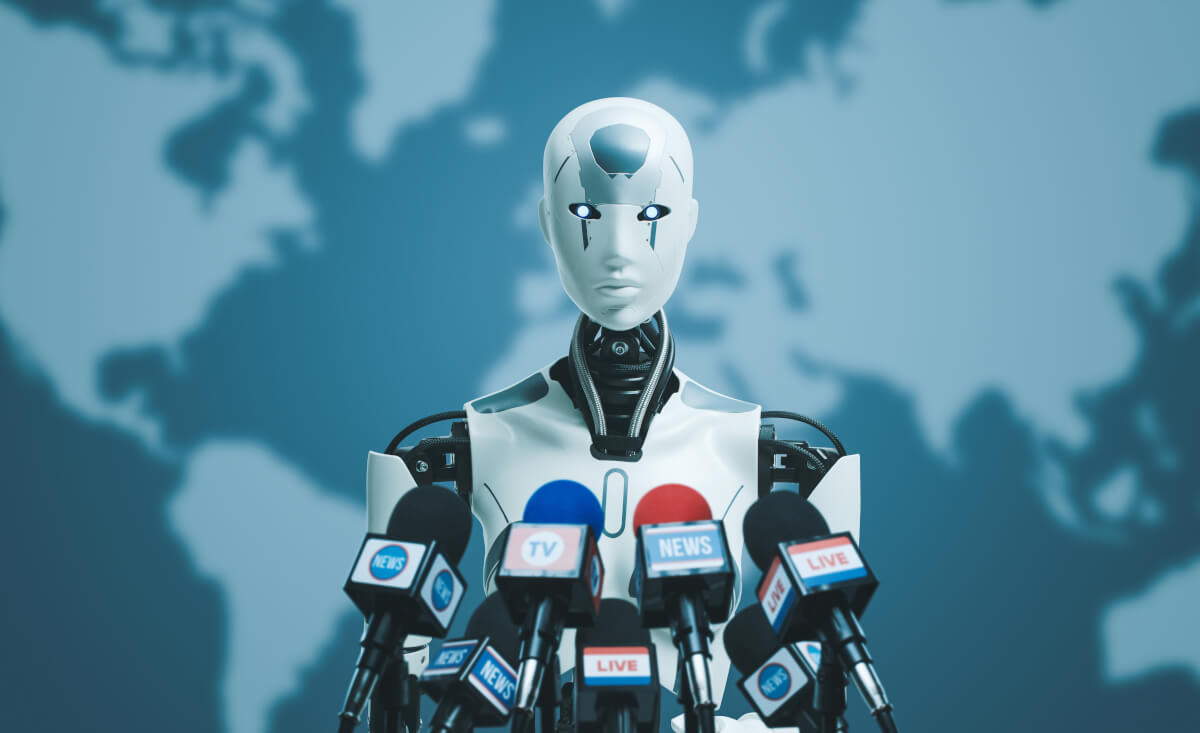
Propaganda is nearly as old as warfare itself. Kings exaggerated victories, empires portrayed enemies as barbarians, governments printed posters designed to stir patriotism, and twentieth-century regimes mastered radio, film, and television as instruments of mass persuasion. Every generation has discovered new ways to influence what its citizens believe during times of conflict.
Artificial intelligence changes the equation.
The danger is not simply that governments will use AI to produce more propaganda. Governments already possess enormous communications operations. The deeper danger is that AI could make propaganda instantaneous, personalized, inexpensive, convincing, and nearly impossible to distinguish from authentic information.
In previous wars, propaganda had production bottlenecks. Someone had to write the leaflet, record the broadcast, edit the film, print the newspaper, or prepare the television segment. Even sophisticated disinformation campaigns required substantial manpower.
AI can eliminate much of that friction.
A government equipped with advanced generative systems could potentially produce thousands of articles, photographs, videos, social-media posts, podcasts, and fabricated eyewitness accounts in minutes. The same system could translate those messages into dozens of languages and continuously modify them according to public reaction.
More troubling, propaganda would no longer have to be designed for populations. It could increasingly be designed for individuals.
Imagine a war in which an AI system analyzes the online behavior of millions of citizens. It identifies which people are frightened by economic instability, which distrust military leadership, which are motivated by patriotism, and which are emotionally affected by images of civilian casualties. The system could then construct different messages for each audience—or eventually each person.
One citizen might receive fabricated footage supposedly showing an enemy atrocity. Another might encounter an apparently independent economic analysis arguing that surrender is inevitable. A soldier’s family could see false reports suggesting that the soldier’s unit has been destroyed. Military personnel themselves could receive convincing deepfake messages appearing to come from commanders.
This is propaganda transformed from mass communication into psychological precision targeting.
The threat becomes even greater when synthetic media reaches the point where ordinary citizens cannot reliably determine whether something is authentic.
A fabricated video of a president announcing mobilization could trigger panic. A synthetic recording of a general ordering retreat could create battlefield confusion. Artificial photographs of atrocities could provoke demands for retaliation before investigators determine whether the event ever occurred.
The critical weapon in such circumstances is not the false image itself. It is speed.
A lie that circulates for six hours before being disproven may accomplish its objective in six minutes.
Democratic societies face a particularly difficult problem because their governments must defend against foreign information warfare without adopting the methods of authoritarian states. That distinction matters.
During wartime, governments understandably protect military secrets and attempt to maintain public confidence. But those legitimate responsibilities can easily become excuses for information control. If officials acquire powerful AI systems capable of shaping public opinion, the temptation to redefine criticism as disinformation may become considerable.
That should concern conservatives in particular because limited government means little if government possesses unlimited power to manipulate perception.
The First Amendment was written in an era of printing presses, pamphlets, and tavern debates. Its principle becomes more important—not less—when technology gives institutions unprecedented ability to manufacture persuasive content.
Government propaganda also creates another danger: destroying confidence in government itself.
Once citizens know that realistic audio, photographs, and videos can be artificially generated, authentic evidence becomes easier to dismiss. A politician caught making an embarrassing statement can claim the recording was synthetic. Governments confronted with genuine evidence of misconduct can characterize it as foreign disinformation.
This phenomenon has sometimes been called the “liar’s dividend”: the existence of convincing fakes makes genuine evidence easier to deny.
Eventually society risks entering an epistemological battlefield where nobody knows what to believe.
The proper response cannot be government censorship. Giving the state authority to determine which political information is true would create precisely the concentration of power that makes AI propaganda dangerous.
Instead, democratic governments should emphasize authentication rather than information control. Official military communications should carry strong cryptographic verification. News organizations should maintain rigorous provenance standards. Technology companies should develop reliable methods for identifying synthetic media while remaining transparent about the limitations of those systems. Congress should insist on clear rules governing domestic government use of generative AI for persuasion.
Most importantly, Americans must preserve a culture in which skepticism toward government claims is not confused with disloyalty.
A free society does not require citizens to believe everything their government says during wartime. It requires citizens capable of evaluating evidence, questioning authority, and ultimately deciding for themselves.
AI may become one of the most powerful instruments of persuasion ever invented. In enemy hands, it can destabilize nations. In government hands, it can quietly weaken the distinction between informing citizens and manipulating them.
The greatest danger may therefore arrive without censorship orders, burning books, or government agents knocking on doors.
It may simply arrive on a screen, perfectly tailored to the person viewing it, telling them exactly what someone in power wants them to believe.