

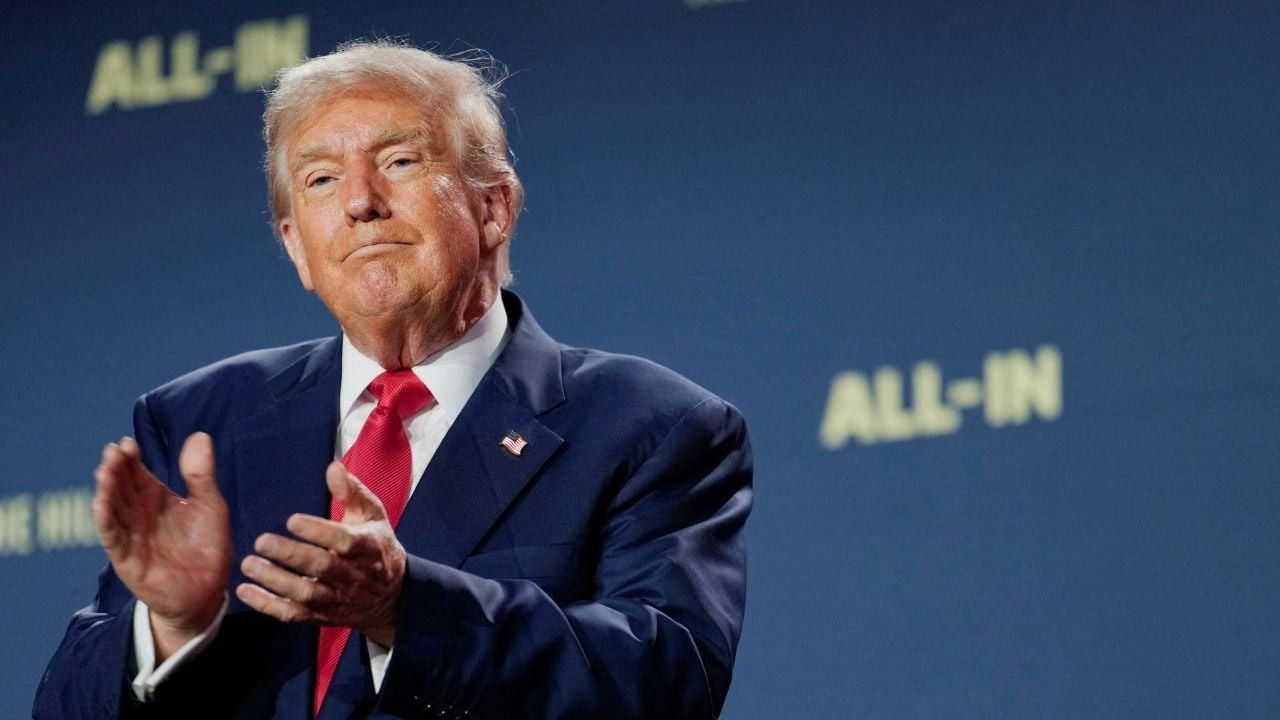
A technology company called Statt has used advanced AI speechwriting tools along with analysis of former addresses, social media, and policy content to generate a full, nearly 5,000-word prediction of what President Donald Trump is likely to say in his upcoming 2026 State of the Union Address, forecasting themes like declaring a “Golden Age” for America and touching on the economy, trade, border security, and health care while also including expected stylistic elements and off-the-cuff critiques of political opponents. Semafor reports that the goal of this generative exercise is not exact word-for-word replication but to capture the main agenda items and tone Trump might employ, illustrating both the current capabilities and the limitations of AI in anticipating political rhetoric. Meanwhile, the official 2026 State of the Union is set for February 24, 2026, when Trump will address Congress in Washington, D.C. Sources outside this report show that AI-generated political texts can differ in linguistic structure from actual speeches and that prediction markets likewise offer odds on what terms and topics presidents will emphasize, highlighting broader interest in forecasting political content and outcomes.
Sources
https://www.semafor.com/article/02/20/2026/can-ai-predict-trumps-state-of-the-union-address
https://statt.com/blog/remarks-by-president-trump-in-state-of-the-union-address
https://en.wikipedia.org/wiki/2026_State_of_the_Union_Address
Key Takeaways
• AI tools are now being used to generate full predictive drafts of major political speeches, drawing on past data and public signals.
• Statt’s AI-generated prediction emphasizes broad themes and the expected tone of Trump’s 2026 State of the Union, but generative models are not yet precise enough to capture all nuances of live presidential rhetoric.
• The official 2026 State of the Union by President Trump is scheduled for February 24, 2026, underscoring why such predictive exercises attract attention ahead of major events.
In-Depth
Artificial intelligence continues to push bounds not just in technology development but in how it intersects with politics and public discourse. A recent example of this is the predictive exercise undertaken by a startup called Statt, which built a nearly complete version of what it anticipates will be President Donald Trump’s 2026 State of the Union Address. Rather than being a decontextualized academic endeavor, this AI-generated draft integrates multiple inputs — historical addresses, Trump’s own social media posts, think tank analyses, and other relevant policy documents — to craft a speech that mirrors the style and substance observers expect from a sitting president. The result, according to reporting, is a script that covers familiar ground for Trump: robust claims about American prosperity, border security, economic achievements, trade priorities, health care reforms, and pointed criticism of political opponents, with stylistic flourishes that seek to echo Trump’s rhetorical cadence.
The exercise serves two purposes. First, it demonstrates the growing sophistication of AI tools in digesting large amounts of political and public information and synthesizing coherent, extended pieces of text that align with recognizable patterns of speech. For policymakers, analysts, and communications professionals, these tools offer a glimpse of how AI can assist in drafting and preparation, even if the outputs are not perfect replicas of human creativity or improvisation. Secondly, efforts like Statt’s prompt discussion about the reliability and interpretation of AI-generated political forecasts. Predictive models can capture patterns and themes, but they cannot read the room or know unspoken intentions, and they are constrained by the data they are trained on and the parameters set by their developers. Indeed, observers note that AI cannot yet “know us better than ourselves,” especially when it comes to the unpredictable elements of live political performance and nonverbal cues.
It is worth noting that the predicted speech is not the official address; the actual State of the Union has been scheduled for February 24, 2026, when Trump will formally deliver his message to Congress and the nation from the House Chamber in Washington, D.C. The interest in AI-generated predictions ahead of this event reflects broader trends in both political forecasting and the incorporation of technology into civic life. In parallel, prediction markets and analytical models have long offered odds on what presidents might say or emphasize, underscoring both the predictive appetite of audiences and the role of data in shaping expectations about political communication. As AI’s capabilities evolve, its application in politics will likely grow, prompting ongoing debate over the usefulness, accuracy, and ethical implications of using machine learning to anticipate or even influence democratic speechmaking. In any case, the exercise by Statt and its coverage by outlets like Semafor highlight a moment in which technology, politics, and public imagination converge around one of the defining rituals of American governance.