

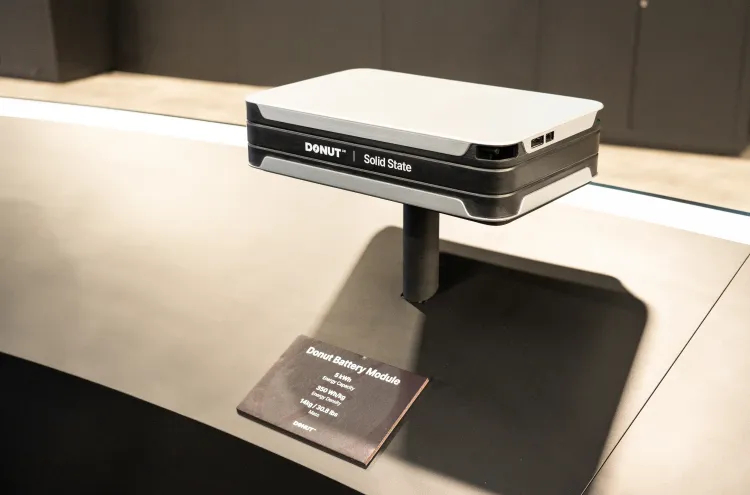
Finnish startup Donut Lab’s much-hyped solid-state battery, which claims 400 Wh/kg energy density, up to 100,000 charge-discharge cycles and full charging in under ten minutes, has delivered its first independent performance results showing blisteringly fast charge speeds in early testing by VTT, charging from 0-80 percent in as little as about 4.5 minutes or around 9.5 minutes in more conservative trials, while retaining near-full capacity, though skepticism remains about whether the underlying technology is truly a next-generation solid-state cell or something else entirely, and many in the battery industry are questioning the physics behind Donut Lab’s specs and the lack of published chemistry, patents, or detailed third-party validation. turn0view0, turn0search16, turn0search7
Sources
https://www.theverge.com/transportation/882993/donut-labs-solid-state-battery-charge-speed-vtt-test
https://hackaday.com/2026/02/08/investigating-the-science-claims-behind-the-donut-solid-state-battery
https://www.batterytechonline.com/battery-news/video-experts-call-donut-labs-solid-state-battery-claims-fake
Key Takeaways
• First independent testing by VTT Technical Research Centre of Finland shows Donut Lab’s solid-state battery can charge from 0 to 80 percent in under 10 minutes with high retained capacity according to early results.
• Donut Lab asserts extremely advanced performance metrics (fast charging, high density, long life, wide temperature range) but has not publicly detailed the battery’s chemistry, manufacturing, or third-party validation.
• Many battery experts and industry critics remain highly skeptical, calling the claims unrealistic or potentially misrepresented until more evidence and independent verification are provided.
In-Depth
Donut Lab’s announcement of what it calls the first production-ready solid-state battery has captivated the EV and energy storage communities with promises that, if real, would mark a massive leap forward for electrification. Early test results released by the VTT Technical Research Centre of Finland indicate that Donut Lab’s battery can charge significantly faster than conventional lithium-ion cells. In tests designed to assess thermal behavior and charging performance, the pack reportedly reached 80 percent state of charge in roughly 4.5 minutes under some conditions and about 9.5 minutes in others, all while maintaining nearly all of its energy storage potential after each cycle. These results have been touted as evidence that solid-state technology — long regarded as the “holy grail” of battery breakthroughs — might finally be moving out of the lab and into real-world use sooner than expected. turn0view0
At the same time, the technical community is divided on what these results truly mean. Donut Lab’s broader claims include 400 watt-hours per kilogram energy density, a design life approaching 100,000 charge-discharge cycles, and robust performance across extreme temperatures. But the company has not disclosed essential details about the internal chemistry, manufacturing methods, or peer-reviewed data that underpin these figures. The absence of published patents and detailed third-party analysis has left experts questioning whether the battery is actually a solid-state cell in the traditional sense or perhaps another device — such as a capacitor-like system — that behaves differently than conventional cells. Some critics argue that the specifications Donut Lab cites are so far beyond current battery physics that they stretch credulity without further verification. turn0search16 turn0search7
Moreover, voices within the battery development community have openly challenged the legitimacy of the technology. Independent analysts and commentators have labeled Donut Lab’s narrative as potentially misleading and emphasized that transformation of battery charging infrastructure and chemistry typically takes years of rigorous testing and verification before industry adoption. The fact that fundamental technical questions remain unanswered — including how the company avoids typical solid-state battery failure modes or produces the material at scale — means that the industry at large is watching closely but remains cautious. Until additional independent tests, published data, and transparent evaluation are made available, the true impact and authenticity of Donut Lab’s fast-charging claims will remain hotly debated even as early tests hint at impressive performance.