

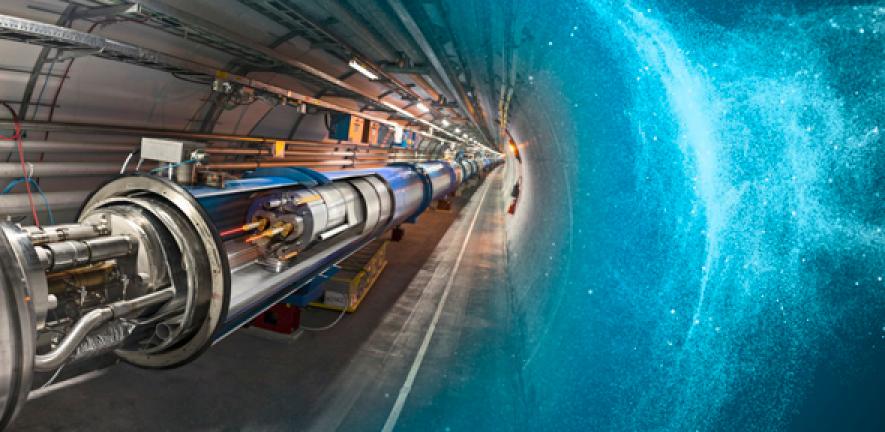
The Large Hadron Collider is heading into its third long shutdown as engineers and scientists prepare a sweeping series of upgrades designed to transform it into the High-Luminosity Large Hadron Collider, a more powerful machine capable of generating significantly more particle collisions and data than ever before. After years of operation that confirmed the existence of the Higgs boson and deepened understanding of fundamental physics, the collider will now undergo extensive improvements to its magnets, detectors, and supporting infrastructure. The goal is to dramatically increase luminosity—effectively multiplying the number of collisions—so researchers can probe rare particle interactions that were previously out of reach. The shutdown, expected to last several years, represents both a technical overhaul and a strategic investment in Europe’s flagship physics laboratory, ensuring it remains at the forefront of high-energy research while nations such as China and the United States pursue their own ambitious collider projects.
Sources
https://www.theverge.com/science/883179/the-large-hadron-collider-is-going-into-a-third-shutdown-period-to-get-an-upgrade
https://home.cern/news/news/accelerators/long-shutdown-3-getting-ready-high-luminosity-lhc
https://www.scientificamerican.com/article/the-large-hadron-collider-prepares-for-its-next-phase/
Key Takeaways
- The collider’s third long shutdown is focused on converting it into the High-Luminosity Large Hadron Collider, dramatically increasing collision rates and data output.
- Upgrades include new superconducting magnets, detector improvements, and infrastructure enhancements to support higher energy precision and data collection.
- The overhaul is intended to keep Europe competitive in particle physics as other global powers invest heavily in next-generation accelerator projects.
In-Depth
The third long shutdown of the Large Hadron Collider marks a pivotal moment for modern physics. Rather than a pause born of failure, this is a calculated recalibration—an engineering reset designed to unlock far greater scientific returns. The transition to the High-Luminosity Large Hadron Collider will increase the machine’s luminosity by a factor of five to seven, allowing researchers to observe rare processes that simply vanish in smaller datasets. In high-energy physics, more collisions mean more chances to spot the subtle signatures of new phenomena.
Engineers are installing powerful new superconducting magnets to better focus particle beams, along with upgraded detectors capable of handling higher radiation levels and more intense data streams. These are not cosmetic improvements; they are structural enhancements that extend the collider’s scientific lifespan well into the 2030s.
The stakes are geopolitical as well as scientific. With China advancing proposals for a new circular collider and American laboratories exploring future accelerator concepts, Europe’s commitment to strengthening its flagship facility sends a clear message: it intends to remain a leader in foundational research. In an era when scientific ambition increasingly intersects with national prestige and economic competitiveness, the High-Luminosity LHC represents both intellectual curiosity and strategic foresight.