

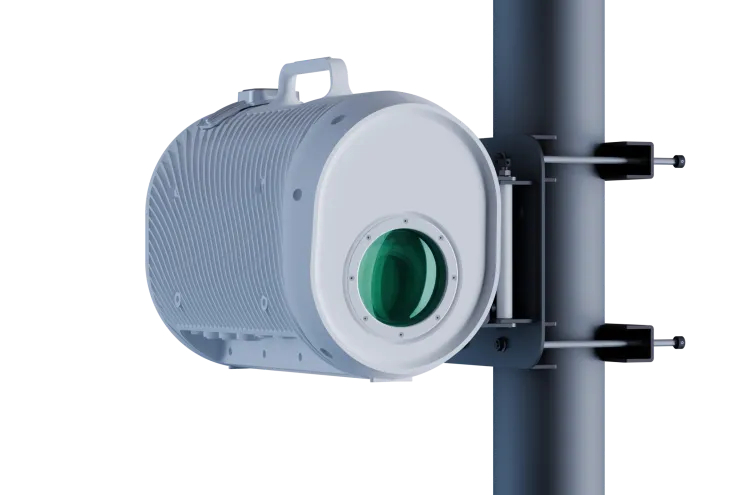
Taara, an Alphabet-originated spinoff now operating independently, officially launched Taara Beam, a compact connectivity device that uses invisible near-infrared light beams to deliver up to 25 Gbps of high-speed, low-latency data across urban areas of up to 10 kilometers with direct line of sight, positioning the technology as an alternative to traditional fiber deployment where infrastructure costs and delays are prohibitive and directly competing with incumbent middle-mile connectivity providers for enterprise and telco network builds.
Sources
https://www.theverge.com/tech/881882/taara-beam-provides-25gbps-connectivity-over-invisible-beams-of-light
https://www.taaraconnect.com/post/introducing-taara-photonics-and-beam
https://www.eejournal.com/industry_news/taara-unveils-photonics-platform-for-wireless-communication-and-taara-beam-latest-product-in-taaras-portfolio-and-first-on-the-new-photonic-core
Key Takeaways
• Taara Beam delivers multi-gigabit connectivity (up to 25 Gbps) via invisible light across line-of-sight links up to 10 km without trenching fiber or waiting for spectrum licensing.
• The product targets enterprise and telco “middle-mile” infrastructure, enabling rapid deployment on poles and rooftops that rivals fiber speeds and vastly outpaces most satellite services in latency.
• Taara Beam is the first commercial product built on the broader Taara Photonics platform, signaling a strategic shift toward scalable optical wireless infrastructure for dense urban networks.
In-Depth
Taara Beam’s emergence represents a noteworthy shift in how high-speed network connectivity could be delivered in built-up environments where pulling fiber remains expensive, time-consuming, and frequently delayed by permitting, right-of-way, and civil engineering hurdles. The core of the technology is the use of narrow, invisible beams of near-infrared light to carry data wirelessly between nodes positioned on street poles, rooftops, or urban infrastructure. Unlike traditional wireless systems that rely on radio spectrum or fiber infrastructure buried underground, Taara’s optical link transmits data through the air with minimal interference, resulting in throughput that can rival fiber and latency that’s staggeringly low compared with satellite-based and many radio-based systems.
The launch announcement emphasized deployment speed and flexibility: devices can be installed in hours rather than weeks or months, reducing the drag that conventional construction and licensing put on network expansion. Taara Beam weighs about 8 kilograms, draws roughly 90 watts of power, and provides a dense connectivity backbone suited for enterprise campuses, data centers, urban distribution hubs, and service providers looking to upgrade or augment existing networks. In conservative terms, the product tackles a real market pain point: the rising costs of deploying fiber in dense metropolitan zones where street work is disruptive and costly, and where legacy service providers have maintained pricing power partly because alternatives have been slow to materialize.
Strategically, Taara Beam differentiates itself from both legacy fiber and emerging space-based broadband by delivering a middle ground where ultra-high bandwidth and low latency co-exist without the infrastructure burdens of either extreme. For telcos and carriers facing competitive pressure and rising customer expectations, the ability to stitch together citywide, high-capacity links with relative ease could prove decisive in retaining enterprise accounts and in building next-generation services. This comes at a time when demands for real-time connectivity — from autonomous vehicles to industrial IoT and edge compute environments — are outpacing what many traditional infrastructures were designed to support.
The launch also underscores a broader industry pivot toward photonic and free-space optical technologies that leverage light rather than radio waves or cables, suggesting that the telecommunications landscape may be poised for a more pronounced evolution. If Taara Beam and its underlying photonics platform prove cost-competitive and robust in real-world deployments, it could reshape expectations about how and where high-speed networks can be deployed, reducing barriers to entry for new competitors and accelerating connectivity upgrades in markets that have lagged in fiber investment. This approach marries the proven speed of optical data transmission with the deployment agility of wireless infrastructure — a combination that might make traditional fiber trenches look like an engineering relic in certain urban contexts.