

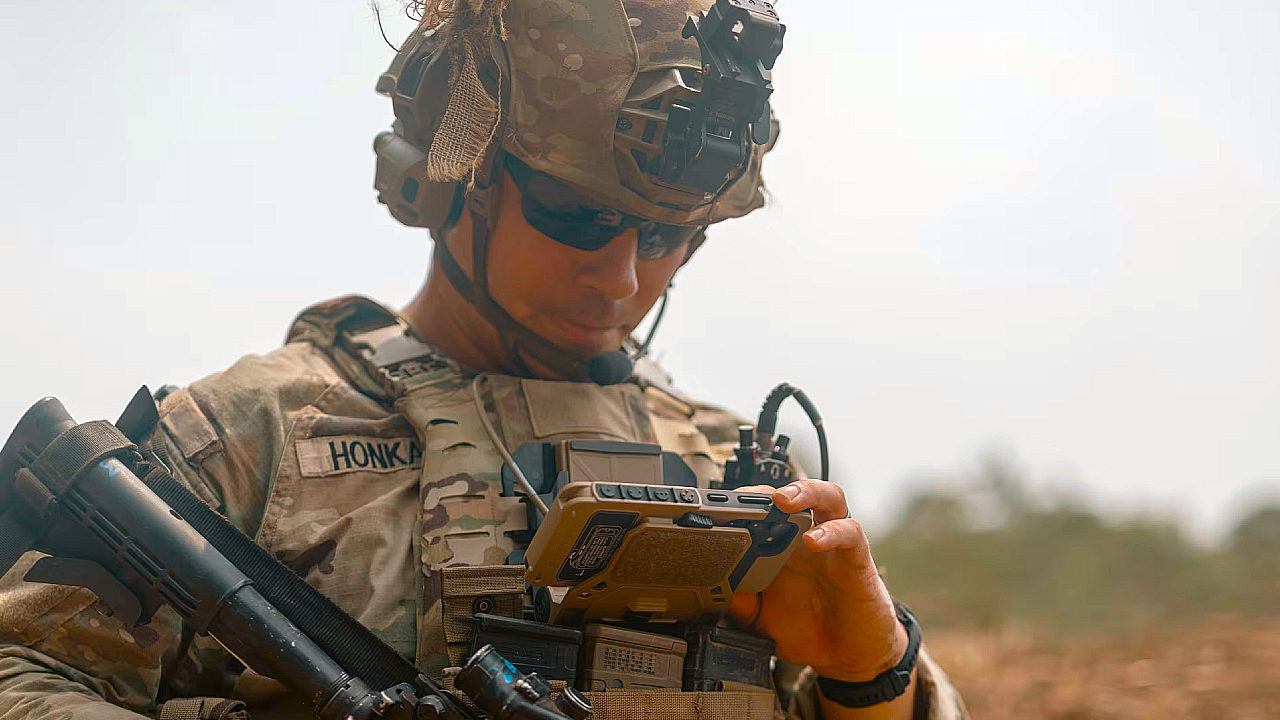
The U.S. Army is rapidly transforming the smartphone from a civilian convenience into a critical battlefield tool, testing networked handheld devices, tactical radios, drones, and cloud-based systems that allow soldiers to track friendly forces, communicate digitally, coordinate operations, and make faster decisions. Recent exercises in Indonesia demonstrated the promise of the Army’s Next Generation Command and Control system, which seeks to replace cumbersome, easily targeted command infrastructure with smaller, mobile networks connecting troops across dispersed battlefields. The technology could dramatically improve situational awareness, casualty evacuation and targeting, but exercises have also exposed serious weaknesses, including overheating devices, inaccurate information and communications failures at crucial moments. The challenge for the Army is therefore not simply adopting commercial technology quickly, but ensuring American soldiers retain the ability to operate when sophisticated adversaries jam, disrupt or destroy the digital networks upon which modern warfare increasingly depends.
Key Takeaways
- Smartphones and commercial end-user devices are becoming integral components of Army command-and-control systems, giving soldiers real-time positioning, mapping, communications and battlefield information directly at the tactical level.
- The Army’s modernization strategy emphasizes dispersed, mobile command networks that could make U.S. forces faster and less vulnerable than formations dependent upon large, centralized command posts.
- Battlefield digitization carries substantial risks: devices can malfunction, networks can be jammed or attacked, electronic emissions can expose troop locations, and soldiers must remain capable of fighting when technology fails.
In-Depth
The Army’s push toward smartphone-centered warfare reflects a hard lesson from Ukraine: speed, dispersion and information increasingly decide who survives and who wins. Under its Next Generation Command and Control effort, soldiers are being equipped with handheld devices, tactical radios, drones and software that can display friendly positions, share intelligence and accelerate decisions that once moved through slower command channels.
The concept is compelling. A platoon leader carrying a ruggedized smartphone can see where troops are located, exchange battlefield data and potentially coordinate fires, evacuation and reconnaissance without depending on a large command post. Army systems already use commercial end-user devices with tactical radios and Tactical Assault Kit software, while newer experiments are attempting to connect information into a common digital architecture. That could make American formations faster and harder for an enemy to locate and destroy.
But technology creates vulnerabilities alongside advantages. During an Indonesian exercise, a communications failure struck at a critical moment, forcing soldiers to relay messages manually. Devices can overheat, networks can fail, batteries die and digital information can be inaccurate. Against a sophisticated adversary, jamming, cyberattack and electronic detection would add even greater pressure.
The Army therefore cannot treat smartphones as replacements for basic soldiering, radio discipline or decentralized leadership. Modernization is necessary, as competitors expand electronic and drone warfare capabilities worldwide. But the winning force will not simply possess the most connected devices. It will be the force capable of exploiting digital tools while continuing to fight effectively when those tools suddenly disappear.
Sources
- https://www.wsj.com/politics/national-security/the-latest-battlefield-essential-for-u-s-soldiers-smartphones-ad143d97
- https://cpeground.army.mil/Equipment/Equipment-Portfolio/PM-SWAR-Portfolio/Nett-Warrior/
- https://tak.gov/solutions/military
- https://www.army.mil/article/290448/4id_successfully_tests_new_technology_to_triage_and_evacuate_soldiers_in_simulated_lsco_environment
- https://tak.gov/