

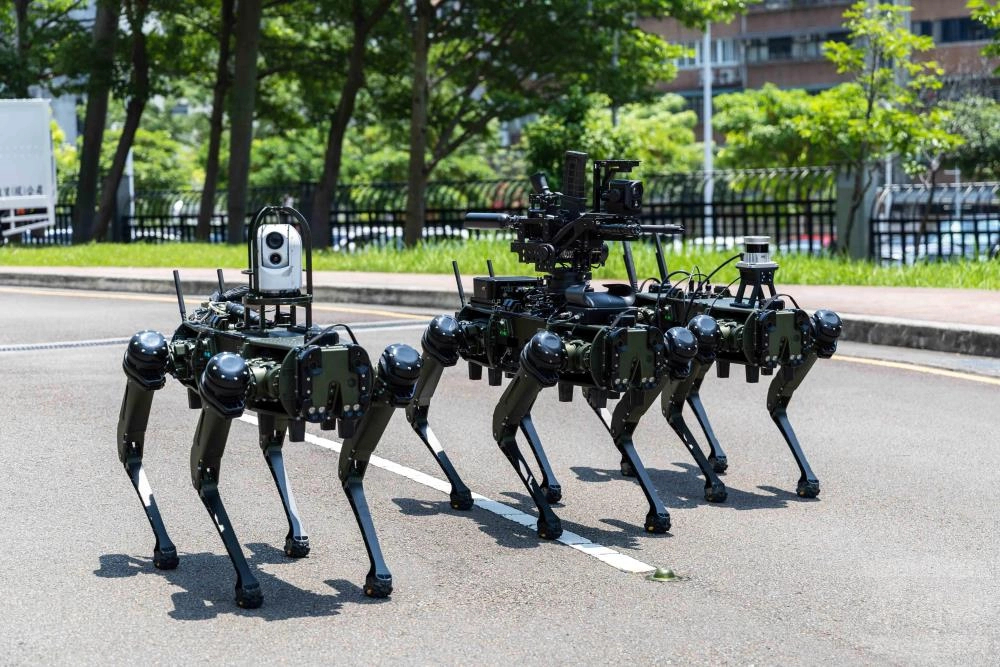
Taiwan’s military research establishment has publicly showcased three quadrupedal robotic systems built on an American-made platform, highlighting the island’s continued effort to strengthen its defense capabilities through advanced technology, artificial intelligence, and unmanned systems. Developed by Taiwan’s National Chung-Shan Institute of Science and Technology using the Ghost Robotics Vision 60 platform from the United States, the robot dogs were demonstrated in reconnaissance, surveillance, and armed configurations. Taiwanese officials emphasized the importance of developing “non-red” supply chains that reduce dependence on Chinese components while expanding domestic defense manufacturing. The demonstration reflects Taiwan’s broader shift toward asymmetric warfare capabilities designed to deter aggression from Communist China through lower-cost, highly mobile, and technologically sophisticated systems.
Sources
- https://www.theepochtimes.com/china/taiwan-military-lab-showcases-robot-dogs-built-on-us-platform-6042183
- https://www.reuters.com/world/china/robot-patrol-dogs-could-be-coming-taiwans-south-china-sea-islands-2026-06-02
- https://www.digitimes.com/news/a20260603PD233/robot-taiwan-military-technology-supply-chain.html
- https://www.viory.video/en/videos/a3026_02062026
Key Takeaways
- Taiwan is accelerating its adoption of unmanned and AI-enabled military systems to offset China’s overwhelming numerical advantages in conventional military assets.
- The robot dogs are built on a proven U.S. platform but incorporate Taiwan-developed sensors, reconnaissance equipment, and weapons integration, strengthening defense cooperation between Taipei and Washington.
- Taiwan’s emphasis on “non-red” supply chains underscores growing concern about reliance on Chinese technology and reflects a broader effort to secure critical defense manufacturing capabilities.
In-Depth
Taiwan’s unveiling of robotic military dogs represents far more than a technological demonstration. It is another visible sign that the island is adapting its defense posture to confront the growing threat posed by the Chinese Communist regime. Rather than attempting to match Beijing tank-for-tank or ship-for-ship, Taiwan is investing in asymmetric capabilities that can complicate an invasion and increase the cost of military aggression.
The systems demonstrated by Taiwan’s National Chung-Shan Institute of Science and Technology are based on the American-made Ghost Robotics Vision 60 platform and have been adapted for reconnaissance, surveillance, and even armed missions. The ability to deploy robotic systems into dangerous environments reduces risk to personnel while expanding battlefield awareness. Such capabilities are particularly valuable for island defense, coastal patrols, and operations in remote outposts across the South China Sea.
Equally significant is Taiwan’s stated goal of building supply chains independent of mainland China. For years, democratic nations have learned the strategic risks associated with dependence on Chinese manufacturing. By integrating domestic technologies into U.S.-sourced platforms, Taiwan is pursuing greater self-sufficiency while deepening security ties with Washington.
The robot dog program illustrates a broader reality: future conflicts will increasingly be shaped by autonomous systems, artificial intelligence, and unmanned platforms. Taiwan appears determined to ensure it is not merely a consumer of those technologies but an active participant in their development and deployment. In the face of mounting pressure from Beijing, that approach may prove essential to maintaining deterrence and preserving Taiwan’s security.