

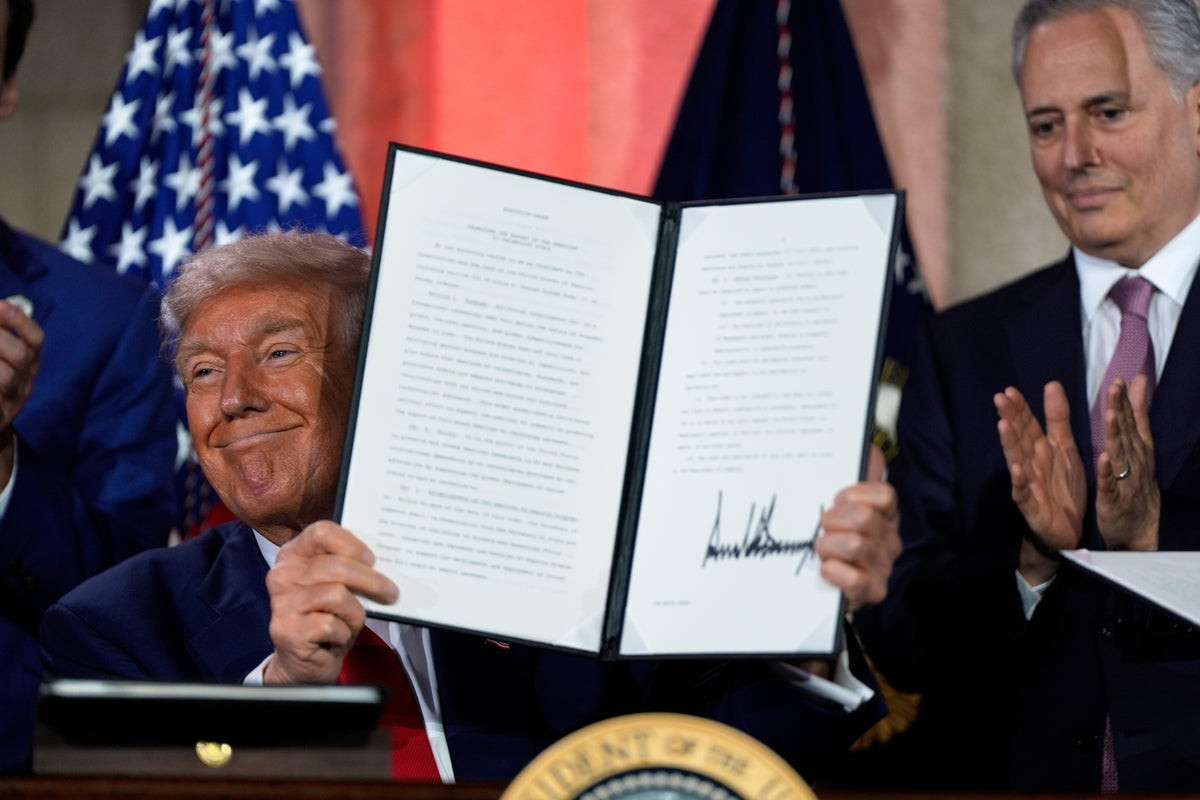
President Donald Trump has signed a new executive order focused on artificial intelligence and cybersecurity, establishing a voluntary framework that encourages leading AI developers to provide the federal government with early access to advanced AI models before public release. The order seeks to strengthen America’s cyber defenses, protect critical infrastructure, and ensure that rapidly advancing AI technologies are not exploited by foreign adversaries or cybercriminals. While maintaining a pro-innovation stance and avoiding mandatory licensing requirements, the administration is directing federal agencies to expand AI-driven cybersecurity capabilities, create an AI cybersecurity clearinghouse, and coordinate with private-sector developers to identify vulnerabilities before they can be weaponized. The move reflects growing concerns that increasingly powerful AI systems could be used both to defend and attack critical networks, placing national security at the center of the AI policy debate.
Sources
- https://www.whitehouse.gov/presidential-actions/2026/06/promoting-advanced-artificial-intelligence-innovation-and-security
- https://www.reuters.com/world/trump-signed-order-promote-advanced-ai-innovation-security-white-house-says-2026-06-02
- https://federalnewsnetwork.com/cybersecurity/2026/06/ai-executive-order-sets-stage-for-new-cybersecurity-directives/
- https://www.tomshardware.com/tech-industry/artificial-intelligence/trump-signs-ai-executive-order-seeking-30-day-government-access-to-frontier-models-before-release
- https://www.axios.com/2026/06/02/trump-signs-new-ai-executive-order
Key Takeaways
- The executive order prioritizes protecting critical infrastructure and federal networks from AI-enabled cyber threats while maintaining America’s technological edge against China.
- AI developers are encouraged, but not required, to provide advanced models to the government for cybersecurity evaluation before public deployment, avoiding a burdensome regulatory regime.
- Federal agencies will expand AI-focused cyber defense programs, including the creation of an AI cybersecurity clearinghouse designed to identify and mitigate vulnerabilities before hostile actors can exploit them.
In-Depth
For years, Washington has struggled to strike the right balance between technological innovation and national security. President Trump’s new executive order on artificial intelligence and cybersecurity represents an effort to walk that line without suffocating America’s private-sector leadership in AI development. Rather than imposing a heavy-handed regulatory structure, the administration chose a voluntary partnership model that seeks cooperation from AI companies while preserving the competitive advantages that have allowed the United States to lead the world in advanced artificial intelligence.
The order arrives at a time when AI capabilities are advancing at a pace that few policymakers anticipated. Powerful models are increasingly capable of identifying software vulnerabilities, automating complex cyber operations, and potentially exposing weaknesses across government and private-sector networks. Those capabilities can be used defensively, but they can also be exploited by hostile nation-states such as China, Russia, Iran, and North Korea. The administration’s response is to strengthen cooperation between government and industry before those risks become unmanageable.
From a conservative perspective, the most significant aspect of the order may be what it does not do. It avoids the kind of expansive regulatory bureaucracy favored by many on the political left while still addressing legitimate national security concerns. By emphasizing voluntary participation, cyber resilience, and protection of critical infrastructure, the administration is signaling that America’s response to emerging AI threats should be rooted in innovation, partnership, and national strength rather than government control. If successful, the initiative could help secure the nation’s digital future without sacrificing the entrepreneurial dynamism that made the United States the global leader in AI in the first place.