

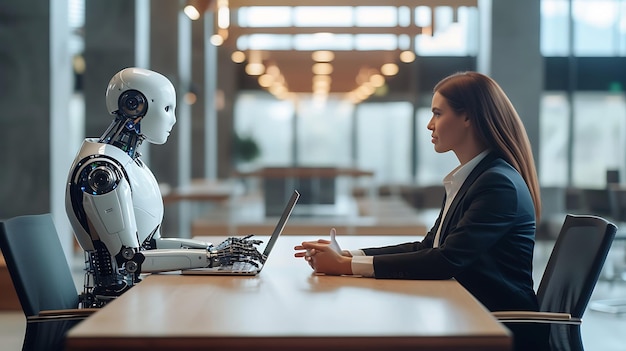
Artificial intelligence is usually discussed as something workers and unions must confront. Automation threatens jobs, algorithms measure productivity, and increasingly sophisticated machines can perform tasks once reserved for human beings. But another possibility deserves attention: What happens when AI stops being merely the subject of collective bargaining and becomes an active participant in it?
AI-powered collective bargaining could fundamentally change negotiations between unions and employers. Both sides could employ sophisticated systems capable of analyzing decades of contracts, corporate financial statements, wage data, inflation, productivity, healthcare costs, pension obligations, labor shortages, competitor compensation and thousands of previous arbitration decisions. Instead of negotiators entering the room armed primarily with experience, spreadsheets and institutional memory, they could arrive with machines capable of calculating the consequences of virtually every proposal in seconds.
That sounds like progress. It could also become an arms race.
Collective bargaining has traditionally depended heavily upon information asymmetry. Management generally knows more about the company’s finances and operating projections, while unions often know more about workforce sentiment, grievances and what employees will tolerate. Negotiation occurs partly in the fog between those competing bodies of knowledge.
AI could burn away much of that fog.
A union negotiating a wage increase could use an AI system to determine whether management’s claim that a 7 percent raise is unaffordable withstands scrutiny. Feed the system public financial statements, industry margins, executive compensation, productivity improvements, inflation and labor-market data, and the union could produce a sophisticated counterargument almost instantly.
Companies could do exactly the same thing.
Management’s AI could calculate the long-term cost of every union demand, including consequences that might not become apparent for decades. A seemingly modest pension enhancement could be modeled against demographic trends and investment returns. Proposed staffing requirements could be tested against productivity. Wage increases could be compared with automation costs, outsourcing possibilities and competitors operating in nonunion environments.
Negotiators would no longer simply argue about whether a proposal was expensive. They could debate remarkably precise estimates of how expensive it might become.
There is an obvious economic benefit. Better information should theoretically produce more rational agreements. AI could identify compromises humans overlook. A system might discover, for example, that workers place greater value on scheduling flexibility than management anticipated, while the company values changes in work rules more highly than employees realized. An AI model could construct a package exchanging those priorities and potentially leave both sides better off.
But conservatives, particularly those who believe strongly in voluntary contracts and competitive markets, should recognize another side of this development. AI could dramatically increase the bargaining power of organized labor.
Historically, sophisticated economic analysis was expensive. Large corporations could afford teams of lawyers, accountants, consultants and economists. A local union could not necessarily match those resources. Generative AI is rapidly reducing the price of expertise. A relatively small union may eventually possess analytical capabilities that once required an enormous professional staff.
Companies will respond with increasingly powerful systems of their own.
That creates the possibility of algorithmic escalation. Union AI recommends a demand. Corporate AI calculates a counteroffer. Union AI analyzes the counteroffer and identifies weaknesses. Management’s system anticipates the union’s response before it arrives. Eventually, humans could find themselves supervising negotiations largely constructed by machines.
That is where caution becomes necessary.
Collective bargaining isn’t simply an optimization problem. It involves trust, personalities, institutional history and judgment. Sometimes accepting a mathematically imperfect agreement preserves a productive relationship. Sometimes an employee concern that looks insignificant on a spreadsheet matters enormously on the factory floor. An algorithm may calculate economic value brilliantly while misunderstanding human value completely.
There is also the question of accountability. Imagine management rejects a wage increase because its AI predicts layoffs will otherwise become necessary. Or a union calls a strike because its system calculates that the company will capitulate after twelve days. If those predictions are wrong, real people suffer the consequences. Workers miss paychecks. Companies lose customers. Families absorb financial hardship.
Neither side should ever be permitted to hide behind the algorithm.
Government will inevitably be tempted to enter this arena as well, perhaps by regulating which AI models unions and employers may use, demanding disclosure of algorithms or eventually supplying government-approved bargaining systems. That would be a mistake. Collective bargaining should remain bargaining between employers and employees, not evolve into negotiations indirectly supervised by government algorithms.
There is a better principle: AI should advise negotiators, not replace them.
Used properly, artificial intelligence could make collective bargaining more informed, transparent and economically realistic. It could expose dishonest claims, identify mutually beneficial compromises and allow smaller organizations to compete intellectually with much larger institutions.
But something important should remain stubbornly human.
A labor contract is ultimately an agreement among people about the value of work, the allocation of economic rewards and the responsibilities each side owes the other. Algorithms can calculate those tradeoffs with extraordinary sophistication. They cannot bear their consequences.
The future bargaining table may have management on one side, labor on the other and artificial intelligence sitting behind both.
The humans should still make the deal.