

Close Menu

    Subscribe to Updates

    Get the latest tech news from Tallwire.

      What's Hot

      Standard Chartered CEO Backtracks On AI Replacing Human Workers

      May 23, 2026

      Nvidia CEO Warns U.S. Chip Bans Failing As China Maintains Access To Advanced Technology

      May 23, 2026

      Air Taxis Over Main Street

      May 23, 2026
      Facebook X (Twitter) Instagram
      • Tech
      • AI
      • Get In Touch
      Facebook X (Twitter) LinkedIn
      TallwireTallwire
      • Tech

        Southwest Airlines Moves To Ban Human-Animal Robots From Flights

        May 22, 2026

        Repurposed EV Batteries Raise Growing Safety and Reliability Concerns

        May 21, 2026

        San Francisco Pushes ‘Smart Parking’ As Cities Double Down On Digital Control

        May 18, 2026

        Fervo Energy’s Explosive IPO Signals a New American Energy Gold Rush

        May 17, 2026

        Reddit’s Search Renaissance Signals Shift Away From Big Tech Gatekeepers

        May 15, 2026
      • AI

        Nvidia CEO Warns U.S. Chip Bans Failing As China Maintains Access To Advanced Technology

        May 23, 2026

        Standard Chartered CEO Backtracks On AI Replacing Human Workers

        May 23, 2026

        U.S. Funnels $2 Billion Into Quantum Computing Push to Counter Global Rivals

        May 23, 2026

        US Export Credit Agency Advances Major AI Export Financing Push

        May 23, 2026

        California Deploys AI To Combat Surging Whale Deaths In San Francisco Bay

        May 22, 2026
      • Security

        AI Chatbots Accused Of Exposing Private Phone Numbers In Growing Privacy Nightmare

        May 21, 2026

        Trump Administration Moves Toward Federal Oversight of Advanced AI Models

        May 20, 2026

        China Rejects Dependence On American AI Chips As Nvidia Faces Strategic Setback

        May 20, 2026

        OpenAI’s Quiet Voice-Cloning Acquisition Raises New Deepfake Alarm Bells

        May 19, 2026

        AI Safety Controls Become the New Battleground in Silicon Valley

        May 19, 2026
      • Health

        Big Tech Funnels Millions Into Youth-Focused Brands As Critics Warn Of Social Media Risks

        May 21, 2026

        AI Medical Scribes Trigger New Fight Over Patient Safety And Federal Oversight

        May 18, 2026

        Lawmakers Rebuke Meta Over Restrictions on Legal Ads for Social Media Addiction Claims

        May 12, 2026

        AI’s Soft Seduction Could Quietly Undermine Humanity, Professor Warns

        May 12, 2026

        AI Outperforms Doctors In Emergency Diagnosis Study, Raising Promise And Caution

        May 11, 2026
      • Science

        U.S. Funnels $2 Billion Into Quantum Computing Push to Counter Global Rivals

        May 23, 2026

        California Deploys AI To Combat Surging Whale Deaths In San Francisco Bay

        May 22, 2026

        Fervo Energy’s Explosive IPO Signals a New American Energy Gold Rush

        May 17, 2026

        Earth AI Moves To Vertically Integrate Critical Mineral Discovery

        May 15, 2026

        AI-Driven Lab Automation Accelerates Scientific Discovery While Raising Oversight Concerns

        May 13, 2026
      • Tech

        SpaceX IPO Filing Ignites Wall Street Frenation Over Musk’s Expanding Empire

        May 23, 2026

        AI Arms Race Is Turning The Hiring Process Into A Digital Circus

        May 21, 2026

        Bezos Blasts AOC’s Billionaire Attacks As Debate Over Wealth And Capitalism Intensifies

        May 20, 2026

        Americans Push Back Against ‘Smart Everything’ Culture

        May 20, 2026

        Altman Pushes Back Against Musk Allegations in High-Stakes OpenAI Trial

        May 16, 2026
      TallwireTallwire
      Home»Opinion»Air Taxis Over Main Street
      Opinion

      Air Taxis Over Main Street

      5 Mins Read
      Facebook Twitter Pinterest LinkedIn Tumblr Email
      Share
      Facebook Twitter LinkedIn Pinterest Email

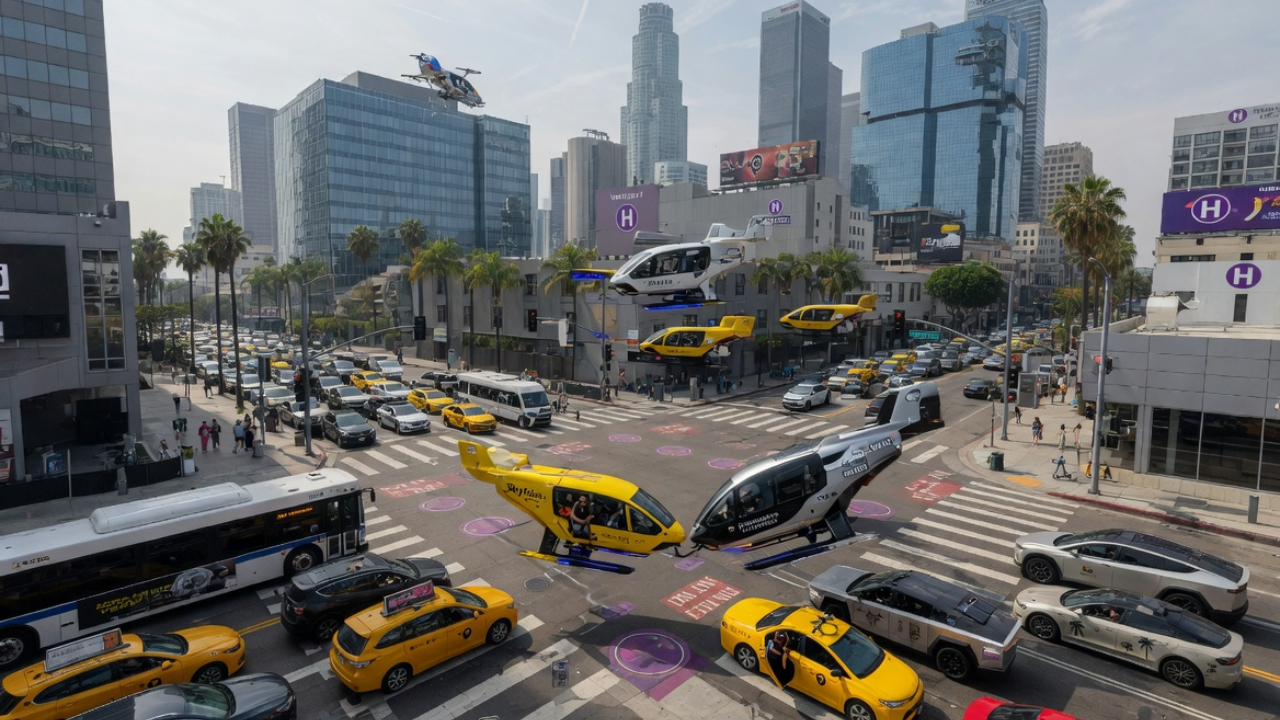
      The promise of air taxis—small, electric vertical takeoff and landing aircraft (eVTOLs) zipping passengers over gridlocked streets—has captured the imagination of city planners, investors, and commuters alike. In an era defined by urban congestion, strained infrastructure, and a growing appetite for technological solutions, the concept offers a tantalizing vision: faster commutes, reduced traffic, and a new dimension of mobility above the chaos of city streets. But like many ambitious innovations, the reality of integrating air taxis into dense urban environments is far more complicated than the glossy renderings suggest.

      On the surface, the advantages are clear. Urban congestion continues to worsen in major metropolitan areas, costing billions in lost productivity and quality of life. Air taxis promise to bypass this bottleneck entirely, providing point-to-point travel that is not constrained by roads, intersections, or traditional traffic patterns. A trip that might take an hour by car during rush hour could, in theory, be reduced to ten or fifteen minutes in the air. For business travelers, emergency responders, and high-value time-sensitive industries, that kind of efficiency has undeniable appeal.

      There’s also an environmental argument that proponents are quick to emphasize. Most air taxi designs are electric, producing zero emissions at the point of use. If powered by a cleaner grid, they could contribute to reducing the carbon footprint of urban transportation. Compared to traditional helicopters—which are noisy, fuel-intensive, and expensive to operate—eVTOL aircraft are designed to be quieter, cheaper, and more scalable. In that sense, air taxis are often presented as the natural evolution of rotorcraft, modernized for a sustainability-conscious age.

      Yet this is where the conversation begins to get more complicated. The assumption that air taxis will meaningfully reduce traffic congestion may not hold up under scrutiny. Historically, new transportation options tend to induce additional demand rather than simply replacing existing trips. In other words, instead of easing congestion, air taxis could create an entirely new layer of traffic—this time in the skies. If access to these services remains expensive, they may primarily serve a narrow segment of affluent users, doing little to alleviate the broader commuting challenges faced by the average urban resident.

      Cost is a central concern. Despite promises of eventual affordability, the initial rollout of air taxi services is almost certain to be expensive. The aircraft themselves are complex machines, requiring advanced materials, batteries, and safety systems. Infrastructure costs—such as the construction of “vertiports” for takeoff and landing—add another layer of financial burden. Regulatory compliance, pilot training (or autonomous system development), and maintenance all contribute to high operating costs. While advocates argue that economies of scale will eventually bring prices down, there is little guarantee that air taxis will ever reach price parity with ground-based alternatives like ridesharing or public transit.

      Safety is another issue that cannot be overlooked. Urban airspace is already tightly regulated, and for good reason. Introducing a fleet of low-altitude aircraft operating in close proximity to buildings, power lines, and each other presents a host of risks. Mechanical failures, software glitches, or even unexpected weather patterns could have serious consequences in densely populated areas. Unlike a car breakdown, an aircraft failure doesn’t offer many forgiving outcomes. Ensuring a level of safety that satisfies both regulators and the public will require rigorous testing, redundant systems, and likely years of incremental deployment.

      Then there is the question of noise—an often underestimated factor. While eVTOL aircraft are designed to be quieter than helicopters, “quieter” is not the same as silent. A steady stream of aircraft flying overhead, particularly in residential neighborhoods, could lead to public resistance. Noise pollution has long been a contentious issue in urban planning, and air taxis risk introducing a new dimension of it. Even modest sound levels, when repeated frequently, can become a significant quality-of-life concern.

      Infrastructure challenges present yet another hurdle. Cities are not currently designed to accommodate widespread aerial commuting. Building vertiports requires space—something that is already at a premium in most urban cores. Rooftops, parking structures, and repurposed land may offer partial solutions, but integrating these facilities into existing zoning and safety regulations is no small task. Additionally, managing air traffic at low altitudes will require sophisticated coordination systems, likely relying on automation and real-time data sharing. This introduces cybersecurity concerns, as any system controlling large numbers of aircraft becomes a potential target for disruption.

      Unforeseen complications may ultimately prove to be the most significant obstacles. For example, how will insurance markets adapt to a new category of transportation risk? How will liability be determined in the event of an accident involving autonomous systems? What happens when air taxis intersect with existing emergency services, such as medical helicopters or police operations? Even issues like privacy—residents uneasy about aircraft regularly flying near their windows—could spark backlash.

      There’s also the cultural factor. Public acceptance of new transportation technologies is never guaranteed. Ride-sharing services faced resistance before becoming mainstream, and autonomous vehicles continue to generate skepticism. Air taxis, operating in a far more visible and potentially intrusive way, may encounter even greater hurdles. Trust, once lost due to a high-profile incident, would be difficult to rebuild.

      In the end, air taxis represent a bold attempt to rethink urban mobility, but they are not a silver bullet. The technology holds promise, particularly for niche applications where speed and flexibility are paramount. However, the broader vision of widespread, affordable aerial commuting faces significant economic, regulatory, and social challenges. For all the excitement surrounding the concept, a measured, realistic approach is warranted.

      Innovation has its place, but it rarely unfolds as smoothly as its advocates predict. Air taxis may indeed find a role in the transportation ecosystem of the future—but whether they become a transformative solution or a high-tech novelty will depend on how these challenges are addressed in the years ahead.

      Software Space
      Share. Facebook Twitter Pinterest LinkedIn Tumblr Email
      Previous ArticleSpaceX IPO Filing Ignites Wall Street Frenation Over Musk’s Expanding Empire
      Next Article Nvidia CEO Warns U.S. Chip Bans Failing As China Maintains Access To Advanced Technology

      Related Posts

      SpaceX IPO Filing Ignites Wall Street Frenation Over Musk’s Expanding Empire

      May 23, 2026

      US Export Credit Agency Advances Major AI Export Financing Push

      May 23, 2026

      California Deploys AI To Combat Surging Whale Deaths In San Francisco Bay

      May 22, 2026

      Southwest Airlines Moves To Ban Human-Animal Robots From Flights

      May 22, 2026
      Add A Comment
      Leave A Reply Cancel Reply

      Editors Picks

      Southwest Airlines Moves To Ban Human-Animal Robots From Flights

      May 22, 2026

      Repurposed EV Batteries Raise Growing Safety and Reliability Concerns

      May 21, 2026

      San Francisco Pushes ‘Smart Parking’ As Cities Double Down On Digital Control

      May 18, 2026

      Fervo Energy’s Explosive IPO Signals a New American Energy Gold Rush

      May 17, 2026
      Popular Topics
      starlink Software Tesla Cybertruck Tesla UAE Tech Tim Cook Viral Series A Startup SpaceX Series B Taiwan Tech Satya Nadella trending spotlight Space Stocks Samsung Satellite Sundar Pichai
      Major Tech Companies
      • Apple News
      • Google News
      • Meta News
      • Microsoft News
      • Amazon News
      • Samsung News
      • Nvidia News
      • OpenAI News
      • Tesla News
      • AMD News
      • Anthropic News
      • Elbit News
      AI & Emerging Tech
      • AI Regulation News
      • AI Safety News
      • AI Adoption
      • Quantum Computing News
      • Robotics News
      Key People
      • Sam Altman News
      • Jensen Huang News
      • Elon Musk News
      • Mark Zuckerberg News
      • Sundar Pichai News
      • Tim Cook News
      • Satya Nadella News
      • Mustafa Suleyman News
      Global Tech & Policy
      • Israel Tech News
      • India Tech News
      • Taiwan Tech News
      • UAE Tech News
      Startups & Emerging Tech
      • Series A News
      • Series B News
      • Startup News
      Tallwire
      Facebook X (Twitter) LinkedIn Threads Instagram RSS
      • Tech
      • Entertainment
      • Business
      • Government
      • Academia
      • Transportation
      • Legal
      • Press Kit
      © 2026 Tallwire. Optimized by ARMOUR Digital Marketing Agency.

      Type above and press Enter to search. Press Esc to cancel.