

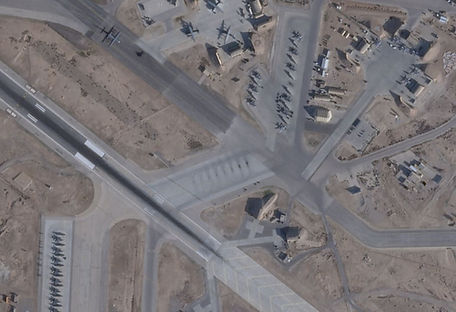
A recent report indicates that Iran secretly obtained a Chinese-built surveillance satellite, significantly enhancing its ability to monitor U.S. military installations across the Middle East, with evidence suggesting the system was used to capture imagery of key bases before and after reported drone and missile strikes, raising serious questions about Beijing’s role, Tehran’s expanding intelligence capabilities, and the evolving balance of power in an already volatile region.
Sources
https://www.jpost.com/middle-east/iran-news/article-893037
https://www.ft.com/content/iran-china-satellite-report (verify access; may require subscription)
https://www.reuters.com/world/middle-east/iran-china-satellite-surveillance-report-2026-04-15
Key Takeaways
- Iran’s reported access to a Chinese-built satellite marks a significant leap in its intelligence-gathering and targeting capabilities.
- The satellite allegedly monitored U.S. military bases before and after attacks, suggesting potential operational use rather than passive surveillance.
- China has publicly denied involvement in enabling military targeting, highlighting growing geopolitical tension and plausible deniability dynamics.
In-Depth
The reported acquisition of a Chinese-built surveillance satellite by Iran underscores a notable shift in the strategic landscape of the Middle East, where technological capability increasingly determines operational reach. According to the details available, Iran’s Islamic Revolutionary Guard Corps secured access to the satellite in late 2024, enabling it to track and image U.S. military installations across multiple countries in the region. This development is not merely incremental; it reflects a broader trend in which adversarial states seek asymmetric advantages through advanced surveillance rather than traditional force projection.
What makes this revelation particularly consequential is the timing and alleged usage of the satellite. Reports indicate that imagery was captured both before and after attacks on U.S.-linked sites, suggesting that the platform may have been integrated into operational planning cycles rather than serving as a passive intelligence tool. If accurate, that would imply a higher degree of sophistication within Iran’s military command structure than many policymakers have publicly acknowledged.
Equally significant is the involvement of commercial infrastructure. Iran reportedly gained access to global ground station networks, allowing it to control and retrieve satellite data beyond its borders. This blurs the line between civilian and military assets, complicating both attribution and response. It also raises uncomfortable questions about how easily advanced capabilities can be transferred under the guise of commercial cooperation.
China’s denial of any role in facilitating attacks fits a familiar pattern in international relations, where economic and technological partnerships are maintained while avoiding direct accountability for downstream military applications. The broader implication is that strategic competition is no longer confined to conventional weapons systems; it now includes data, orbit-based assets, and the infrastructure that connects them.
Taken together, the situation highlights a growing reality: adversaries are investing heavily in surveillance and precision capabilities that can challenge U.S. dominance without engaging in direct confrontation. Whether policymakers choose to treat this as an isolated incident or part of a larger pattern will likely shape the next phase of regional security strategy.