

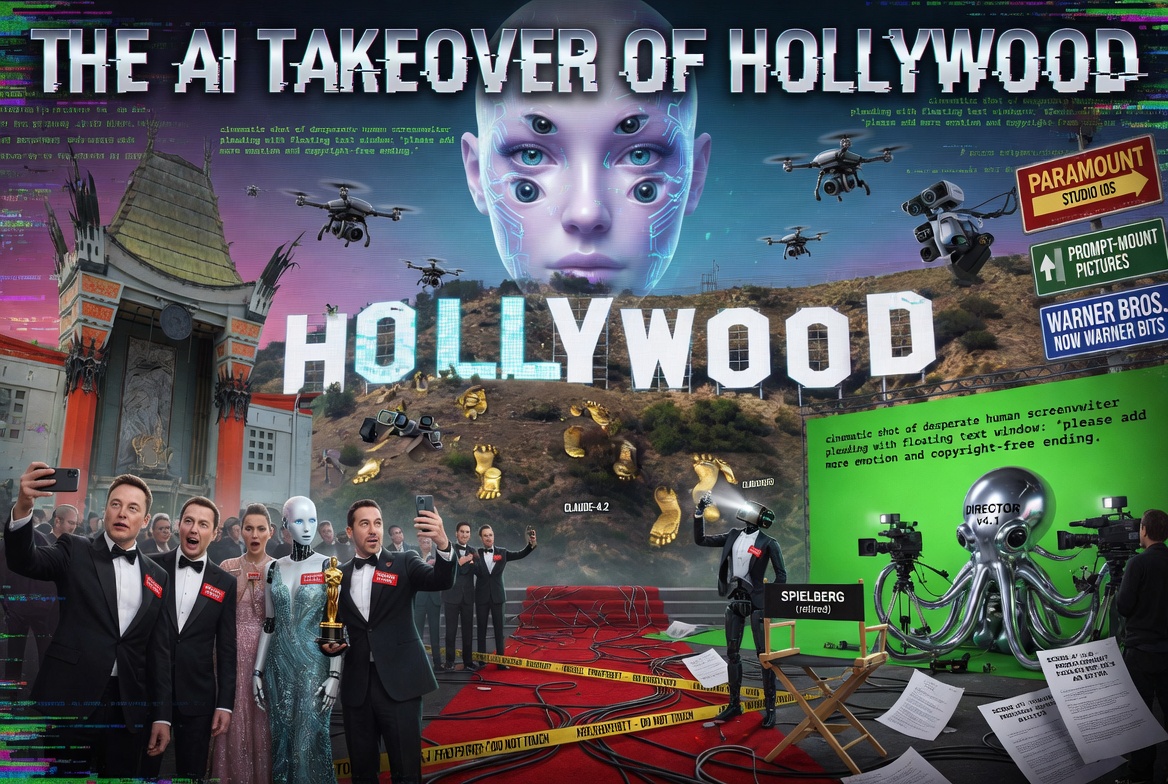
There’s always been tension between art and industry in Hollywood, but what we’re seeing now with artificial intelligence isn’t just another technological shift—it’s a fundamental challenge to the role of the human creator. The entertainment business has long chased efficiency, scalability, and profit margins, but the accelerating embrace of AI threatens to sideline the very people who make storytelling meaningful in the first place. And while proponents frame this shift as innovation, there’s a growing sense that something essential is being lost.
At its core, storytelling is a human act. It emerges from lived experience, emotional depth, and cultural context—things that cannot be cleanly replicated by algorithms trained on existing data. Yet studios, under constant pressure to reduce costs and maximize output, are increasingly turning to AI tools to generate scripts, de-age actors, clone voices, and even simulate performances. What was once a collaborative, often messy creative process is being streamlined into something far more mechanical. The result may be efficient, but it risks becoming sterile.
The first and most obvious casualty in this shift is the working creative—the screenwriter, the voice actor, the background performer. These are not glamorous positions, but they are the backbone of the industry. AI tools can now draft passable scripts in minutes, generate synthetic voices that sound eerily human, and populate scenes with digital extras who never ask for a paycheck. For studios, this represents a clear financial incentive. For artists, it represents a slow erosion of opportunity.
Defenders of AI integration argue that these tools simply augment human creativity, freeing artists from repetitive tasks and allowing them to focus on higher-level storytelling. That’s the theory. In practice, however, the incentives don’t align that way. When a studio can replace a team of writers with a single AI-assisted editor, the pressure to cut human labor becomes overwhelming. The “augmentation” quickly becomes substitution.
There’s also a deeper, less quantifiable damage being done—the flattening of originality. AI systems are, by design, derivative. They learn by analyzing patterns in existing works and recombining them in statistically probable ways. This means they excel at imitation but struggle with true innovation. Hollywood, already criticized for its reliance on sequels, remakes, and formulaic storytelling, risks doubling down on sameness when its creative engine is driven by algorithms trained on past successes.
What gets lost in this process is the unpredictable spark that comes from human imagination. The films that define eras, that challenge audiences, that push boundaries—those rarely come from playing it safe. They come from individuals willing to take risks, to draw from personal experience, to tell stories that don’t fit neatly into pre-existing templates. AI, for all its computational power, has no personal experience. It cannot suffer, dream, or wrestle with moral ambiguity. It can only simulate those things based on patterns it has observed.
There’s also an ethical dimension that shouldn’t be ignored. Many AI systems are trained on vast datasets that include copyrighted material—scripts, performances, voices—often without the consent of the original creators. In effect, artists are being used to train the very tools that may replace them. It’s a dynamic that raises serious questions about ownership, compensation, and respect for intellectual labor.
The recent labor disputes in Hollywood have brought some of these concerns into sharper focus. Writers and actors have pushed back against the unchecked use of AI, demanding protections that ensure their work and likenesses cannot be exploited without consent. These aren’t abstract fears; they are grounded in real-world contracts and negotiations where the balance of power has shifted toward the studios.
From a broader cultural perspective, the stakes are even higher. Hollywood isn’t just an उद्योग—it’s a major force in shaping narratives, values, and collective imagination. If the stories being told are increasingly generated by machines optimized for engagement metrics rather than human insight, the cultural output risks becoming shallow and homogenized. Entertainment may become more abundant, but less meaningful.
None of this is to say that AI has no place in filmmaking. Like any tool, it can be used responsibly to enhance certain aspects of production. Visual effects, editing workflows, and even early-stage brainstorming can benefit from technological assistance. But there’s a line between using tools and replacing the toolmaker. Cross that line, and you don’t just change the industry—you change the nature of the art itself.
The challenge moving forward is one of balance and principle. If Hollywood continues down a path driven purely by cost-cutting and technological capability, it risks undermining the very foundation of its success. Audiences may not immediately notice the difference, but over time, they will feel it—a subtle but persistent sense that something is missing.
In the end, the question isn’t whether AI can produce content. It clearly can. The question is whether that content can carry the weight of human experience in a way that resonates deeply and authentically. If the answer is no—and there’s strong reason to believe it is—then sidelining human creators isn’t just a business decision. It’s a cultural misstep with long-term consequences.
Hollywood has always been about telling stories that matter. If it forgets that, no amount of technological advancement will save it from becoming just another content factory, churning out polished but hollow entertainment.