

Close Menu

    Subscribe to Updates

    Get the latest tech news from Tallwire.

      What's Hot

      Louisiana Intensifies Crackdown After Sex Offender Caught Targeting Child on Roblox

      June 13, 2026

      China Claims First Commercial Brain Chip Victory Over Musk

      June 13, 2026

      Uber Cuts Nearly A Quarter of HR and Recruiting Staff Amid Corporate Restructuring

      June 12, 2026
      Facebook X (Twitter) Instagram
      • Tech
      • AI
      • Get In Touch
      Facebook X (Twitter) LinkedIn
      TallwireTallwire
      • Tech

        China Claims First Commercial Brain Chip Victory Over Musk

        June 13, 2026

        Schools Push Back Against Social Media as Concerns Over Student Well-Being Grow

        June 11, 2026

        AI Agents Enter the Arena as Silicon Valley Chases the Next Computing Revolution

        June 10, 2026

        AI Farms Are Transforming Rural America and Raising New Questions About Power

        June 10, 2026

        Nvidia Unveils RTX Spark to Bring AI Agents Directly to Personal Computers

        June 9, 2026
      • AI

        China Claims First Commercial Brain Chip Victory Over Musk

        June 13, 2026

        Federal Court Suspends California Lawyers After AI-Generated False Citations Exposed

        June 12, 2026

        AI Disruption Forces Big Law to Rethink the Billable Hour

        June 12, 2026

        Robot Caregivers Gain Ground as Aging Americans Seek Independence at Home

        June 12, 2026

        Amazon Pushes AI Into Hollywood While Promising Humans Remain in Control

        June 12, 2026
      • Security

        Louisiana Intensifies Crackdown After Sex Offender Caught Targeting Child on Roblox

        June 13, 2026

        AI-Powered Computer Worms Raise Alarms Across Cybersecurity Community

        June 11, 2026

        Trump Signs AI Cyber Defense Executive Order To Strengthen National Security

        June 9, 2026

        China Circumvents U.S. AI Chip Restrictions Through Third-Country Networks

        June 8, 2026

        House Republicans Push FBI to Probe Alleged Foreign Campaign Against U.S. AI Infrastructure

        June 8, 2026
      • Health

        China Claims First Commercial Brain Chip Victory Over Musk

        June 13, 2026

        Robot Caregivers Gain Ground as Aging Americans Seek Independence at Home

        June 12, 2026

        Drug-Resistant Typhoid Raises New Fears of a Global Health Crisis

        June 6, 2026

        AI Accessibility Breakthrough Shows Technology’s Best Use Case

        June 5, 2026

        Smart Tattoo Breakthrough Could Revolutionize Early Skin Cancer Detection

        June 4, 2026
      • Science

        China Claims First Commercial Brain Chip Victory Over Musk

        June 13, 2026

        Amazon’s Data Center Breakthrough Could Cement America’s AI Dominance

        June 7, 2026

        Drug-Resistant Typhoid Raises New Fears of a Global Health Crisis

        June 6, 2026

        AI Accessibility Breakthrough Shows Technology’s Best Use Case

        June 5, 2026

        Smart Tattoo Breakthrough Could Revolutionize Early Skin Cancer Detection

        June 4, 2026
      • Tech

        Arbitrator Orders Ex-Girlfriend of Former Google CEO Eric Schmidt to Pay More Than $10 Million

        June 12, 2026

        Reid Hoffman Steps Down From Microsoft Board To Refocus On AI Ventures

        June 10, 2026

        Gwynne Shotwell Emerges as the Operational Force Behind SpaceX’s Rise

        June 10, 2026

        Zuckerberg’s Superyacht Arrival Sparks Backlash Amid Meta Layoffs

        June 1, 2026

        Nvidia Chief Deepens China Ties Amid Intensifying AI Power Struggle

        June 1, 2026
      TallwireTallwire
      Home»Opinion»When the Machine Takes the Stage
      Opinion

      When the Machine Takes the Stage

      5 Mins Read
      Facebook Twitter Pinterest LinkedIn Tumblr Email
      Share
      Facebook Twitter LinkedIn Pinterest Email

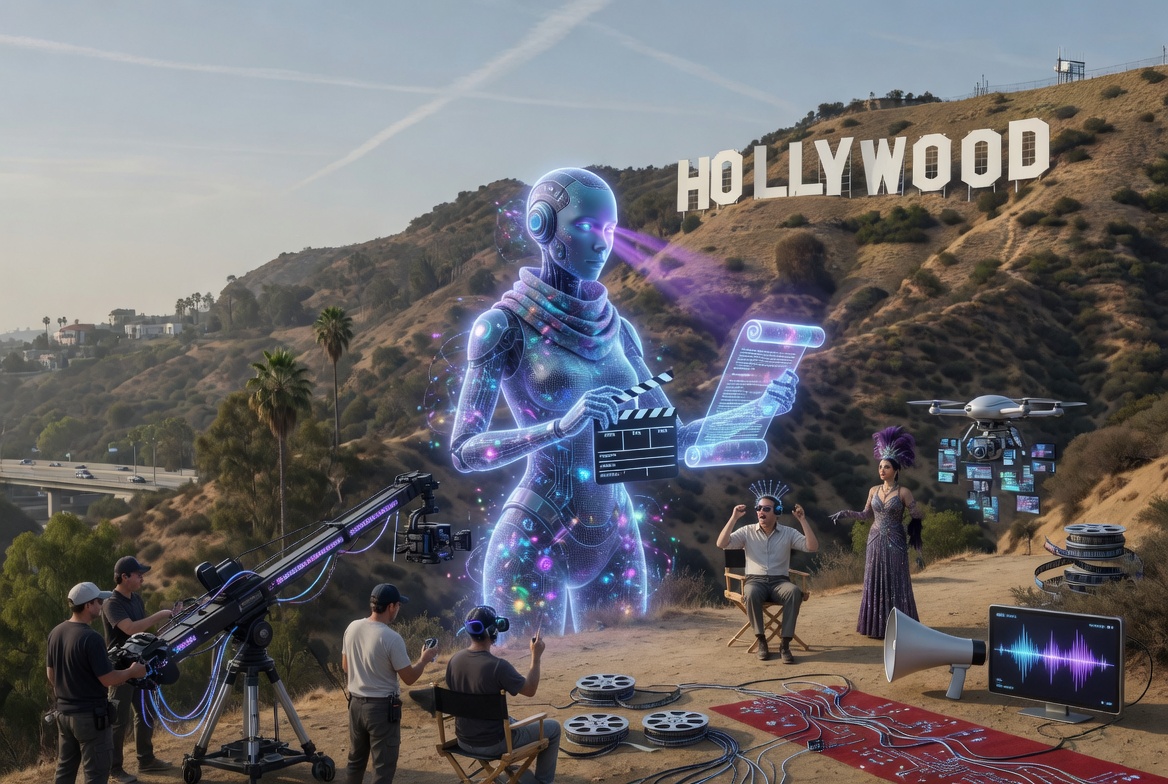
      For decades, the entertainment industry has been a proving ground for human ingenuity. From the golden age of Hollywood to the rise of streaming platforms, the driving force behind compelling storytelling has always been the same: human experience translated into art. Now, artificial intelligence is stepping onto that stage—not as a tool in the artist’s hand, but increasingly as a substitute for the artist altogether. And that shift raises serious concerns about the future of creative professions.

      At first glance, AI in entertainment looks like progress. Studios can generate scripts faster, music producers can create tracks in minutes, and visual effects teams can render entire scenes with unprecedented efficiency. For an industry constantly under pressure to produce more content at lower cost, this is understandably appealing. But efficiency is not the same as artistry, and that distinction matters more than ever.

      The core issue isn’t that AI exists—it’s how it’s being deployed. Historically, new technologies have enhanced creativity. The camera didn’t eliminate painting; it changed it. Digital editing didn’t erase filmmaking; it expanded its possibilities. In those cases, the artist remained central. AI, by contrast, has the potential to sideline the artist entirely. When a machine can write a screenplay, compose a score, or generate a digital actor, the role of the human creator becomes optional in the eyes of cost-conscious executives.

      That’s not just a technical shift—it’s a cultural one. Creative work is rooted in lived experience, emotion, and perspective. A songwriter draws from heartbreak, a screenwriter from observation, a comedian from timing and instinct. AI doesn’t possess any of that. It mimics patterns. It recombines existing material. It produces something that may sound convincing, even impressive, but ultimately lacks the authenticity that resonates on a deeper level.

      Supporters of AI argue that audiences won’t notice—or won’t care. That’s a risky assumption. Entertainment isn’t just about consuming content; it’s about connecting with it. When people watch a film or listen to a song, they’re engaging with the mind behind it. Remove that human element, and you risk turning art into a commodity—interchangeable, disposable, and ultimately forgettable.

      There’s also a more immediate concern: the economic impact on working artists. Actors, writers, musicians, voice performers—these are not abstract roles. They are careers, often precarious ones, that rely on steady opportunities. AI threatens to undercut those opportunities in a very direct way. Why hire a team of writers when a machine can generate dozens of scripts overnight? Why pay a voice actor when a synthetic voice can be cloned and reused indefinitely?

      This isn’t hypothetical. We’re already seeing disputes in Hollywood and beyond over the use of AI-generated likenesses, scripts, and performances. Creative professionals are pushing back, and rightly so. At stake isn’t just compensation, but ownership and identity. If an actor’s face or voice can be replicated without their ongoing consent, what does it mean to “own” your own image? If a writer’s past work is used to train an AI that then replaces them, is that innovation—or exploitation?

      There’s a tendency in tech circles to frame resistance to AI as fear of change. That’s an oversimplification. Artists aren’t rejecting technology; they’re questioning a model that prioritizes scale and speed over substance and fairness. And they have a point. Not every advancement is inherently beneficial. Some require boundaries, especially when they disrupt entire professions.

      From a broader perspective, the unchecked expansion of AI in entertainment risks homogenizing culture. Algorithms tend to favor what already works—familiar structures, popular tropes, proven formulas. That can lead to a feedback loop where originality is squeezed out in favor of predictability. The result is a landscape filled with content that feels eerily similar, lacking the boldness and risk-taking that define truly great art.

      None of this means AI has no place in entertainment. Used responsibly, it can be a powerful tool—assisting with editing, enhancing visual effects, streamlining production workflows. The key word is “assisting.” The moment AI shifts from collaborator to replacement, the balance tips in a way that undermines the very foundation of creative work.

      The challenge ahead is not technological but philosophical. What kind of entertainment industry do we want? One that values efficiency above all else, or one that preserves the human element that makes art meaningful? The answer will shape not just the livelihoods of artists, but the cultural fabric itself.

      If the industry chooses the former, it may gain short-term savings but lose something far more important: the authenticity that keeps audiences engaged. If it chooses the latter, it will need to draw clear lines—protecting intellectual property, ensuring fair compensation, and reaffirming the role of the human creator.

      The machine may be capable of producing content, but it cannot replace the human impulse to create. And if that impulse is pushed aside in favor of automation, the entertainment industry may find that what it gains in efficiency, it loses in soul.

      Intel
      Share. Facebook Twitter Pinterest LinkedIn Tumblr Email
      Previous ArticleAmazon Pushes AI Into Hollywood While Promising Humans Remain in Control
      Next Article Robot Caregivers Gain Ground as Aging Americans Seek Independence at Home

      Related Posts

      China Claims First Commercial Brain Chip Victory Over Musk

      June 13, 2026

      Federal Court Suspends California Lawyers After AI-Generated False Citations Exposed

      June 12, 2026

      Uber Cuts Nearly A Quarter of HR and Recruiting Staff Amid Corporate Restructuring

      June 12, 2026

      AI Disruption Forces Big Law to Rethink the Billable Hour

      June 12, 2026
      Add A Comment
      Leave A Reply Cancel Reply

      Editors Picks

      China Claims First Commercial Brain Chip Victory Over Musk

      June 13, 2026

      Schools Push Back Against Social Media as Concerns Over Student Well-Being Grow

      June 11, 2026

      AI Agents Enter the Arena as Silicon Valley Chases the Next Computing Revolution

      June 10, 2026

      AI Farms Are Transforming Rural America and Raising New Questions About Power

      June 10, 2026
      Popular Topics
      Software spotlight Space UAE Tech starlink Tesla Cybertruck trending Taiwan Tech Viral Stocks Startup Tim Cook SpaceX Satya Nadella Series A Sundar Pichai Satellite Series B Tesla Samsung
      Major Tech Companies
      • Apple News
      • Google News
      • Meta News
      • Microsoft News
      • Amazon News
      • Samsung News
      • Nvidia News
      • OpenAI News
      • Tesla News
      • AMD News
      • Anthropic News
      • Elbit News
      AI & Emerging Tech
      • AI Regulation News
      • AI Safety News
      • AI Adoption
      • Quantum Computing News
      • Robotics News
      Key People
      • Sam Altman News
      • Jensen Huang News
      • Elon Musk News
      • Mark Zuckerberg News
      • Sundar Pichai News
      • Tim Cook News
      • Satya Nadella News
      • Mustafa Suleyman News
      Global Tech & Policy
      • Israel Tech News
      • India Tech News
      • Taiwan Tech News
      • UAE Tech News
      Startups & Emerging Tech
      • Series A News
      • Series B News
      • Startup News
      Tallwire
      Facebook X (Twitter) LinkedIn Threads Instagram RSS
      • Tech
      • Entertainment
      • Business
      • Government
      • Academia
      • Transportation
      • Legal
      • Press Kit
      © 2026 Tallwire. Optimized by ARMOUR Digital Marketing Agency.

      Type above and press Enter to search. Press Esc to cancel.