

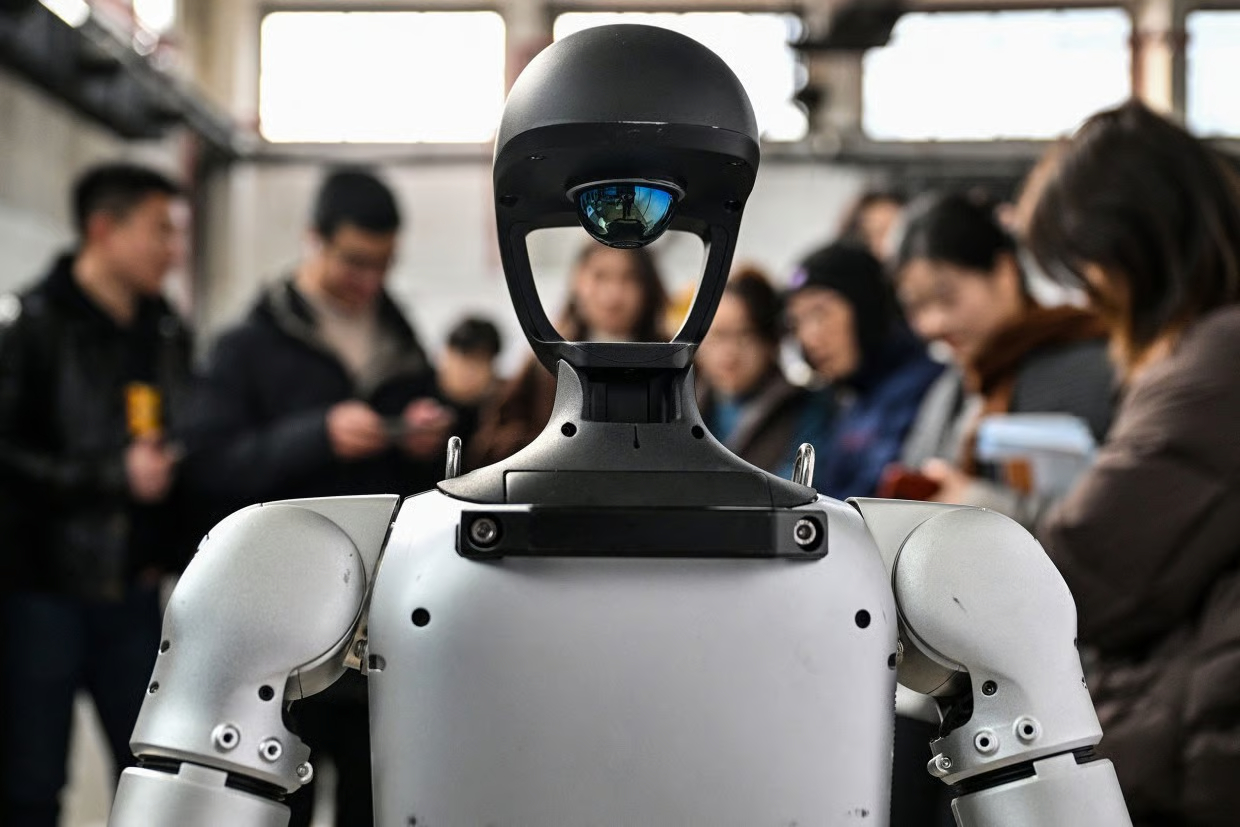
China’s humanoid robotics sector reached a significant milestone with the public listing of Unitree Robotics, the first mainland Chinese humanoid robot manufacturer to complete an initial public offering. The offering values the Hangzhou-based company at roughly $9 billion and provides billions of yuan for expanded research, software development, new products, and manufacturing capacity. The move comes amid escalating technological competition between the United States and China, with Washington tightening restrictions on advanced Chinese robotics imports over national security concerns while Beijing continues investing heavily in artificial intelligence and embodied robotics. The IPO underscores China’s determination to dominate next-generation manufacturing and automation, even as questions remain about long-term profitability, commercial demand, and geopolitical barriers to overseas expansion.
Sources
- https://www.nytimes.com/2026/08/06/business/china-unitree-ipo-robot.html
- https://www.reuters.com/world/asia-pacific/chinese-robot-maker-unitree-prices-shanghai-ipo-2026-08-06
- https://www.reuters.com/world/asia-pacific/deepseek-invests-208-million-unitrees-shanghai-ipo-2026-08-06
- https://www.investors.com/news/technology/humanoid-robots-usa-china-conflict-tesla-nvidia/
Key Takeaways
- China continues to prioritize humanoid robotics as a strategic national industry, with Unitree’s IPO providing substantial capital to accelerate research, production, and commercialization.
- The United States and China are increasingly treating advanced robotics as both an economic opportunity and a national security issue, leading to expanding trade restrictions and technology competition.
- While Chinese manufacturers currently enjoy advantages in manufacturing scale and lower-cost hardware, the broader race will likely be determined by advances in artificial intelligence, autonomy, and software capabilities as much as mechanical engineering.
In-Depth
Unitree’s successful IPO represents more than another technology company reaching public markets. It is another indication that China views robotics as a strategic pillar of future economic and geopolitical influence. Beijing has spent years encouraging investment in advanced manufacturing, artificial intelligence, and automation, and Unitree’s rapid growth demonstrates how those policies are beginning to produce globally competitive companies.
For the United States, the development should reinforce the importance of maintaining technological leadership rather than assuming it. China’s ability to manufacture sophisticated humanoid robots at increasingly competitive prices presents both an economic challenge and a national security concern, particularly as these systems become more capable in logistics, manufacturing, infrastructure, and potentially defense-related applications. Recent U.S. restrictions on advanced Chinese robotics reflect growing recognition that robotics, like semiconductors and AI, has become a strategic technology.
At the same time, investors should avoid assuming that enthusiasm alone guarantees success. Commercial demand for humanoid robots remains in its early stages, development costs remain substantial, and international expansion faces political as well as regulatory obstacles. Nevertheless, Unitree’s IPO marks another milestone in an increasingly consequential technological competition. The nation that combines the strongest artificial intelligence with scalable manufacturing, secure supply chains, and practical commercial deployment will likely establish the standards that define the global robotics industry for decades to come.