

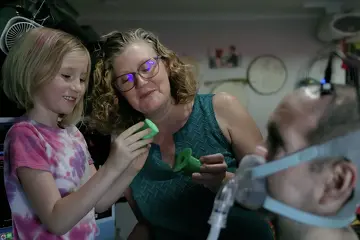
A man with advanced amyotrophic lateral sclerosis (ALS) has regained the ability to communicate through a cutting-edge brain implant that translates neural signals into lifelike speech, marking a major step forward in brain-computer interface technology. The system uses implanted electrodes to capture brain activity associated with speech, which is then decoded by artificial intelligence into words spoken in a synthetic version of the patient’s own voice. Unlike earlier efforts that produced slow or robotic output, this approach allows near real-time, expressive communication—including tone, emphasis, and even simple singing—bringing a level of human connection previously out of reach. While the achievement highlights the promise of restoring dignity and communication for patients with severe neurological decline, it also underscores a rapidly advancing frontier where major tech players are pushing similar technologies toward broader, potentially non-medical applications, raising ethical and societal concerns alongside the medical optimism.
Sources
https://www.sfchronicle.com/bayarea/article/als-brain-implant-speech-21359382.php
https://www.scientificamerican.com/article/brain-implant-lets-man-with-als-speak-and-sing-with-his-real-voice/
https://www.nasw.org/article/scientists-gave-man-als-his-voice-back
Key Takeaways
- Brain-computer interface technology is now capable of converting thoughts into near real-time, expressive speech for ALS patients, restoring a core human function once thought permanently lost.
- Advances in artificial intelligence have significantly improved accuracy, speed, and personalization, including replicating a patient’s original voice and speech patterns.
- The same technology attracting medical interest is also drawing attention from major tech firms, raising concerns about privacy, commercialization, and non-medical uses of brain data.
In-Depth
The implications of this breakthrough go well beyond a single patient’s regained voice. At its core, this development represents a convergence of neuroscience and artificial intelligence that is beginning to deliver on promises long confined to science fiction. By implanting microelectrodes into the brain’s speech centers, researchers can now capture the neural signals that occur when a person attempts to speak—even if their body can no longer carry out those commands. Those signals are then translated into coherent, audible language by sophisticated AI models trained to recognize patterns in brain activity.
What makes this advance particularly notable is the leap in realism and responsiveness. Earlier systems required users to spell out words or produced delayed, monotone output. Now, patients can generate speech almost instantaneously, complete with natural inflection and emotional nuance. That’s not a cosmetic improvement—it’s the difference between basic communication and meaningful human interaction. For individuals with ALS, a disease that progressively strips away motor function while often leaving cognition intact, this kind of restoration carries enormous personal and psychological value.
At the same time, the technology is advancing within a broader ecosystem that includes aggressive investment and ambition from the private sector. Companies are already exploring applications that extend far beyond treating disease, including consumer interfaces and productivity enhancements. That trajectory raises legitimate concerns about how brain data could be used, stored, or even exploited. While the humanitarian upside is undeniable, the long-term direction of this technology will depend heavily on how—and by whom—it is governed.