

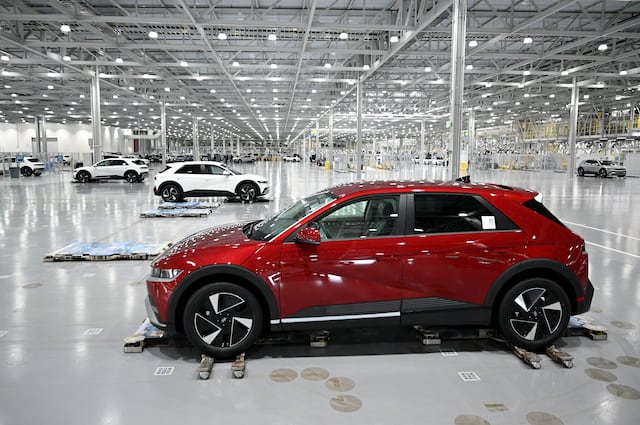
Hyundai’s state-of-the-art Metaplant in Ellabell, Georgia, demonstrates how advanced robotics and artificial intelligence are rapidly reshaping American manufacturing without eliminating the need for human workers. Hundreds of robotic arms, autonomous guided vehicles, robotic inspection systems, and emerging humanoid robots perform many of the repetitive, dangerous, and physically demanding tasks once handled by assembly-line employees. Yet company executives, manufacturing experts, and engineers acknowledge that people remain indispensable for quality control, flexible problem-solving, and installing components that require dexterity beyond current robotic capabilities. Hyundai maintains that the facility remains committed to creating thousands of American jobs while leveraging automation to increase productivity, improve workplace safety, and strengthen the long-term competitiveness of U.S.-based automobile manufacturing in an increasingly challenging global market.
Sources
- https://www.ajc.com/business/2026/07/robots-are-everywhere-in-hyundais-georgia-plant-but-they-cant-do-everything
- https://www.reuters.com/business/autos-transportation/hyundai-motor-group-plans-deploy-humanoid-robots-us-factory-2028-2026-01-05
- https://www.wsj.com/business/autos/hyundai-factory-georgia-automation-jobs-6d7d4e5d
Key Takeaways
- Automation is expanding rapidly across advanced manufacturing, but today’s technology still depends heavily on skilled human workers for precision assembly, quality assurance, troubleshooting, and adaptable decision-making.
- Hyundai argues that investing in robotics is intended to keep American manufacturing globally competitive while creating new technical careers involving robot programming, maintenance, and systems management rather than simply eliminating factory jobs.
- The Georgia Metaplant offers a preview of the future industrial workforce, where employees increasingly work alongside sophisticated automation instead of competing directly against it.
In-Depth
The Hyundai Metaplant illustrates both the remarkable promise and the practical limits of modern automation. Robots excel at welding, lifting heavy components, transporting materials, and repeating identical tasks with extraordinary precision. They improve worker safety by assuming many of the dull, dirty, and dangerous jobs that historically contributed to workplace injuries. At the same time, Hyundai executives and manufacturing experts readily acknowledge that today’s machines still struggle with many tasks requiring human judgment, touch, and adaptability, particularly when working with flexible materials such as wiring harnesses, carpeting, trim panels, and hoses.
For conservatives who have long advocated rebuilding America’s manufacturing base, the Georgia facility demonstrates an important reality: reshoring production does not mean returning to the labor-intensive factories of the 1970s. The factories that can successfully compete with China and other low-cost producers will almost certainly rely upon advanced robotics, artificial intelligence, and highly skilled American workers operating together. Rather than resisting technological advancement, policymakers should focus on ensuring the American workforce possesses the technical education necessary to thrive alongside increasingly capable machines. If the United States intends to remain an industrial powerhouse, embracing innovation while investing in skilled labor may prove to be the only sustainable path forward.