

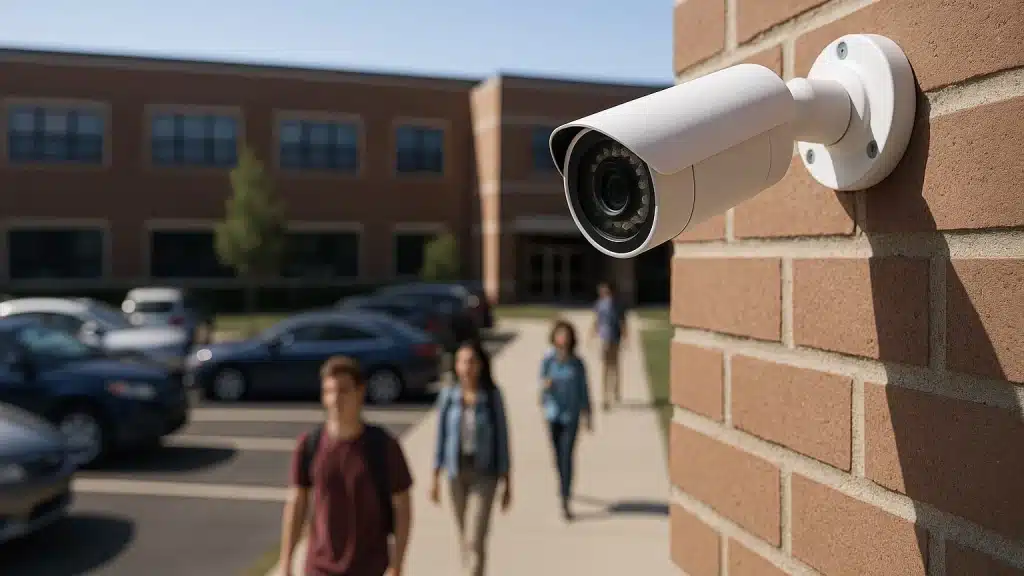
There is perhaps no responsibility more fundamental to a school district than protecting the children entrusted to its care. Parents have every right to expect administrators to take reasonable precautions against violence, abduction, reckless drivers, unauthorized visitors, and other threats. Yet the legitimate pursuit of security does not automatically justify every technology capable of advancing it.
That is the ethical dilemma presented by Flock cameras and similar automated license-plate recognition systems on school campuses.
Unlike an ordinary security camera, an automated license-plate reader does more than record what happens within its field of view. It can identify vehicles, record license plates, associate those observations with a particular time and location, and make the resulting information searchable. Depending upon how a system is configured and how information is shared, something installed to protect a school can become part of a much broader surveillance infrastructure.
That distinction matters.
Conservatives have traditionally understood that government power should be evaluated not merely according to the intentions of those currently exercising it, but according to how that power might eventually be abused. The question should never simply be, “Do we trust today’s school superintendent, police chief, or mayor?” The more important question is whether we would be comfortable giving the same authority to officials we emphatically do not trust.
School campuses make that question especially important.
Parents generally cannot avoid schools in the same manner they can avoid a private business employing surveillance technology. Families arrive every morning because children are legally and practically required to receive an education. Teachers, custodians, coaches, contractors, volunteers, grandparents, babysitters, and countless others routinely enter school property.
Consequently, placing automated vehicle-tracking technology at entrances can create records concerning people who have done absolutely nothing suspicious.
The strongest argument for such cameras is obvious: safety.
If police are searching for a vehicle associated with an abducted child, an armed suspect, a stolen automobile, or someone believed to pose an immediate threat to students, identifying that vehicle approaching a campus could save lives. Few reasonable people would object to technology being used to prevent an imminent tragedy.
But useful technology is not necessarily unlimited technology.
The moral distinction lies between surveillance directed toward a legitimate threat and indiscriminate data collection merely because modern technology makes it possible.
America’s constitutional tradition was built around suspicion of generalized government surveillance. The Founders understood that liberty depends partly upon requiring government to justify intrusions rather than requiring citizens to justify why they deserve privacy.
Automated surveillance threatens to invert that principle.
A mother dropping off her daughter should not become part of a government intelligence network merely because she drove onto school property. Neither should a teacher arriving for work, a grandparent attending a basketball game, or a taxpayer appearing at a contentious school-board meeting.
That last example deserves particular attention.
Schools increasingly serve as political arenas where citizens debate curricula, taxation, parental rights, discipline, library materials, union contracts, and administrative policies. Citizens must remain free to attend those meetings without wondering whether their presence is being catalogued in a database accessible beyond the immediate security needs of the campus.
The chilling effect need not involve actual abuse. The reasonable fear of abuse can itself discourage civic participation.
This does not mean schools should rip out every license-plate reader tomorrow. It means their use should be governed by strict limitations.
Data retention should be as short as reasonably possible. Access should be logged and restricted. Searches should require legitimate public-safety purposes. Information should not casually migrate among agencies or databases. School boards should publicly disclose what is collected, how long it is retained, who can access it, and under what circumstances it can be shared. Independent audits should determine whether those promises are actually being honored.
Most importantly, surveillance policies should be established publicly rather than quietly through administrative contracts.
Parents and taxpayers deserve to know when a school district transforms its parking lots and entrances into automated data-collection points. The fact that surveillance occurs in public does not eliminate the ethical obligation to explain its scope.
There is also a larger principle involved.
Technology has made surveillance extraordinarily cheap. Activities that once would have required dozens of police officers can increasingly be accomplished automatically, continuously, and invisibly. That changes the traditional relationship between citizens and government.
The question therefore is not whether Flock cameras can make schools safer. Under certain circumstances, they plainly can.
The question is what limits a free society places upon itself while pursuing that safety.
Conservatives should resist the false choice between security and liberty. Government should possess the tools necessary to protect children from genuine threats, but those tools should be narrow, transparent, accountable, and subject to meaningful restraints.
A camera watching the entrance to a school may be prudent.
A system quietly documenting the movements of thousands of innocent citizens is something altogether different.
The moral boundary between the two should be established before technology—and institutional convenience—establishes it for us.