

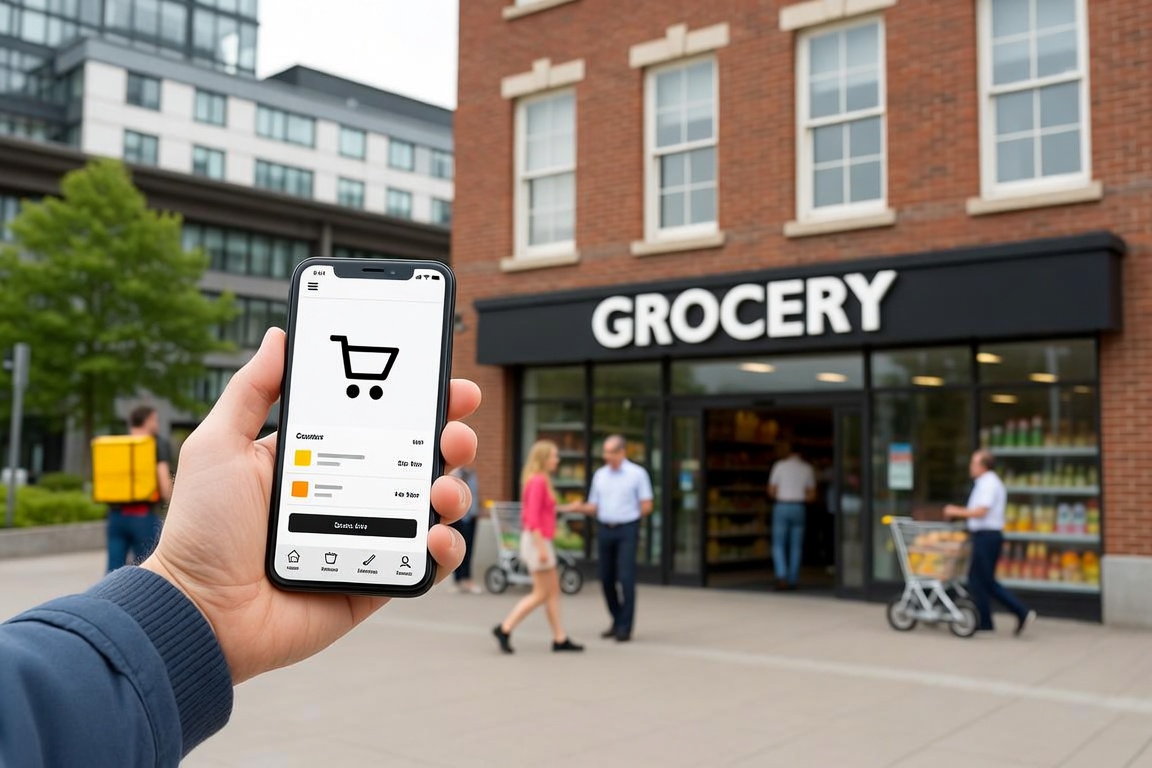
For more than a century, the American grocery store has been a cornerstone of daily life—a physical space where commerce, community, and culture intersect. From the neighborhood market to the sprawling suburban supermarket, these institutions have provided more than just food; they have offered consistency, human interaction, and a tangible connection to the supply chain that feeds the nation. Yet today, that model faces a formidable challenge. Delivery platforms like Uber Eats, Instacart, and emerging competitors such as Hero are rapidly reshaping consumer expectations, raising an unavoidable question: what becomes of the traditional grocery store in an era increasingly defined by convenience and digital immediacy?
At first glance, the appeal of delivery services is undeniable. With a few taps on a smartphone, consumers can summon groceries to their doorstep within hours—sometimes minutes—without navigating traffic, parking lots, or checkout lines. For busy families, elderly individuals, and urban professionals, this is not merely a luxury; it is a practical solution to time constraints. The pandemic accelerated this shift, normalizing behavior that might have otherwise taken a decade to evolve. What was once considered a niche convenience has quickly become a mainstream expectation.
But beneath the surface of this transformation lies a more complicated economic and cultural reality. Delivery services, while convenient, are not inherently efficient in the long term. They rely on a layered cost structure that includes gig labor, platform fees, and logistical overhead. These costs are often subsidized—either by venture capital or by squeezing margins from retailers and workers. The result is a system that appears seamless to the consumer but remains financially precarious. Traditional grocery stores, by contrast, operate on thin but stable margins built over decades of optimization. They benefit from scale, direct supplier relationships, and a workforce that, while imperfectly compensated, is at least more structured than the gig economy alternative.
This raises a critical point: convenience alone does not guarantee sustainability. If delivery platforms cannot achieve profitability without raising prices or reducing service quality, consumers may eventually rediscover the value proposition of in-store shopping. There is a reason why, even in the height of delivery adoption, millions of Americans continued to walk grocery aisles. The ability to select produce by hand, compare prices in real time, and make spontaneous purchasing decisions remains a powerful draw. No algorithm can fully replicate the tactile and sensory experience of shopping for food.
Moreover, traditional grocery stores are not standing still. Many have already integrated delivery and curbside pickup into their business models, effectively turning themselves into hybrid operations. Major chains are investing in automation, data analytics, and private-label products to compete with digital-first platforms. Some are experimenting with smaller, more localized store formats designed to serve as both retail spaces and fulfillment hubs. In this sense, the future of grocery retail is not a zero-sum battle between physical stores and delivery apps, but a convergence of the two.
Still, there are cultural implications worth considering. The erosion of in-person commerce has broader societal consequences. Grocery stores have long served as informal gathering places—spaces where neighbors cross paths and communities maintain a sense of cohesion. The shift toward isolated, app-based consumption risks further fragmenting an already atomized society. While efficiency may improve, the intangible benefits of shared public spaces diminish. This is not merely nostalgia; it is a recognition that markets function not only as economic engines but also as social institutions.
There is also the question of labor. Delivery services depend heavily on gig workers who lack the protections and stability of traditional employment. As these platforms expand, they may displace jobs that once offered at least some degree of predictability. Grocery stores, for all their flaws, provide a more structured employment environment with clearer career pathways. The long-term implications of replacing these roles with gig-based alternatives should not be dismissed lightly.
Looking ahead, the most likely outcome is not the disappearance of traditional grocery stores, but their evolution. Physical locations will remain essential, but their role will shift. They will become more efficient, more technology-driven, and more integrated with digital platforms. Delivery services will continue to grow, but they will face increasing pressure to prove their economic viability. Consumers, for their part, will ultimately decide the balance—choosing between convenience and cost, speed and experience.
In the end, the future of grocery shopping will be shaped not just by innovation, but by fundamentals. People still need food, and they still value quality, affordability, and reliability. The companies that succeed will be those that respect these priorities while adapting to changing expectations. Whether that means walking the aisles or tapping a screen, the core transaction remains the same. The question is not whether grocery stores will survive, but what form they will take in a world where algorithms increasingly compete with aisles.