

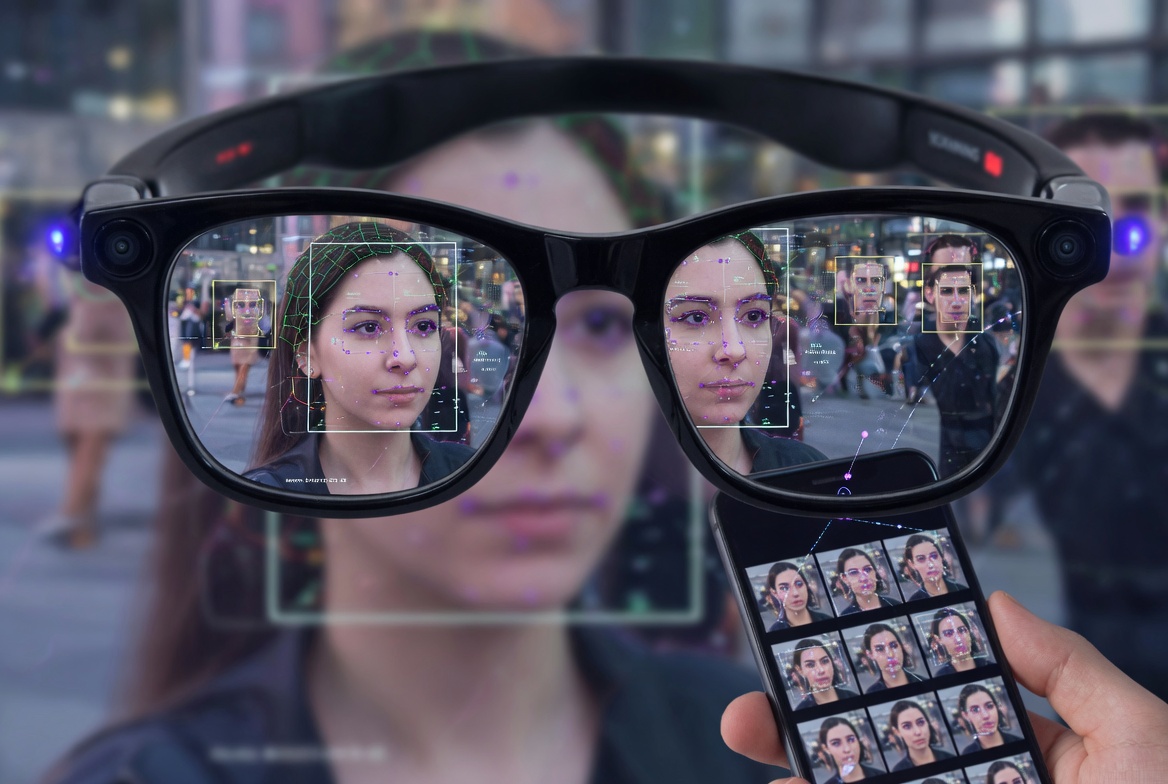
There’s something undeniably compelling about the promise of smart glasses. The idea that a lightweight, everyday accessory can layer digital intelligence onto the real world feels like a natural evolution of the smartphone era. Navigation directions hovering in your field of view, real-time translations appearing as you speak, the ability to capture moments hands-free—it all sounds like progress. And in many ways, it is.
But beneath the glossy surface of innovation lies a more complicated reality, one that deserves serious consideration: the normalization of constant surveillance through facial recognition technology embedded in these devices.
Smart glasses are not just another gadget. They represent a shift in how technology interacts with the physical world—and more importantly, how it interacts with other people without their consent.
At the heart of the issue is facial recognition. This isn’t a hypothetical concern or some far-off future scenario. The technology already exists, and in many cases, it’s frighteningly effective. With the right software, a pair of smart glasses could identify a stranger walking down the street, pull up their social media profiles, display personal details, and even track their movements over time. All of this could happen instantly, invisibly, and without the subject ever knowing.
That should give anyone pause.
Privacy, as traditionally understood, has always included a degree of anonymity in public spaces. You could walk through a city, attend an event, or simply go about your day without being cataloged, analyzed, or recorded by strangers. That expectation is now eroding. Smart glasses equipped with cameras—and potentially facial recognition—turn every wearer into a potential data collector.
Supporters of this technology often argue that it’s simply the next step in convenience. After all, smartphones already take photos, record video, and run powerful apps. But there’s a meaningful difference between pulling out a phone to capture a moment and wearing a device that is always on, always watching, and always capable of identifying the people around you.
Intent matters. Visibility matters. Consent matters.
With a smartphone, there is at least a visible action when someone records or takes a picture. Smart glasses blur that line. A person could be scanning faces in a crowded room without any outward indication. The social contract—imperfect as it may be—breaks down when people can no longer tell when they are being observed or analyzed.
There’s also the question of who controls the data. Facial recognition systems rely on massive databases of images and personal information. Where does that data come from? Who has access to it? How securely is it stored? And perhaps most importantly, how easily could it be misused?
History doesn’t offer much reassurance here. Large tech platforms have repeatedly demonstrated a willingness to collect vast amounts of user data, often pushing the boundaries of privacy until public backlash forces a retreat. It’s not unreasonable to assume that, without clear limits, smart glasses could follow a similar trajectory—especially if the financial incentives are strong enough.
Then there’s the issue of error and bias. Facial recognition systems are not infallible. They have been shown to produce false matches, sometimes with serious consequences. In a world where these systems are embedded in everyday eyewear, the potential for misidentification increases dramatically. An innocent person could be flagged, tracked, or confronted based on flawed data, all because someone nearby is wearing a device that quietly made a mistake.
Some will argue that regulation can solve these problems. And to a degree, that’s true. Clear rules around data collection, storage, and usage are necessary. Restrictions on facial recognition in consumer devices could help preserve a baseline level of privacy. But regulation tends to lag behind innovation. By the time laws catch up, the technology is often already widespread and deeply integrated into daily life.
That’s why the conversation needs to happen now, before smart glasses become as ubiquitous as smartphones.
There’s a broader philosophical question at play here as well: just because we can do something, does that mean we should? Technological capability doesn’t automatically justify its application. A society that values individual freedom and personal privacy has to be willing to draw lines, even when doing so means limiting certain conveniences.
None of this is to suggest that smart glasses are inherently harmful. Like any tool, they can be used responsibly. They have the potential to improve accessibility, enhance productivity, and open up new ways of interacting with the world. But the inclusion of facial recognition changes the equation in a fundamental way. It shifts the balance of power, placing unprecedented informational control in the hands of individuals—and, by extension, the companies that build and maintain these systems.
That’s not a trivial shift.
If this technology is going to move forward—and it likely will—it needs to do so with clear boundaries. Transparency should be non-negotiable. Users should know exactly what their devices are capable of, and the people around them should have reasonable expectations about how they might be affected. Opt-in systems, visible indicators when recording is active, and strict limits on facial recognition functionality are not unreasonable demands. They are basic safeguards.
The alternative is a world where anonymity disappears entirely, replaced by a constant, invisible layer of identification and analysis. That may be efficient. It may even be useful. But it comes at a cost—one that shouldn’t be dismissed simply because the technology is impressive.
Progress is not just about what we build. It’s about what we choose to protect along the way.